As Tesla’s existing markets give it the cold shoulder, it is turning to India after a decade of false starts.
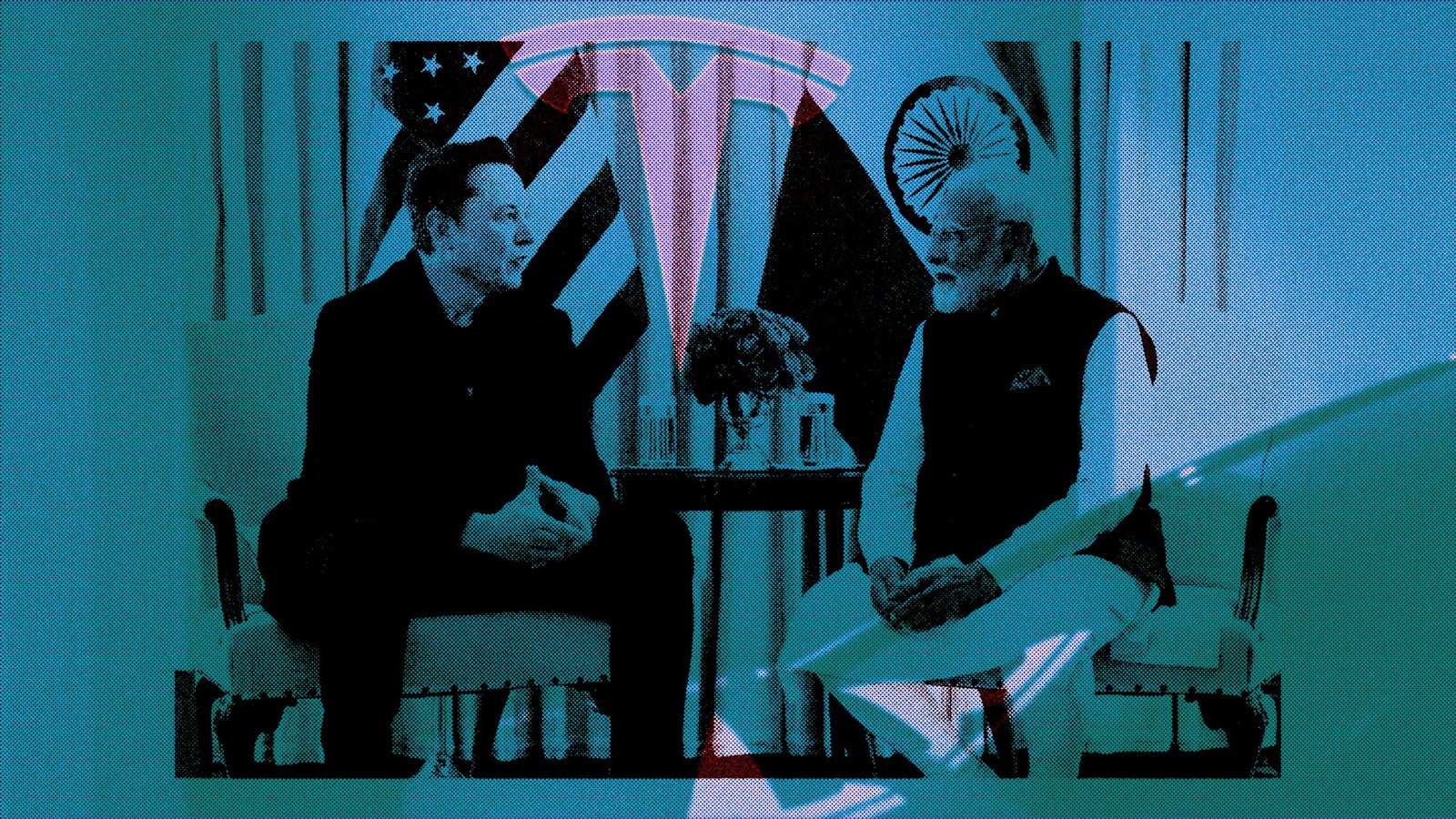
Days after Elon Musk met Indian Prime Minister Narendra Modi in Washington, Tesla reportedly leased a sprawling showroom in India’s financial capital, Mumbai, for five years, forking out $446,000 in rent for the first year. Plans for a second showroom in Delhi are in the works. The company is also hiring for nearly two dozen roles in India across customer support, sales operations, and product development. Indians — who, until last year, were chasing the company for refunds on unfulfilled pre-bookings from 2016 — may finally get to claim their electric car of choice.
“Everyone is excited to get their hands on a Tesla,” Nikhil Chaudhary, a 25-year-old computer science student who runs Tesla Club India, an online community with nearly 20,000 enthusiasts on X, told Rest of World.

In February, Tesla’s sales slumped in the U.S., Australia, China, and several European countries. The fall was precipitous in some markets, including Germany, where sales collapsed by 76% last month, and Italy, where Tesla registered a 55% drop. Rising competition along with Musk’s support of the U.S. government and far-right leaders in Europe are among the reasons for Tesla’s poor performance, which led to an $800 billion erosion in its market capitalization.
“Every major company is interested in the Indian market,” Biswajit Dhar, an economics professor who has worked on the multilateral trading system for several decades, told Rest of World. “Tesla’s sales have been declining — and what better opportunity to make it up than investing in India?” Tesla did not respond to queries relating to its entry in the country.
In India, the world’s third-largest auto market, the government has targeted 30% EV adoption by 2030, and the race to go electric is gaining momentum. But Tesla will have to contend with established local players, pricing pressure, and infrastructural gaps, experts told Rest of World.
Electric car sales in India rose 20% year on year in 2024. The market is, however, small: EVs comprised only 2.5% of the 4.3 million cars sold in the country last year. India’s EV market is estimated to be worth $54.41 billion, and expected to reach $111 billion by 2029.
Domestic automobile giant Tata Motors commands 60% of the electric car market in India, followed by JSW MG Motor India — a joint venture between India’s JSW Group and China’s SAIC Motor — and Indian automobile manufacturer Mahindra & Mahindra. The companies offer a range of affordable EV car options in the price-sensitive Indian market.
While Tesla has not yet disclosed its India pricing, automobile experts estimate the company’s cheapest car, the Model 3, would cost around $40,000, excluding tariffs. This is significantly higher than “mass-market models available in India,” Kwan Wongwetsawat, a senior auto analyst at the research firm GlobalData, told Rest of World. Tata’s and MG Motors’ most affordable offerings sell at less than $10,000.
Everyone is excited to get their hands on a Tesla.”
Electric cars in the premium range, priced at over $20,000, accounted for only 6.6% of the EVs sold in India last year. The country is grappling with widening income inequality — 90% of its population has no money to spend on non-essential items, according to a study by venture capital firm Blume Ventures.
Musk’s electric cars will initially be “a status symbol for fairly well-off, maybe tech-oriented, and business-anchored crowd in the large cities,” David Bach, president of the International Institute for Management Development in Switzerland, who has studied Tesla’s global expansion, told Rest of World.
Tesla “is likely to have some impact on the luxury BEV [battery electric vehicle] segment, particularly affecting entry-level models from Mercedes-Benz and BMW,” Wongwetsawat said. Tesla could follow its approach in markets such as Germany, where it entered with luxury models, “established the brand, became desirable,” and then introduced more affordable variants, said Bach.
“Essentially you start with exports, then you open a local factory, you benefit from policies for locally manufactured EVs, and suddenly your market share increases dramatically,” he said.
The existing design of Tesla’s cars is ill-suited to India’s uneven roads, experts said, as most of its models have low clearance, which means the vehicles’ bottommost part is close to the ground.
India’s geopolitical tensions with China may work to Tesla’s benefit.
Unlike other Asian markets, where Chinese EVs are establishing dominance, Tesla has a “clear white space in India, because there are not many Chinese [automakers] in India, and even if they are, they are not able to invest in India because of the government policy,” Puneet Gupta, who leads the India and Southeast Asia teams at automotive intelligence firm S&P Global Mobility, told Rest of World. In 2023, the Indian government rejected the Chinese auto giant BYD’s proposal to establish a $1 billion factory for electric cars and batteries.
Musk’s perceived proximity to U.S. President Donald Trump will likely help, too, Dhar said.
India has already made a policy change that makes it easier for Tesla to enter and operate. Until last year, the country levied a 110% import duty on all cars. The Indian government then reduced import duty on fully assembled EVs that cost more than $35,000 to 15% for 8,000 units a year. Manufacturers, however, have to commit to investing at least $500 million and establishing local production within three years.
Trump, who thinks Musk building a factory in India would be “unfair” to the U.S., has complained about the tariffs on car imports. He has demanded that they be brought to zero, threatening reciprocal action if India does not change course.
India will try its best, everything that it can, to please the U.S. administration and Elon Musk.”
In a bid to avoid trade conflicts with the U.S., the Modi government is “extending certain special favors to Tesla,” said Dhar, who has led India’s multilateral treaty negotiations, including with the World Trade Organization. “This will be a part of that larger strategy. India will try its best, everything that it can, to please the U.S. administration and Elon Musk.”
Last week, Musk’s satellite internet firm, Starlink, announced its long-delayed India entry through a partnership with two major telecom players, Airtel and Jio.
Meanwhile, Trump, who rallied against EVs until a couple of years ago, showcased a Tesla purchase at the White House and declared any violence against a Tesla dealership an act of domestic terrorism.
Musk’s “political activities are directly impacting his companies by removing his focus from them, by alienating significant swathes of potential customers, and by puncturing the halo of genius surrounding him that has been a major component of his companies’ extraordinary valuations,” Gautam Mukunda, an author and leadership expert who teaches at Harvard Business School, told Rest of World.
Tesla’s current crisis makes India a high-stakes gambit. “Tesla needs markets like India,” Gupta said, and there is no better time for the company to enter India than “when Trump is there in the center.”