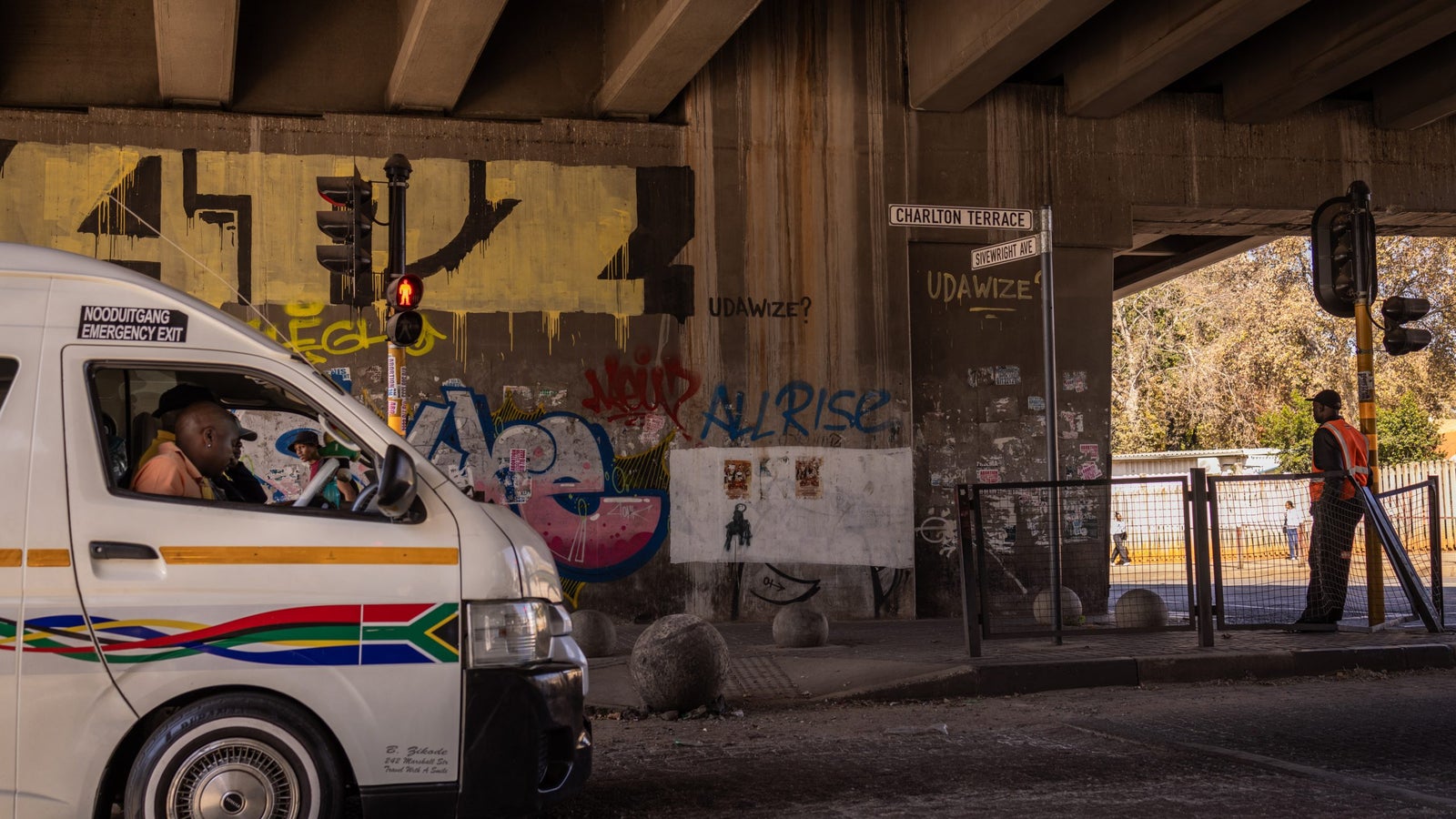
In July, Progress, a used-clothes trader, disembarked from his bus at Pretoria’s main station. The night was dark, and he knew that violent assault was a serious risk in the South African capital.
Walking to his destination in a university suburb about 10 kilometers (1 mile = 1.6 kilometers) away wasn’t an option. It would be safer, he thought, to call a ride-hailing service. He opened the Bolt app and entered his location.
His phone pinged. A driver had accepted the ride request. Then his screen flashed a message from the driver: “Walk to Minnaar Street. You’ll get me ambushed by Shesha app thugs if I pick you [up] there.”
You’ll get me ambushed by Shesha app thugs if I pick you there.”
Shesha is a ride-hailing company that was launched in South Africa in May as a fair-minded local competitor to Western companies Uber and Bolt. Just five months in, however, according to local media reports as well as Rest of World’s interviews with drivers and union leaders, Shesha has acquired an ugly reputation for using intimidation to coerce drivers and passengers to join its app.
Shesha was started by two unions for South Africa’s traditional minibus drivers: the South Africa National Taxi Council (Santaco) and the National Taxi Alliance (NTA). “Shesha” means “hurry up” in Zulu.
“Shesha app is an indigenous e-hailing app that is established to address the historical conflict between the taxi industry and Bolt/Uber, who currently dominate the business,” Theo Malele, a spokesperson for the NTA, told Rest of World.
South Africa’s e-mobility market is projected to reach $443 million by 2029, an annual growth rate of 5.26%, according to Statista. Uber, which has operated in South Africa since 2013, is the country’s top ride-hailing service, with 2.1 million active users.
While Uber and Bolt have created jobs across South Africa, the companies have also contributed to the decline of the country’s metered taxi and minibus taxi industry. In 2021, South Africa’s competition commission found that rideshare companies lowered prices by as much as 250%, leading legacy taxi drivers to bankruptcy and causing them to lose possession of their vehicles.
“The rapid expansion of e-hailing platforms is unjust,” Malele said.
At its launch, Shesha announced that 3,000 people had signed up to drive for the platform. The company promised to allocate 10% of its shares to a drivers’ trust for medical aid, pensions, and provident funds. The app also included a fingerprint ID system to screen fake profiles and criminal backgrounds — a desirable measure in South Africa, where there have been cases of Uber and Bolt drivers robbing, raping, and killing passengers. The provident funds have not materialized, however, and the fingerprint ID system is not fully functional, according to drivers who have attempted to switch to the app.
To gain users, the taxi unions have resorted to violence, Uber and Bolt drivers told Rest of World. In the past five months, groups of people working for the Shesha app, who call themselves “taxi patrollers,” have illegally zoned off large sections of city streets, including transport hubs like Pretoria’s Bosman Station, to keep out Uber and Bolt drivers. Rideshare drivers have posted in Facebook and WhatsApp groups about patrollers stopping their cars, forcing them to download the Shesha app, herding the passengers into minibus taxis, and demanding payouts of 3,000–6,000 rand ($172–$340) to return the cars.

Ruth Castel-Branco, a labor sociologist at the University of the Witwatersrand in Johannesburg, told Rest of World that Shesha’s alleged tactics might be mimicking a cartel style of organization, “which the taxi industry historically was. And which was, in many ways, broken through these apps, Uber and Bolt.”
“Minibus taxi unions are a law unto themselves. They have guns cocked,” Bamuza Dlomo, a Bolt driver, told Rest of World. He said his Honda Fit was seized by Shesha patrollers last month as he picked up a passenger near Bosman Station.
Shesha’s aggressive tactics to intimidate the competition are proving to be bad for business.
“The app has no passengers,” Hardy Lungile, a driver in Johannesburg, told Rest of World. He said that when he tried to drive for Shesha, he only managed to get 30 trips in a week. According to Lungile and other drivers, the app’s user interface periodically crashes. On the Google Play store, the app has just 10,000 downloads and a rating of 1.9 out of 5.
“Every app has its own disadvantages, this one is worse. Victimising drivers into working with an app that doesn’t have clients,” said a reviewer.
“Not safe and user friendly. They demand money from driver if they find you using Bolt or Uber. They’re scavengers and need to be removed asap,” another reviewer wrote.
Henry Mathebula, the chairperson of the South Africa E-Hailing Partners Council, a nonprofit advocacy organization, confirmed the stories about Shesha patrollers. “We have received such reports — it has been happening,” he told Rest of World.
Every app has its own disadvantages, this one is worse.”
“They do illegal roadblocks in certain districts, and they stop any car suspected to be Uber [or] Bolt to ask, ‘Do you have Shesha app?’ and say, ‘You’re not allowed here, this is a Shesha district,’” he said.
Mathebula said he has received five official reports of violence against Uber and Bolt drivers committed by Shesha patrollers. However, the number of unofficial reports he has seen circulating in the council’s Whatsapp groups is much higher, exceeding 50. In July, Zwelinzima Vavi, head of the South African Federation of Trade Unions, demanded that Shesha patrollers stop their harassment of Uber and Bolt drivers.
Santaco denied any association with violence and harassment, though it stated it would investigate any such incidents. Spokesperson Rebecca Phala told Rest of World that imposters, criminals, and wayward taxi operators are pretending to be vigilantes for Shesha. The company is enforcing internal disciplinary measures, she said, but did not give further details.
“These acts are not sanctioned by Shesha as a company. Shesha’s objective is to enter the market and grow organically,” Phala said.
Bolt did not confirm reports of harassment against its drivers, citing privacy reasons. Uber did not respond to requests for comment.
The E-Hailing Partners Council reported the violence to the Gauteng provincial police, but “not much was done,” Mathebula said.
“There are rumors that some of these police bosses own fleets of minibus taxis,” he said. Last year, South Africa’s police commanders issued a public warning to law enforcement officers moonlighting as taxi owners, which is prohibited. Athlenda Mathe, a spokesperson for the South Africa national police, and Mavela Masondo, a police spokesperson for Gauteng province, did not provide a statement to Rest of World.