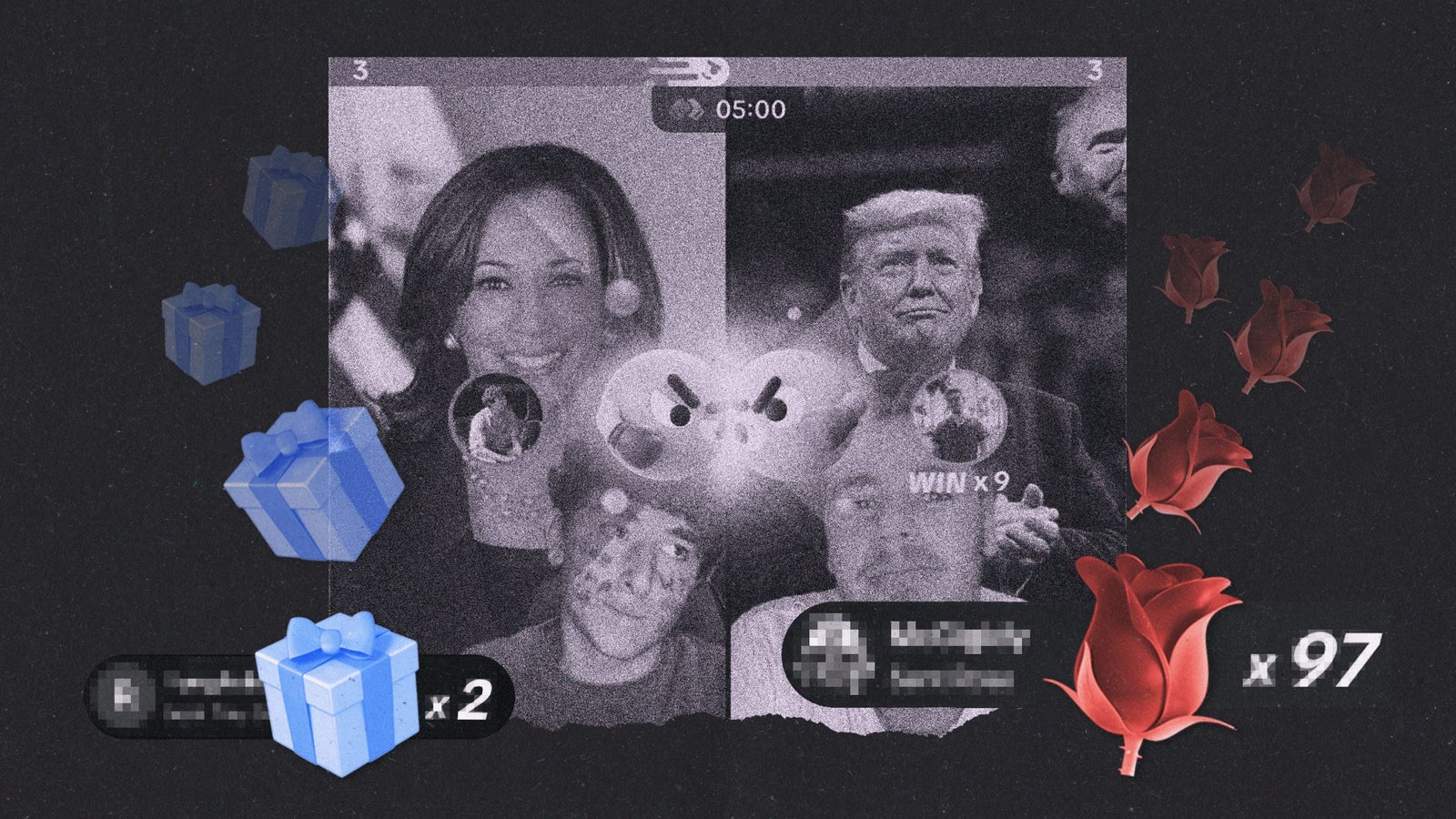

On the afternoon of August 19, Democrat Liam Keyes entered a TikTok battle. Against a blue background, the 19-year-old lashed out at his Republican opponent, fellow TikToker “Jackson,” who donned a “Trump 2024” cap and spoke in front of a Donald Trump portrait. More than 150 viewers joined the room.
“She listens to us, bro. She is not self-centered!” Keyes, in a black hoodie, hollored from one side of the split screen. “She puts the people before herself.”
“Just wait until she gets into an actual debate,” Jackson, livestreaming from the other side, fought back. “You’re gonna see how much of an idiot Kamala Harris really is!”
The showdown took place through a niche TikTok feature called “live match,” which originated in China and has grown in popularity in the U.S. since 2022. As the 2024 presidential election approaches, a group of creators, known as “political battlers,” have adopted the format to stage political debates.
Keyes started doing live matches in the spring, after noticing how many gifts streamers received for debating politics. As a liberal, he reached out to conservative creators on TikTok, inviting them to live matches. The hustle paid off quickly. Keyes makes $100 to $1,000 from one night’s battling. In a good month, he could make up to $7,000.
Each round lasts five minutes. During a match, spectators pump up the scores of their favorite hosts by sending them virtual gifts with cash value — popping up on the screen as ice cream cones, a whale, or a lion. The side with the higher score wins. The losing creators often take on comedic punishments on camera, such as pouring milk on themselves and eating raw eggs. Keyes shaved his head after one match.
On TikTok Live, creators have made money in the past from debates pitting personalities like Vladimir Putin against Volodymyr Zelenskyy, and Brazilian President Luiz Inácio Lula da Silva against his predecessor and opponent Jair Bolsonaro. Globally, TikTok is playing an increasing role in hosting political discussions. Ahead of 2024 elections in countries including Indonesia, the U.K., France, Germany, and Mexico, politicians have sought to reach out to young voters by not only promoting policies but also dancing, singing, and mocking their opponents with silly memes.
“I was really, really nervous about struggling to pay for school,” Keyes, a marketing major at the State University of New York (SUNY) College at Geneseo, told Rest of World. During the summer break, Keyes has been working as a furniture mover and janitor during the day and battling “Jackson” and other Trump supporters at night. With his TikTok income, he paid for one semester’s tuition and bought a secondhand car. “It’s a big sense of relief that I have some money now that probably would have taken a few years to get.”
One of Keyes’ biggest supporters is a 56-year-old Democrat from Florida. Chris, a health-care administrator and grandmother in Orlando, told Rest of World she came across these political battles about three months ago. She requested her full name be withheld for fear of harassment from Republican supporters. Finding the matches interesting, Chris, who previously had been watching mostly dog and family videos on TikTok, sent small gifts like roses and “money guns” to Democratic creators like Keyes.

The lack of political substance does not stop supporters like Chris from paying up. Modeled after its Chinese sister app Douyin, TikTok has complicated features designed to encourage viewers to buy gifts for creators during livestreams. Users first purchase TikTok coins — rates differ depending on the size of a coin bundle — and then use the coins to buy gifts. A rose costs one coin, or about 1.5 cents, and the luxurious “TikTok universe” costs 44,999 coins, roughly $560. When someone gets a universe, a red banner carrying the handles of the creator and their patron shows on top of every single TikTok livestream.
Chris’ spending went through the roof during one match between Keyes and Jackson. Jackson accused Biden of making stocks drop, Chris recalled, but the stocks were actually surging that day. She took out $7,500 from her own stock gains and bought TikTok coins. She started sending pricey gifts like unicorns, dinosaurs, and even the TikTok universe.
Chris loves throwing out pricey gifts at the last moment to flip the result of a close match. “My favorite one is the lion,” she told Rest of World. A lion costs about $400. “This big roaring lion comes out in the last two seconds of the game. Sure. That’s a hoot.” Chris said she had spent more than $10,000 on gifts to a dozen battlers, whom she called “Biden kids,” all of whom were college students struggling with finances.
In dozens of political battles Rest of World watched recently, the creators sometimes talk about policy issues such as immigration and the economy, but, most of the time, they repeat the same lines, such as “Trump is a felon,” “Vote Kamala,” or simply “Let’s go.” When viewers send gifts, they thank them by calling out “Tina with the rose!” or “Wendy with the confetti!” If the gifts are big, they cover their mouths or raise their arms to show excitement. A pair of battlers could face off in five-minute matches over and over again for hours.
Crystal Abidin, a professor at Curtin University in Australia and founder of the academic group TikTok Cultures Research Network, said the live battles are an example of how TikTok creators combine politics and humor to make money. The live match format has made political content more compelling by turning it into a team sport, she said. “It could be that some [livestreams] are not factual or not useful for informing people about politics,” Abidin told Rest of World, “but if they’re entertaining, the algorithm doesn’t discriminate.”
In China, live matches on Douyin and other platforms have given rise to overspending and wild stunts, prompting government regulations on livestream battles. The same problems seem to be unfolding on TikTok. In December, Business Insider reported on a 65-year-old woman spending more than $25,000 in live matches — she enjoyed being called out as the top supporter. A Texas woman was recently jailed for stealing $1.2 million from her employer, partly to spend on TikTok coins.
It could be that some [livestreams] are not factual or not useful for informing people about politics, but if they’re entertaining, the algorithm doesn’t discriminate.”
TikTok appears to be stepping in to ban some political battlers. Several creators have been banned from live matches in recent weeks and had to create new accounts, Keyes and another battler told Rest of World. TikTok’s monetization policy states that creators are not allowed to monetize content that “exploits controversial issues in a polarizing or inflammatory manner to bait engagement.” Creators “solely presenting two or more opposing viewpoints” for gifts are also banned from profiting.
A TikTok representative did not comment on banning accounts for political live matches, but referred Rest of World to its live monetization policy, which states that creators are not allowed to monetize content that “exploits controversial issues in a polarizing or inflammatory manner to bait engagement.” Creators “solely presenting two or more opposing viewpoints” for gifts are also banned from profiting.
The high commissions taken by livestream platforms have also caused tension. “That drives me crazy,” Chris said about how half of her spending was going to TikTok. She said she offered to pay the creators directly through PayPal, but the “Biden kids” preferred livestream gifts, which could provoke the opposing teams and help both sides win more. Despite representing different parties, many battlers have become online friends with their familiar adversaries.
TikTok says it gives 50% of its net revenue from gifts to creators. Similar to Douyin, TikTok has made it difficult to calculate exactly how much creators are earning from every gift, which researchers say is one way to obscure TikTok’s own earnings. TikTok did not comment on this allegation.
Keyes said he was not sure how long political battles will survive on the platform, or if viewers would be interested in them after the election in November. But as long as people are still watching, he will carry on. “If we put effort into this, it’s going to be the easiest money we will probably ever make in our lives,” Keyes said. “It would be stupid not to try.”