Just as the internet, and internet cafes, took off across the world, Argentina was experiencing one of the worst economic crises in its history. Sparked by a foreign currency crisis that led to an external debt default, in 2001 the country was on the brink of disaster. The banking system had collapsed, and ATMs were rendered useless overnight. Protestors set up barricades, lit fires across Buenos Aires, and pelted the presidential palace.
With the country’s unemployment rate at 23%, buying a PC at the time was a distant fantasy. Mid-range desktop computers went for about $1,200, and private internet access could cost up to $30 per hour — in a country where the average worker earned $870 per month.
This prompted Argentines to turn to the many internet cafes that had emerged by the early 2000s. Buenos Aires was the first Latin American city to get one: American Cybercafé, which opened in December 1995. The industry exploded — for just a few dollars, customers could rent a PC for an hour and escape into a digital universe. In 2004, 800,000 of the 1 million new Argentine internet users frequented internet cafes, spending an average of $1.30 per week.
Two decades later, the country is undergoing another severe crisis — and for some, computer access is still a luxury. Although recent reports indicate that most Argentines have a phone (89.3%) and/or internet access (88.4%), a much smaller percentage owns a computer: just 39.2%. Because of recently depreciated salaries, many are still unable to afford laptops. The government has implemented currency control policies to safeguard the Central Bank’s low reserves, making imported goods like laptops, tablets, printers, and other electronic devices more expensive.
Internet cafe owners told Rest of World the current economic crisis translates to a small but constant stream of customers: those who generally use their phones for most internet activities, but visit shops to print their documents. For elderly clients, internet cafes are an important tool for booking appointments or paying bills online.
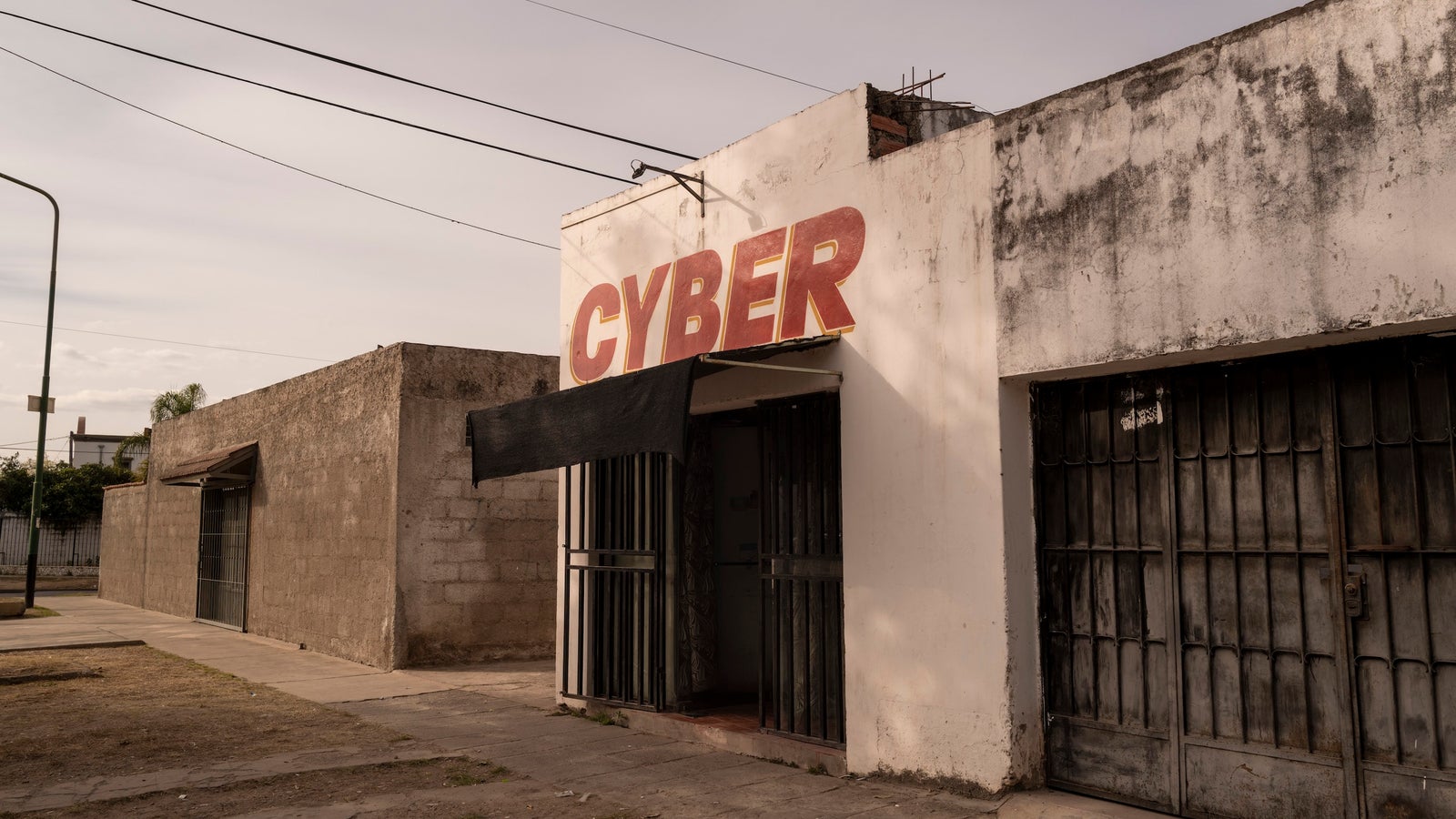
Rest of World visited internet cafes in the city of Salta, located in northwestern Argentina. With more than 1 million people in the city and the surrounding area, Salta is one of Argentina’s largest urban centers. It also has one of the highest connectivity rates in the country at 95%.
Locals said that 20 years ago, Salta had more internet cafes than fast food restaurants. Today, no more than a dozen are left. Internet cafe owners told Rest of World the demand for internet access has dropped off — but they still manage to keep their shops open, day after day.
Ciber España
Barrio Los Molles
On a recent afternoon, Melisa Duarte, an employee at Ciber España, was busy meticulously writing down an elderly customer’s name and ID number so that she could book them an appointment with their bank online. Filling out social security paperwork, printing, selling pens and notebooks, booking appointments — these are some of the many services Ciber España now offers to keep its business afloat.
Duarte, 38, has worked at Ciber España since 2008, when it first opened. The space looks squarely locked in the mid-2000s: The walls are covered with signs printed in Comic Sans; yellowing books line the shelves. Located near the city’s main square, surrounded by banks and souvenir shops, this was once a thriving business — but its better days are behind it.
Ciber España still offers customers 15 phone booths and access to more than 20 old-fashioned PCs, but Duarte told Rest of World most of her business comes from other services. She said customers rarely use the phone booths, but that teachers still use the computers to prepare homework, and students drop by to do their schoolwork. Sometimes, remote workers book computers to hold Zoom meetings. On the day Rest of World visited, only two computer stations were being used. At one, a young man was typing frantically and laughing; at the other, a man seemed to have fallen asleep in front of the screen.
“People from the suburbs of the city, or even those who live in the towns further away, sometimes come in because the internet is not really fast where they live,” Duarte said.
After Duarte’s elderly client left, two teenage boys holding a sandwich and a windshield washer approached the counter. “Can we use a PC for an hour?” they asked.
Duarte said she knew them. They work right outside the cafe, cleaning cars that have stopped at traffic lights. “Street boys come now and then to play for an hour,” she said. “Then they’ll go back to work.”
-
Melisa Duarte has worked at Ciber España for 14 years. -
Ciber España has 20 computers for customers, but makes most of its income from other services like printing and selling stationery.


Orion Cyber 2
El Centro
Fernando Herrera opened his first internet cafe, called Orion, in 2001. In the aftermath of Argentina’s 2001 financial crisis, business was so good that he opened a second shop. Because of the currency devaluation, PCs were unaffordable for most people, so they would queue up to use the cafe’s computers.
“I swear, had I had 100 machines, they would have all been booked at all times,” Herrera recalled. Salta was full of internet cafes during those years — you might have seen two or three on a single block.
In 2015, Herrera shut down his original shop. Easy internet access and the proliferation of tablets, laptops, and smartphones had eaten into his business. By 2016, studies show, 46.9% of Salta citizens had internet access, at least through a mobile device.
Now all he has is Orion Cyber 2, his second shop, with 23 PCs. On a recent visit, all of the stations were empty except for one in the back, where a young man wearing an Argentina football jersey played FIFA. Herrera told Rest of World most of his customers are young kids who come in to play League of Legends and Fortnite, plus the occasional student or worker who pops in to do some work.
Herrera, 43, said he’s been forecasting the death of his business for years now — but the clients keep trickling in. In Argentina, 40% of the population lives under the poverty line, and with a 115% year-over-year inflation, many still can’t afford their own internet-enabled devices.
“Cybers will be there as long as we’re still under crisis, because there are many people who can’t afford a computer, or a printer, or sometimes they can’t even afford fixing them if they break,” Herrera said. “This business started in the middle of a crisis, and will continue to live while there is one.”

-
Orion Cyber 2 is Fernando Herrera’s second internet cafe. He closed the first, Orion, in 2015. -
-
He has 23 computers for people to use.


Ciber S22
Finca Santa Anita
Ciber S22 is located five kilometers outside Salta’s city center, in the working-class neighborhood of Finca Santa Anita. Inside the internet cafe, owner Paola Vilte smiled as a chatty customer explained that she wanted to buy some stickers for a horse fair she planned to attend that weekend. “I want to put these on my car windows, and save some to share with the rest [of the people],” she said. Vilte designed the logo, with a horse drawn in the center, printed half a dozen stickers, and handed them off to the customer — all for less than 300 Argentine pesos ($1).
Vilte, 47, opened Ciber S22 in 2004. For 13 years, the internet cafe was her family’s primary source of income. She remembers clients coming in from 9 a.m. to 1 a.m. — at one point, she hired two assistants to split the long shifts. But as internet access spread, customers dropped off. Eventually, she changed her hours. Since 2017, Ciber S22 is only open from 9:30 a.m. to 1 p.m., and then from 4 p.m. to 8 p.m. The pandemic was a serious blow to business — Covid-19 quarantine measures meant that Vilte had to close her shop for three months in the spring of 2020. To make it through, she sold 14 of the shop’s 15 desktop computers.
Now, Vilte’s family relies on her husband’s income from his job at the public electric company to pay the bills; the cafe just brings in extra money. Although she now has just one computer, Vilte has found a new way to keep her business going: She prints stickers and logos, designs postcards, and offers to help customers navigate online payment systems. Customers bring their gas, electricity, and phone bills, and she helps them use the internet to pay them.
At the start of every month, Vilte gets a flood of clients who need help paying their bills — sometimes up to 50 customers a day. Later in the month, after business trails off, she uses the spare time to focus on her new hobby: printing on mugs, clothes, and “anywhere else that you can print on.” During the pandemic, she set up a small workshop at the back of the internet cafe.
On a recent afternoon, the internet cafe’s single PC was occupied by a man sending work emails. Vilte doesn’t want people to use her PC for gaming, she said, as she can’t stand the noise of the shooter games kids usually play.
Behind the counter where Vilte sits, a sign lists all the services she offers in addition to internet access: card design, stickers, souvenirs, photo printing. “Please ask for any other type of services,” it adds.