With over 31,000 free Wi-Fi hot spots, Mexico City officials often claim it’s now the most connected city in the world. That could mean a death sentence for the city’s internet cafes, which have been slowly disappearing since the rise of smartphones.
Few of Mexico City’s internet cafes today resemble those of the past. Rather than neat rows of cubicles with tens of computers, most of the cafes now tend to be simple mom-and-pop shops, equipped with a couple of outdated machines. Often, these shops have at least one printer, a scanner, a photocopy machine, and various items for sale — from office supplies to Funko Pop figurines. Smartphones, laptops, and Wi-Fi have largely replaced desktop computers. In some shops, the only computer with a hard line connection is the one used by management.
The surviving internet cafes are usually in working-class neighborhoods — often improvised inside a garage, or an extra room in someone’s house. They tend to be close to government offices, schools, or transportation hubs, drawing customers who need to print documents or official paperwork.
Printing and photocopying documents has provided an unlikely lifeline for these cafes. Government-issued personal ID numbers and birth certificates can be accessed online, but Mexico’s red tape means that these and other digital documents often have to be physically presented. Customers send files through WhatsApp, email, or USB drives to the internet cafe workers to print out. If the shop offers internet access by the hour, workers help less tech-savvy customers navigate government websites and digital bureaucracy. The printing and photocopy services have proved so popular that a few shops focused primarily on these have popped up in recent years.
Café Internet Emi
América
Rosario Espinosa opened her internet cafe in late 2019 in América, a working-class neighborhood that’s also home to Observatorio, a busy subway and bus station. She chose the location because few people in the area have a laptop, internet access, or a printer. She told Rest of World many of her customers are students who come in to type up and print their homework, but she also gets a lot of passersby looking for a place to print documents.
During the Covid-19 pandemic, which started a few months after Espinosa opened her shop, business was booming. “I’m doing okay now, but I was doing better back then. Schools were closed and many kids had to take their classes online,” she said, adding that sometimes, her five computers would be fully booked for hours. Her work station still has the visual hallmarks of the pandemic: clear plastic shields around every cubicle.
In a few months, Espinosa plans to move Emi a couple of blocks away, as the rent at her current location is going up. She’s not concerned about losing her customers — she thinks her regulars will follow her. Espinosa, who’s in her mid-50s, has become close to some of them: Her cafe sometimes acts as an impromptu day-care center.
“There are moms from the neighborhood who leave their kids here to play on the computer while they go run errands. I keep an eye on them,” she said. She charges 20 pesos (a little over $1) per hour to use the computer, so it’s cheaper than a nanny.
Espinosa has expanded her offerings: She now also sells office supplies, SIM cards, waffles, and cappuccinos. She even hung four of her sons’ used suits outside, to see if they might interest shoppers passing by.

-
-
Rosario Espinosa opened the cafe in the América neighborhood of Mexico City in late 2019. -
Alejandra Rajal for Rest of World


Café Internet Deimyn
Del Valle
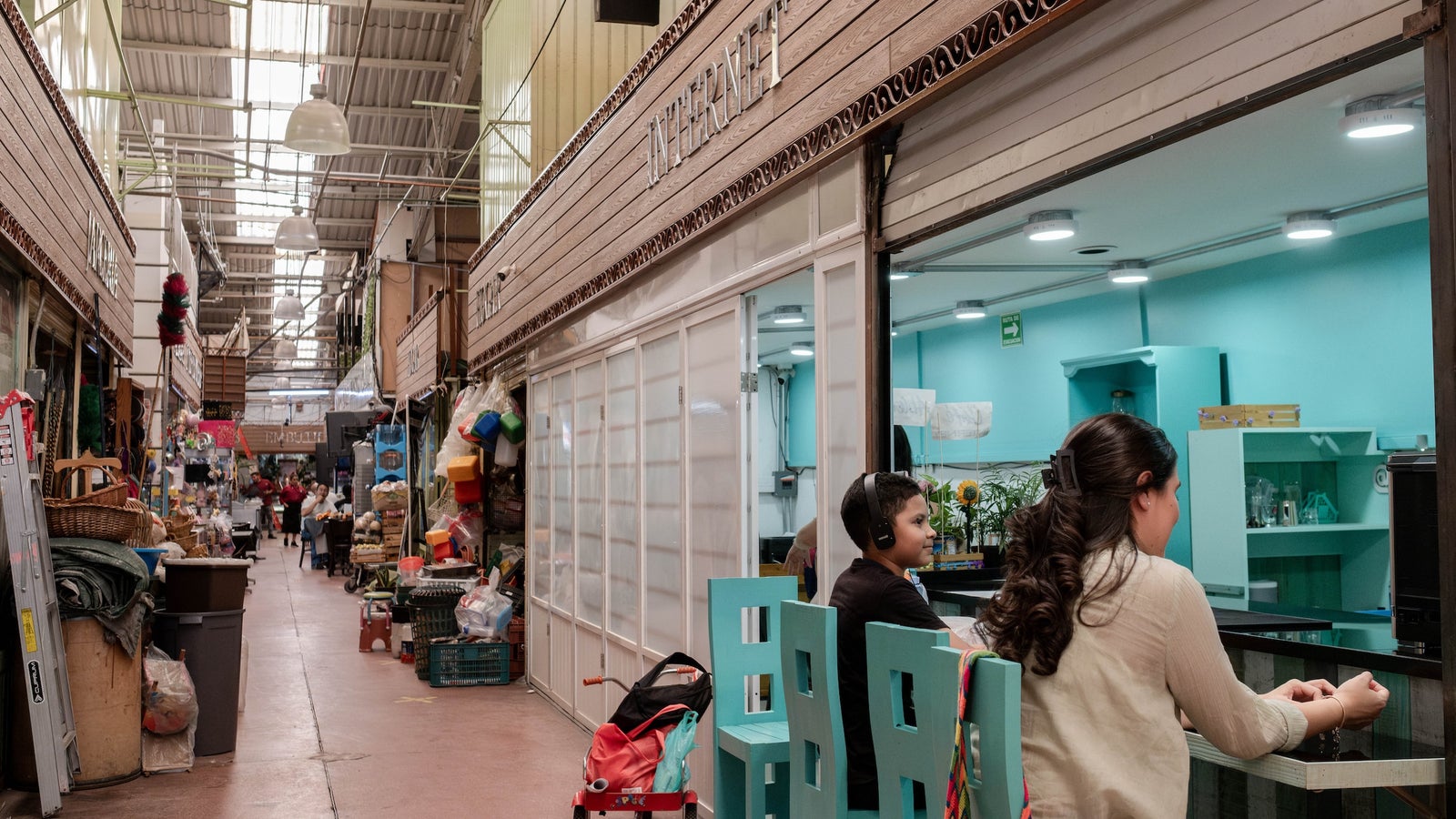
Isabel Gutiérrez, 34, and Fernando Solano, 30, opened Café Internet Deimyn a year ago. The small shop is located inside a market in the bustling Del Valle neighborhood — a middle-class area populated with residential buildings, local restaurants, offices, and a university.
The young couple saw it as a viable business opportunity, since there was nowhere in the area where people could print or download an official document. Gutiérrez and Solano also offer a graphic design service to make flyers and banners for small businesses in the area.
The interior of Deimyn is decorated in bright turquoise, which makes it stand out among the flower shops and produce stands in the market. The cafe has three cubicles with computers that can be rented out — 5 pesos (30 cents) for 15 minutes, and 20 pesos (a little over $1) for an hour.
Most of the customers are students who come in to print their homework, or old people who need help making an appointment or filling out paperwork online, Gutiérrez told Rest of World. A group of young kids comes in almost every day after school to watch YouTube or play Roblox while they wait to be picked up. To attract more diverse customers, Deimyn also offers Wi-Fi. “Sometimes we have people coming in and working on their laptops for hours,” she said. Deimyn serves coffee and milkshakes to entice them to stay longer.

-
A child watches YouTube Reels on a computer at the cafe. -


-
-
Gutiérrez helps a customer with one of the computers.