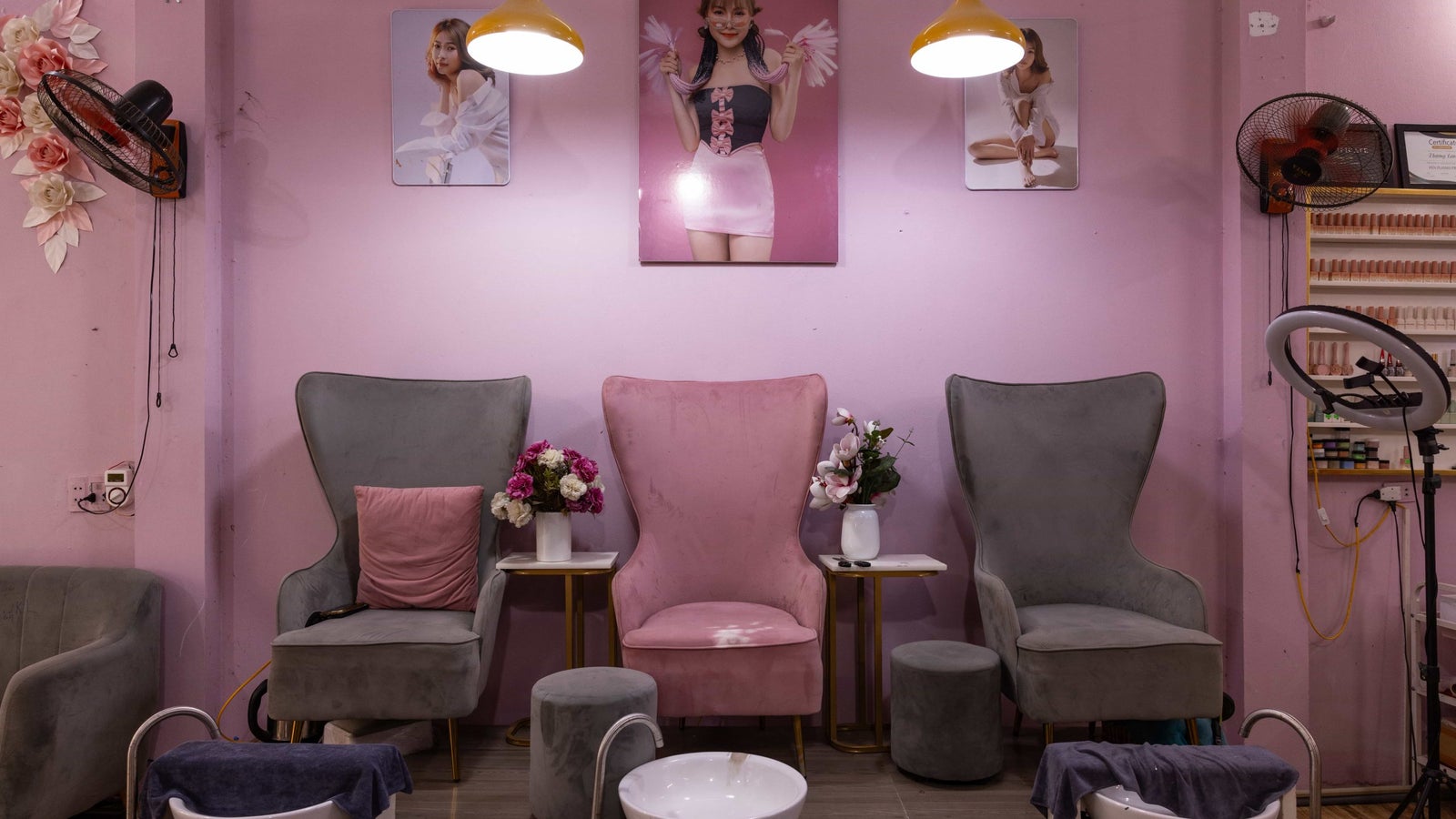
On a Sunday morning in November, the Yen Phong district, which houses two massive Samsung factories, lay nearly deserted. But there was a commotion inside Phuong Lan Academy, a nail salon near the factories. Inside the one-room facility with bright pink interiors, four women trainees sat opposite their models, learning the basics of manicures from the salon owner, Nguyen Thi Lan.
Weekends are when most of these trainees find their way to the academy; on weekdays, many work at Samsung’s factories or those of its suppliers in the district. “No one can work in a factory forever,” Lan, 29, a former Samsung factory worker, told Rest of World. “[The trainees] are doing this in part because they think like I did — they don’t want to work for a [factory] forever. They’ve been away from home for too long [and] want to go back to their hometowns to open a salon near their husband and children, to help out their family.”
The Yen Phong district — northeast of Vietnam’s capital, Hanoi — is lined with many such salons, where female factory workers can pay to learn beauty services like hairdressing, manicures, makeup, and massages. Nearly all the salons have signboards that say “Trainees accepted.” The beautician courses are in high demand among the young women who work at the local factories, because their careers are transient — they feel they can get laid off at any time or age out of the job.

The workforce at electronics factories typically comprises young people from faraway provinces who are looking for regular income, according to Dao Quang Vinh, a labor researcher and contributor to a recent International Labour Organization study on the electronics industry in Vietnam. The women from this group are usually married with children, and can’t afford to become homemakers as the “welfare benefits are insufficient,” Vinh told Rest of World.
Current and former factory workers in Yen Phong told Rest of World they signed up to learn beauty services at the salon-academies because a beautician’s job is more stable and flexible compared to factory work.
Lan had worked at Samsung’s smartphone assembly plant in the Thai Nguyen province for five years before quitting in 2020, when production slowed down due to the Covid-19 pandemic. Much like her current trainees, she had dedicated all her days off during her last year at Samsung to learning the basics of the beauty business. The beauty industry “never goes out of style,” she said. After quitting her job, she invested in a six-week advanced course and then opened a salon of her own. Over the past three years, Lan has trained about 50 women — 15 of whom have opened salons in their hometowns, she said.

The Vietnamese government has also offered training for backup jobs to factory workers — the country’s labor code deems the state responsible for facilitating training for professions that are “suitable for women’s physical, physiological and maternal characteristics.” The government-led initiatives have been largely unsuccessful, however, due to limited participation from companies, a lack of funding, and limited training options, according to labor researcher Vinh.
Women make up around 60% of the workforce in electronics components and equipment manufacturing, but they don’t last long in these jobs. In 2018, the Vietnamese government acknowledged the high rate of dismissal of female factory workers in their 30s, with electronics assembly among the top affected industries. “When faced with the decision to lay off workers, companies and factories usually will target older, less efficient workers to lower their input costs,” Hoan Tran, associate director for northern Vietnam at recruitment firm Navigos Search, told Rest of World.


Perhaps due to widespread concerns around the issue of women aging out of factory work, Samsung itself offers its workers training courses that could help them become professional makeup artists, hairdressers, and manicurists. This training is offered in partnership with the Hanoi Vocational College of High Technology. “Samsung wants [its employees] to have a vocation so that when they no longer work there, they can return to their hometowns and have another job,” Pham Van Quang, one of the college instructors involved in the program, told Rest of World. “[At Samsung,] their work is quite arduous, and they have to both work and go to [beauty] classes.” Rest of World reached out to Samsung for comment but did not get a response.
Local salon owners like Lan have stepped in to capitalize on this opportunity while also helping women who are desperately in need of an alternative profession.
Mai Hien Academy, a hair salon across the street from Lan’s business, has trained nearly 300 people in the last eight years. Around 90% have been factory workers who “want to learn a profession for stability,” Nguyen Thi Hien, the salon’s co-owner, told Rest of World. Before moving to Yen Phong, Hien used to work in a shoe factory in China.
A few blocks away, 26-year-old Vo Thi Sen runs Sen Suri Beauty & Academy, a popular brow-and-lip tattoo parlor. “This profession will only grow further and can’t be replaced by machines,” Sen, who quit Samsung in 2018 after the birth of her first child, told Rest of World. She started out by offering door-to-door beauty services while her husband, Ta Cong Chinh — whom she met at Samsung — stayed on at the company. In 2020, they opened their first salon. Two years later, the business had become so successful that Chinh quit his managerial job at Samsung to support his wife as a stay-at-home dad.


“[Factory work] is the time to try to save up money and build up experience. Once you’re ready, you leave to open your own business,” Chinh told Rest of World as he sat in the parlor with his daughter on his lap, while Sen trained future brow tattooists.
At 29, Lan feels she dedicated her youth to working for Samsung — a sentiment that several other practicing and trainee beauticians echoed. Starting a business or trying to learn a new skill can also be risky. Many former Samsung workers who opened salons in the area were forced to shut them down after a year or two, Ma Thi Huong, a former Samsung worker who owns a hair salon in Yen Phong with her husband, told Rest of World. But despite the challenges, many still opt for beautician training because factory jobs don’t pay enough to support their growing families.


Quang Thi Hai Duong, a 28-year-old trainee beautician from the Nghe An province, told Rest of World she worked at Samsung for 10 years before quitting two months ago to train full-time at Sen Suri. At Samsung, she used to make around 8 million dong ($330) per month. “Now that I have a family of my own, the wages won’t be enough to sustain us,” she said. Duong plans to use her social insurance fund — which she will be eligible to withdraw next year — to open a spa in her home province. She is aware that this means she will forgo state pension in her old age, which is applicable to workers who have contributed to social insurance for at least 20 years.
Pham Thi Van, a 36-year-old single parent, has worked at Samsung for seven years. In 2020, she moved out of the rent-free accommodation provided by the company so she could have greater flexibility over her hours — like many other workers — and live closer to the hair salon where she trains. Van told Rest of World she now pays 800,000 dong ($33) a month for a windowless room that barely fits a double bed, a small closet, and a table for two.


Van’s wages from Samsung are not enough to support her two children and her mother, who live in the mountainous Yen Bai province. “It’s not just me; my colleagues are also looking for a new direction in life,” she said. “When I quit [Samsung], I’ll be able to have a more stable life as a hairdresser. I could open a salon close to my family and take care of my kids.”