
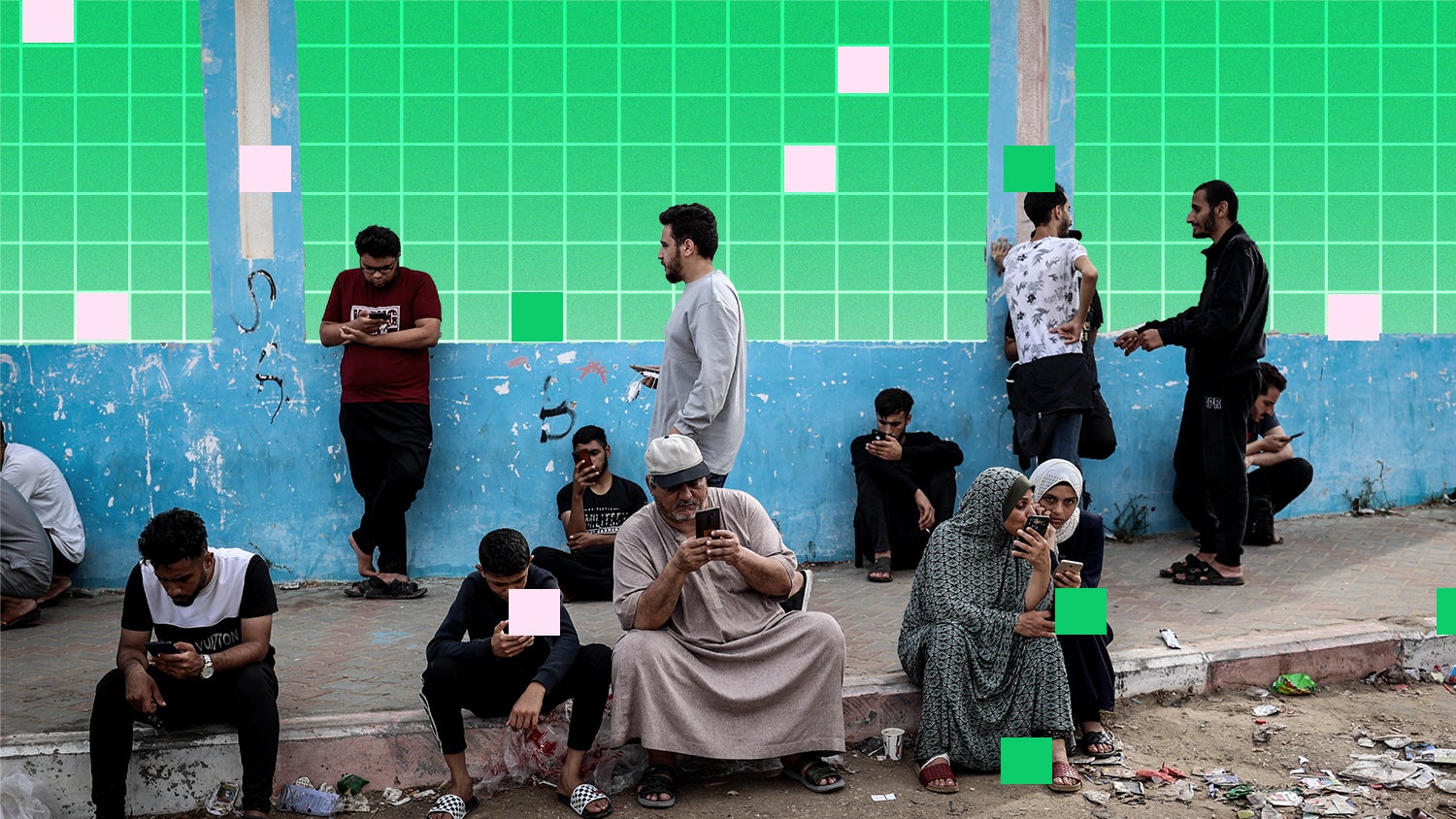
On Friday night, after weeks of bombardment, Gaza disappeared from the internet. Cellular towers, landlines, and internet connections all dropped at once, making it all but impossible to get digital information in or out of the territory. The cut coincided with a ground assault by the Israeli military, commencing what Prime Minister Netanyahu called “the second phase of the war.”
It was the culmination of weeks of mounting dread. Hamas is still holding 229 Israeli civilians hostage somewhere in Gaza — prisoners from a series of bloody attacks on October 7. The Israeli Defense Forces’ response has been all-out war. More than 7,000 people have been killed, according to Gaza’s Health Ministry, including more than 3,000 children. Entire blocks have been reduced to rubble. Hamas is the dominant political power in Gaza, which makes it difficult to distinguish between a war against a belligerent military force and the violent displacement of 2 million unarmed civilians. Worse, Netanyahu seems untroubled by the difference.
More and more, a direct line is being drawn between internet shutdowns and human rights violations.”
Many of the worst moments of the war have been spread through the same data channels that were shut down by the blackout — starting with footage of the October 7 attack and spreading to unsettling images of the assault on Gaza. One emotional video showed Al Jazeera bureau chief Wael al-Dahdouh receiving news that his wife, son, daughter, and grandson had been killed in an Israeli airstrike. Another video showed the scale of the destruction in Gaza City in the first week of bombing. For as long as they were able to spread, the videos had caused real alarm internationally, driving home the humanitarian cost of the bombings.
On Sunday morning, the blackout lifted. The U.S. was quick to claim credit, saying the White House had applied pressure, but there were plenty of other groups who saw the blackout as a warning sign. Israel’s ground assault is ongoing and people are still being killed in Gaza at a horrifying rate — but for whatever reason, cutting off internet access was seen as a step too far.
It’s a remarkable moment in a war that’s disregarded so many international norms of warfare, whether through attacks on civilian targets or the use of banned munitions like white phosphorus. But for many advocates, an information blackout is more threatening than a specific tactic or armament. With no connection to the outside world, whatever happened inside Gaza could be shared or kept secret at the military’s discretion. The Israeli military was operating out of public view and with complete impunity.
That’s why, for many civil society groups, an internet blackout is one of the most ominous turns countries can make in a conflict. Marwa Fatafta, Access Now’s policy manager for the Middle East and North Africa, said the blackout in Gaza was particularly alarming because of how actively Palestinians had been using documentation as a tool of self-defense.
“The internet, as slow and unreliable as it was, opened communication channels between Palestinians and the outside world,” Fatafta told me, “allowing people to document the atrocities on the ground, debunk misinformation and disinformation, mobilize in solidarity, and raise their voices in demanding a ceasefire.”
Access Now was part of a group statement calling for internet access to be restored in Gaza on Friday, but the statement was building on years of work. Since 2016, Access Now has led a coalition of more than 300 civil society groups in tracking and opposing internet shutdowns. The campaign operates under the name #KeepItOn, and its message is simple: Cutting off internet access comes with a deadly human cost.
“More and more, a direct line is being drawn between internet shutdowns and human rights violations,” Fatafta said. “Civil society organized to say internet shutdowns violate human rights, period, and the UN and states have largely responded in agreement, with multiple resolutions and declarations.”
The dangers go far beyond Gaza. Last year, Rest of World tracked blackouts from Egypt to Russia, finding chilling effects that spread through entire countries at once. The problem hasn’t gotten any better in the months since. Access Now has tracked more than 80 shutdowns in 2023 so far, most notably the string of blackouts in Manipur that coincided with some of the worst violence in the region. India leads the world in internet shutdowns, focusing on short, localized blackouts in response to regional protests, turning the collapse of networks into a kind of chilling routine. The basic principle holds true: Once nobody can see what’s happening in a region, unspeakable crimes can take place.
It took years to establish the norm against internet blackouts — and civil society groups will be defending it for years to come. As with similar prohibitions on cluster munitions or torture, nations will continue to ignore the rules when it suits them. All humanitarian groups can do is try to raise the diplomatic costs when that happens.
The situation in Gaza would be worse under a blackout, however hard that is to imagine. The norm worked; the blackout ended. Whatever happens in Gaza will be documented. Now it’s up to international bodies to make that documentation matter.