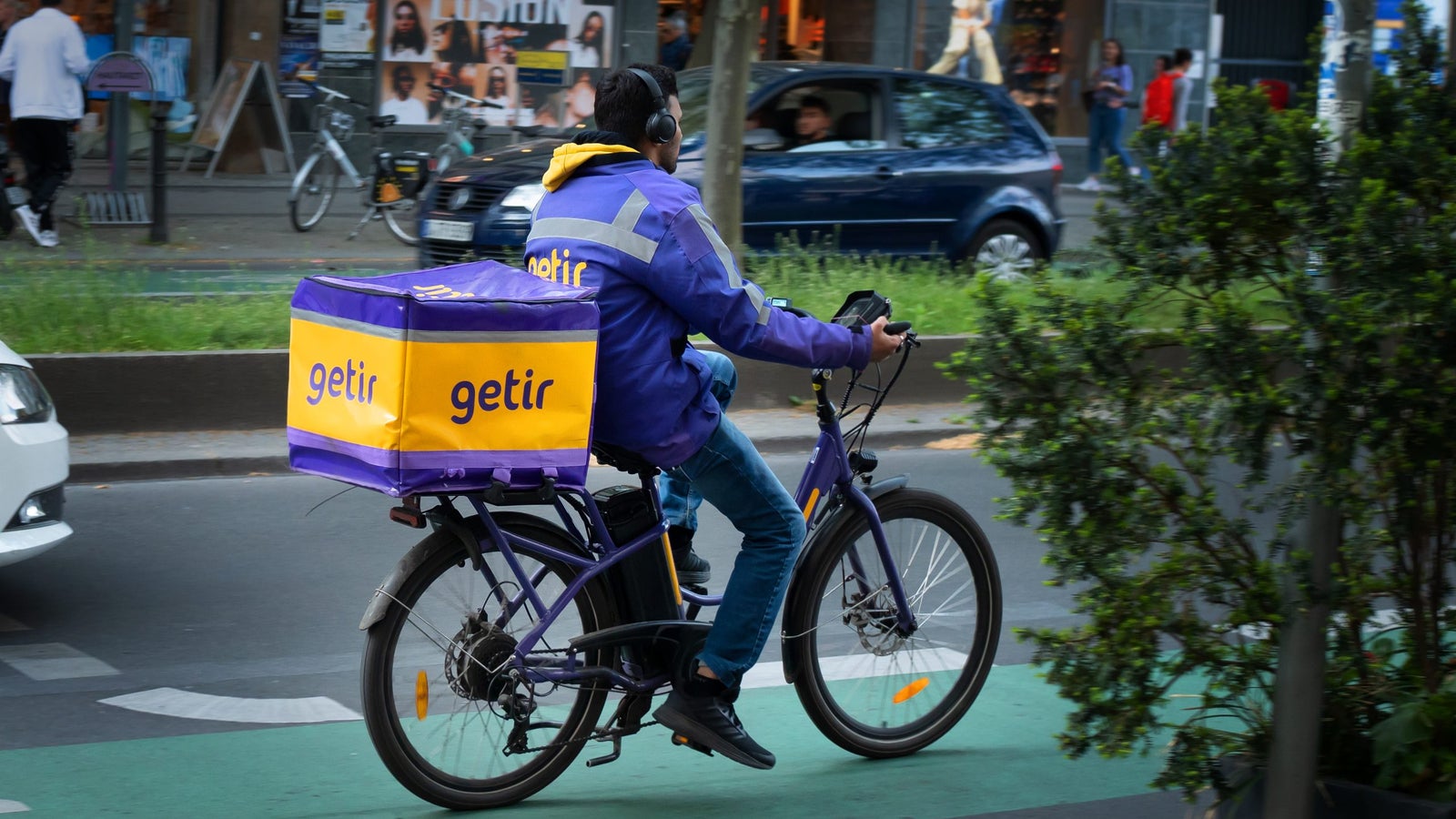
Late in 2021, the Turkish startup Getir rolled out its first dark stores in New York City, Chicago, and Boston. It hired Gen-Z Americans to tout its services online, with groceries delivered in minutes on late nights or in the rain. It filled subway trains with bright violet ads, appeared on-screen on city streets, and aired across Citi Field in partnership with the Mets. From the rolling hills of Istanbul to the dense cities of Europe, it seemed Getir was ready to serve the notoriously cutthroat American metropolis.
“Just like every basketball player dreams of playing in the NBA, a startup dreams of playing in the U.S.,” founder and chief executive Nazim Salur said when his company arrived.
At the time, Getir’s valuation stood at more than $7.5 billion, a number that would swell to almost $12 billion in March 2022. For years, the startup closed round after round of venture funding, riding the wave of pandemic-induced online shopping and investment. But all this would soon dry up, as inflation and the war in Ukraine drove up interest rates, forcing investors to press pause on free-flow funding. The drastic shift forced five of Getir’s competitors to fold, retreat, or get acquired — and the drought isn’t over yet.
By the latest count, Getir is valued at $2.5 billion, down nearly 80% from its peak last spring. Though it secured a $500 million cash infusion in September, media reports say the company bleeds an estimated $100 million per month. Getir faces two remaining rivals in the ultrafast delivery space: Gopuff from the U.S. and Flink in Europe, where Getir appears to be taking the lead. If the company can prove its long-term viability to investors, it will be one of the biggest success stories to come out of Turkey’s startup ecosystem. For now, however, Getir is nowhere near establishing a clear path to profitability, even as employees bear the brunt of the funding winter.
“They have launched many initiatives to improve their margins, but I’m not sure that is going to offset losses they’re currently making,” Sujeet Naik, an analyst at Coresight Research who focuses on the quick commerce industry, told Rest of World. “They have to fix their model first.”
It’s a little bit of a game of chicken. Investors have lost billions at this point.
According to Naik, Getir now acts as both retailer and distributor. Unlike Instacart, which collects items from a range of stores and charges a delivery fee, Getir buys its own inventory and stocks it behind the counter in its judiciously placed dark stores. When orders come in, pickers speed-walk through the aisles and hand off packages to riders on e-bikes. This model unlocked 10-minute delivery times, and allows customers to order from early morning until midnight.
It’s also exactly what will weigh Getir down as it seeks to scale.
This year, the company laid off at least 2,600 employees, according to Layoffs.fyi, a project that tracks downsizing in the tech sector. It shuttered stores in the U.K. and withdrew from peripheral markets in Italy, Portugal, and Spain. Each of these concessions cut down on costs, but they don’t address the fact that some companies with this core business model lose $20 per order — and that customers who came for the discounts will eventually need to pay full price.
Angela Lee, professor at Columbia Business School, points to her own experience as an example: Using a discount on Getir, she paid $5 for $25 worth of groceries, amounting to roughly $10 in revenue for the company after shipping. Without knowing exact numbers, she estimates that Getir likely purchased the groceries wholesale at two-thirds to half the price, like other retailers. A generous estimate of $12.50 for the groceries is already more than they brought in — all without factoring in the expense of full-time workers, equipment, advertising, and ground-floor commercial real estate in some of the most expensive cities in the world.
At this point, Lee told Rest of World, Getir’s investors are rolling the dice. They’re betting that customers will get used to ordering Ben & Jerry’s on demand, and that Getir’s team will outlast the others. But the likelihood of reaching an IPO still seems unlikely, given their unsustainable losses and dependence on impulse buys. “It’s a little bit of a game of chicken,” Lee said. “Investors have lost billions at this point.”
Getir’s value proposition for online groceries will also soon be watered down, as U.S. retail giants close in on their own same-day delivery systems. “It will be very difficult for smaller companies like Getir to compete with the massive infrastructure a company like Amazon or Walmart can muster,” Khaled Naim, CEO of software logistics provider Onfleet, told Rest of World over email. “The behemoths have their own in-house fleets with delivery density.”
The likes of Amazon also don’t need to spend on advertising. According to a 2023 Coresight survey of American online grocery shoppers, a quarter to a half of all respondents had used five companies — Amazon, Walmart, DoorDash, Instacart, and Uber Eats — in the past year, while just 8% ordered from Getir (though Getir is active in fewer cities). To stay in the game, Naik said, the startup needs to partner with larger players to reduce their own capital investments — a strategy that may already be underway in Europe.
On the long-term viability of the company, Getir’s workers in New York appear divided. For this story, Rest of World spoke to five current and former employees at Getir, including three riders and two shift leads, most of whom spoke under the condition of anonymity to protect their positions at the company.
It’s upsetting because at this time, all you could think about is like, today’s the day I could get fired.”
While Getir’s acquisition of its rival Gorillas was widely seen as a victory, those who came from Gorillas point to systemic challenges that suggest Getir is cutting corners. All three riders raised issues with e-bikes provided by the company, including faulty batteries, rusty brakes, and clear signs of age. Over the summer, two said, they started to receive more pressure to hit faster delivery times, against computer-generated estimates that fail to account for traffic, stairs, or a failing battery on a poorly maintained bike. In the past month alone, they said, some of their colleagues were fired for failing to hit faster delivery times.
“It’s upsetting because at this time, all you could think about is like, today’s the day I could get fired, or I’m gonna get fired today,” one rider said. “At the end of the day, nobody wants to lose their jobs.”
In-store workers, by contrast, felt cautiously optimistic about Getir’s management since the merger. Though the transition was “shaky,” one said, since the company reassigned workers to new stores, employees had the opportunity to build working relationships with one another — for them, the greatest advantage Getir has over gig work platforms. “Efficiency comes with time,” the shift leader said. Getir did not respond to multiple requests for comment.
Greater efficiency may not be enough to save Getir in the U.S. Its primary competitor, the Philadelphia-based Gopuff, operates across dozens of states and leverages twice the inventory. Though Getir reached profitability in its home country of Turkey, it will need far more funding in the months ahead to gain a permanent foothold.
According to Davis Valiyev, a former Getir rider who left the company in June, “If they [buy new bikes], they will solve one issue out of hundreds.”