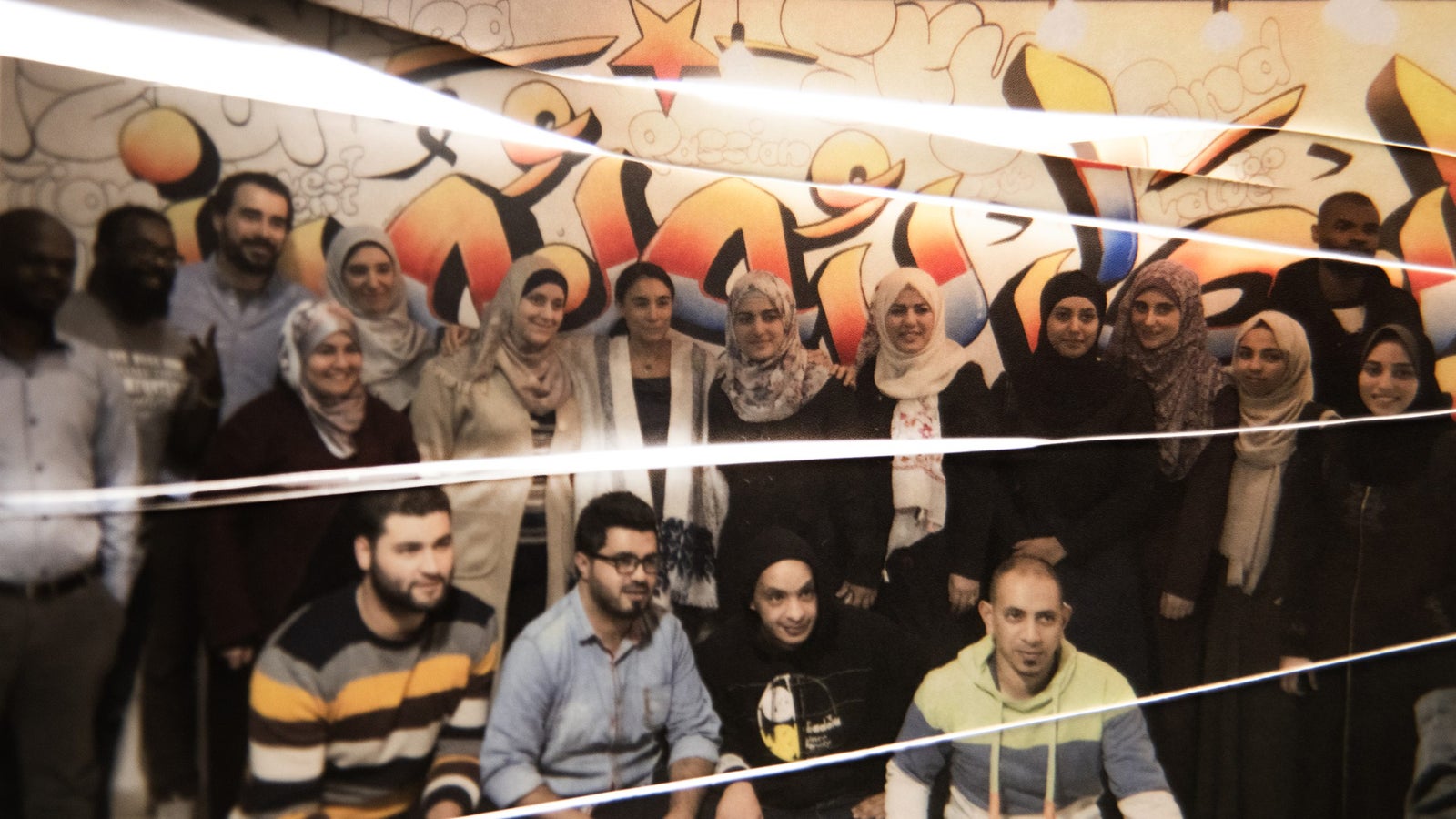
In late September 2023, staff at Gaza Sky Geeks were preparing for an October full of milestones. The pioneering tech hub, headquartered in Gaza City, was planning a traveling hackathon that would connect programmers in Gaza and the West Bank. Staff had just circulated invitations to a graduation ceremony for the largest-ever cohort to complete the group’s startup accelerator. At least 100 people were expected to attend the October 10 celebration.
Rand Safi, the organization’s senior program manager, planned to travel to Gaza from Ramallah for the graduation. She looked forward to being in the office she remembered from past visits: a light-filled space covered in colorful graffiti and stickers, always full of young people. In the mornings, the office would smell of coffee and mint tea. Colleagues often ordered in breakfasts of hummus, eggs, and avocados.
Gaza Sky Geeks (GSG) was founded in 2011 with support from Google and operated by Mercy Corps, a global humanitarian nonprofit. Over the next decade, it became the heart of the Strip’s startup and freelancing scene. Its programs trained thousands of young people in coding, digital marketing, graphic design, and entrepreneurship, offering a rare gateway to remote work and global markets from within a besieged territory.
It also offered a glimpse of an international future that Israel’s blockade tried to deny. Trainees landed internships in data entry and app testing. Women who had never imagined independence designed for companies abroad and took online freelance gigs. Adham, a former GSG team member remembered watching some of them get their first jobs, recalling the pride of knowing he’d helped make it possible.
Alumni often stayed late, debugging code or helping trainees refine their ideas. Slack channels buzzed with team updates, book recommendations, and chatter about lunch orders. “It was like a second home,” Adham said.
Fatma Newiji, then 26, remembered visiting GSG’s coworking space near its Gaza City office in the first days of October 2023 and running into friends. “It was full of people,” she recalled. “We chatted for a bit about projects and work and also talked about family and personal life.” She’d just completed a GSG course and felt she was finally stepping into her life. She had a meeting scheduled with a lawyer to register the name of her new web-design startup and obtain a business license. It was set for the afternoon of Saturday, October 7.
That morning, Hamas launched a surprise attack on Israel, killing around 1,200 people and taking more than 200 hostages. In the days that followed, the Israeli military told Gazans to flee south as it prepared to launch a full-scale war. Like the hackathon and graduation ceremony, Newiji’s meeting never happened.
In the two years since, hundreds of the staff, teachers, students, mentors, and founders involved with GSG have been forcibly displaced and subjected to extreme trauma. Some have been killed. Others managed to flee Gaza but live in mourning. Many have remained engaged in supporting the GSG network — determined to preserve a vision for Gaza that the war all but extinguished.
Now, with a tentative ceasefire plan in place, the GSG community is surveying the damage done to Gaza’s tech scene — and asking how to rebuild it. “If there is still a Gaza,” the organization’s former director Ryan Sturgill told Rest of World, “there will continue to be a Gaza Sky Geeks.”
Gaza Sky Geeks started with a question that sounded like a dare: could a startup accelerator survive under siege?
Gisel Kordestani, then the director for new business development at Google, recounted a moment of inspiration. It was 2008, and Kordestani was tasked with incentivizing developers to launch products on Google and Android platforms. The company hosted a hackathon in Tel Aviv. Hundreds of Israeli engineers showed up, Kordestani told Rest of World, but only one Palestinian.
It turned out he was one of eight Palestinians who’d tried to attend from the West Bank — just an hour away by car — and the only one to make it through Israeli checkpoints. The event underscored a deep inequality in access. “It felt like one of those moments where we had chosen sides without actually ever deciding to,” Kordestani said.
She organized a developer day in the West Bank. Next, she held one in Gaza. Getting mentors into — or Gazans out of — the blockaded territory was a herculean effort. So Kordestani and others developed an idea to support a permanent organization inside Gaza itself. Kordestani convinced Google to donate $1 million for the project, and what would eventually become Gaza Sky Geeks was born. GSG would be operated by Mercy Corps, which already had infrastructure in the territory. [Google did not respond to a request for comment for this article. Eric Schmidt, the father of Rest of World founder Sophie Schmidt, was the CEO of Google at the time.]
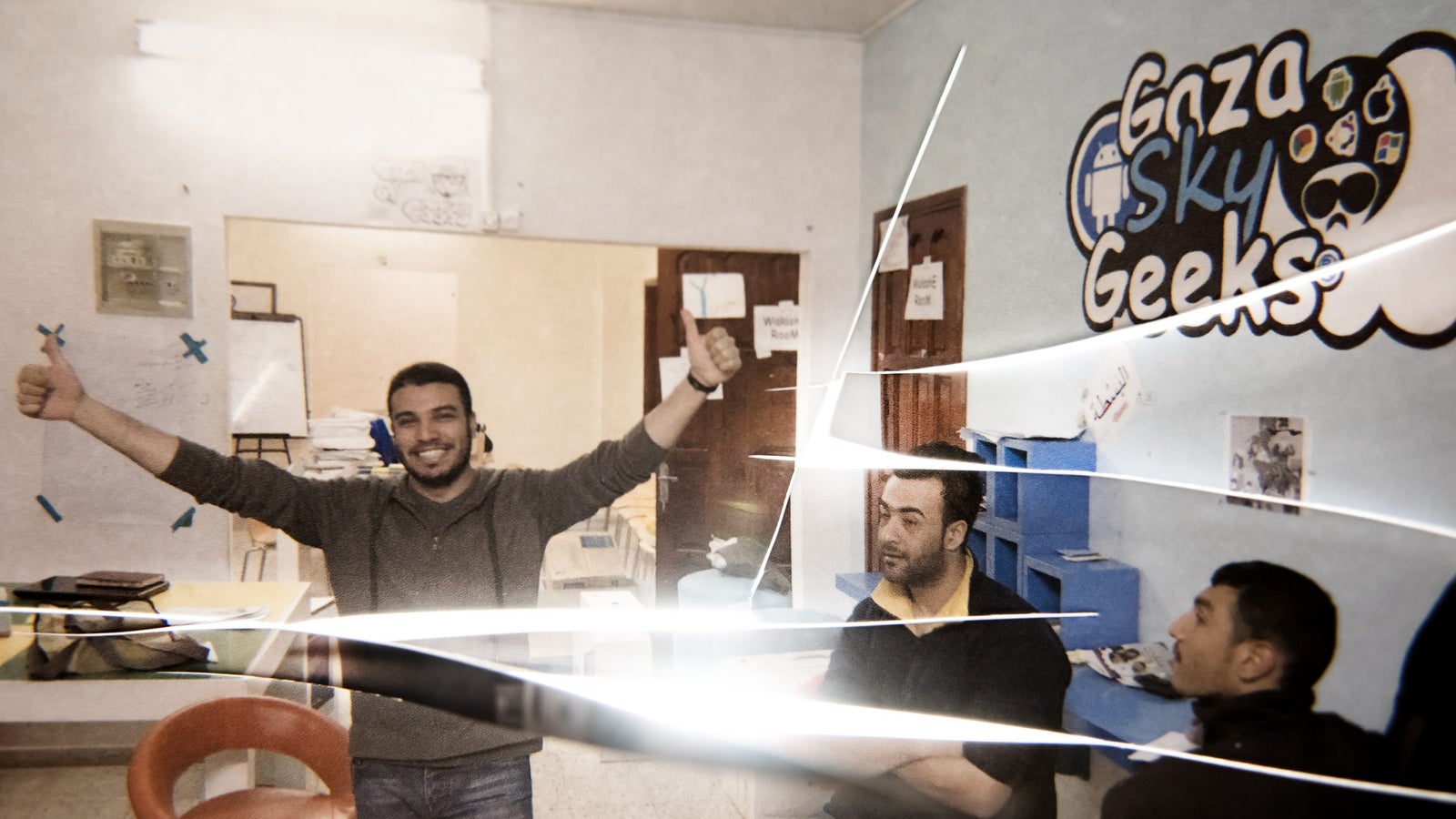
At first, the organization focused on encouraging entrepreneurs to launch startups. Few Palestinians at the time took the precarious step of starting tech companies. Mohammad Khatib, who co-founded a tech hub in Ramallah, said in a 2011 TED Talk that Palestinians typically preferred steady jobs rather than risk the startup lifestyle. Combined with the difficulty of leaving Gaza to pursue investments or to scale a business internationally, Gaza’s tech hopefuls faced serious obstacles.
Despite that, in 2013, GSG ran a competition of 164 local startups and partnered with international investment firms to give two winning teams $14,000 each. It comprised “the first-ever seed-level investments in Gaza,” the group said at the time. GSG hosted Startup Weekends, in which mentors from countries like Denmark, Poland, and Dubai listened to locals’ pitches and awarded grant money and incubation options to winning teams.
Iliana Montauk, GSG’s director between 2013 and 2015, remembered the team working out of a dingy and cramped apartment near the Gaza port in those days. Members sat on beanbags or whatever else they could find. For relief from the summer heat, some worked from the apartment’s small balcony. Events were hosted in conference centers and hotels nearby. In 2015, the organization moved into a dedicated office in Gaza City: a modern, open space with movable desks, soundproofed rooms, a kitchen, and graffiti by local artists — the space that Safi would remember years later.
In 2015, GSG raised more than $267,000 from international donors in a crowdfunding campaign. The group also received sustained support from the governments of the Netherlands, Sweden, and Canada as well as organizations including the Paltel Group, the Asfari Foundation, and the Bank of Palestine. Still, money was an issue.
Ryan Sturgill, an American with a background in international development and finance, moved to Gaza to become GSG’s executive director in 2015. The organization needed funds, but he had confidence in its central premise. “This notion that you could compete in the global economy through remote work, [allow] smart people to access markets despite the blockade, and actually support a startup in an environment like that,” appealed to him, he told Rest of World.
Sturgill led a strategy revamp that emphasized not just entrepreneurship but also teaching young people to code, enabling them to tap into a global freelance economy. His team launched another fundraiser to buy a new generator, pay for the new office, and start the first coding academy in Palestine. They raised more than $400,000. Four companies incubated within GSG secured investments ranging from $30,000 to $65,000 — a sizable sum in the Strip.

Set against the harsh realities of Gaza, the success of GSG drew industry accolades and a steady stream of glowing coverage from outlets eager to tell a story of hope and resilience. The New York Times wrote up GSG, as did WIRED and Vanity Fair.
Still, the Israeli government made day-to-day operations grueling. Getting a permit for mentors and teachers to come to Gaza, or for GSG members to leave the territory, was unpredictable at best. “I’ve always thought about the denial of all the opportunities there,” Sturgill said. “People getting scholarships and Fulbrights and things like that and then being denied the ability to leave and take advantage of them.”
In addition to mentoring local companies, GSG aimed to train individuals in the thousands to earn a living online by delivering services overseas. Alumni of the organization’s freelancing academy landed internships or contracts to work remotely for companies abroad. Some ended up doing work for Google; others launched their own startups. Despite years of political tension and logistical challenges, by 2023, the organization had approximately 40 team members based in Gaza and five in the West Bank. They’d opened an office and coworking space in Khan Younis.
The students included Abdulhameid Alfayoumi, a large, warm, and understated founder whose startup, Vidmass, helped businesses develop content for social media by automating video production. As the company grew, Alfayoumi moved to Turkey, where he and his family could move more freely. But like many in the GSG community, he returned to the territory, according to Vidmass co-founder Muhammad Qumboz. He was working to build a large local team of creatives and software developers. “Every sign in his path was telling him to go back to Gaza,” Qumboz told Rest of World.
Moin Zomlot, an IT entrepreneur, spent long nights at GSG refining his health care app, iClinic, sketching interfaces on sticky notes and running early tests with friends and colleagues. Soft-spoken, with a thoughtful demeanor, Zomlot said GSG was more than just an office. “It literally embraced us emotionally and mentored and guided us in every way possible,” he told Rest of World. “I still have real friends from GSG until this very day.”
Ikhlas Farajallah, a recent computer science graduate, discovered freelancing through GSG’s Code Academy. She described the GSG office as “a beehive — always bustling, with everyone striving and ignited with the desire to grow better.” At home, she sometimes did her programming work by candlelight during power cuts. GSG offered her not only technical skills, she said, but also the confidence to pursue opportunities online that once felt unreachable.
The fall of 2023 was a hopeful time for GSG. That all changed in an instant.
On the morning of October 7, Hamas launched a surprise attack on Israeli communities surrounding Gaza. Fierce retribution from the Israeli military would come quickly. GSG paused all its work on the ground in Gaza immediately.
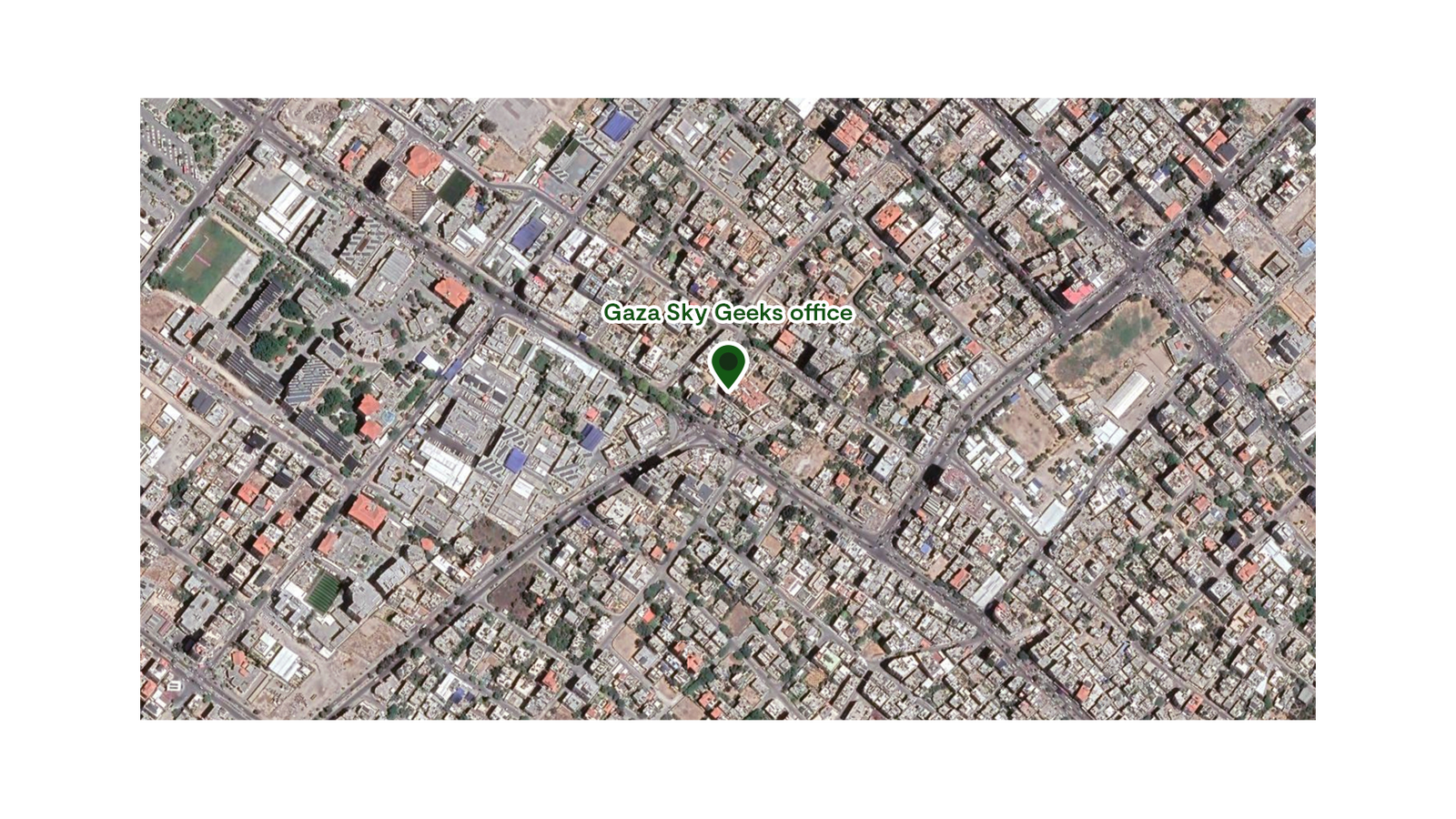
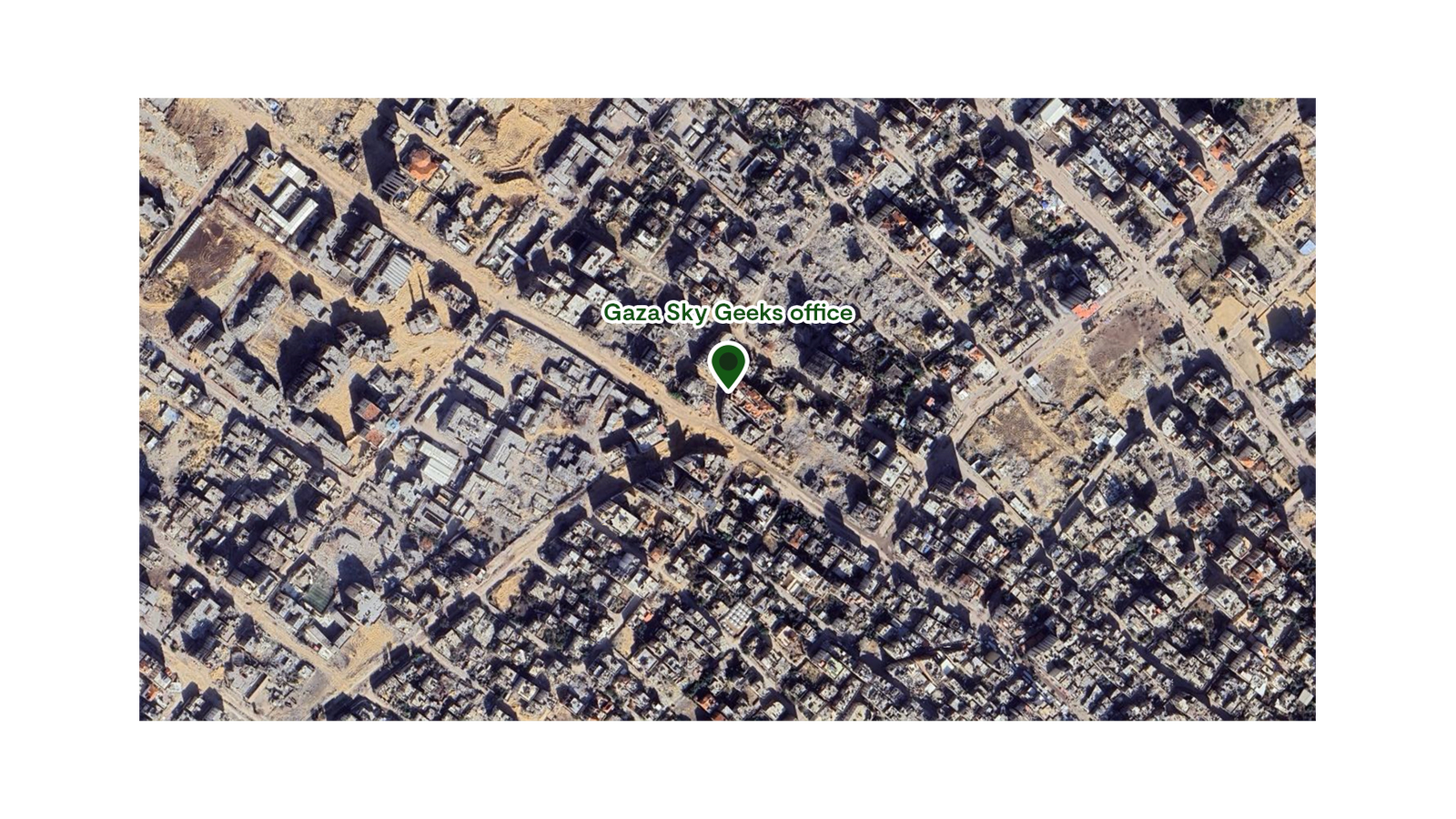
Days after the initial attack, Israel struck the Al Rimal neighborhood, where GSG’s primary office was located. The blasts blew out the office’s windows, destroyed equipment, and flooded the surrounding streets with concrete rubble. “Everything inside was vanished,” a staffer at GSG told Rest of World.
In response to a Rest of World query about why the office was destroyed, an IDF spokesperson wrote: “The IDF does not aim to inflict excessive damage to civilian infrastructure, and strikes exclusively on the grounds of military necessity and in strict accordance with international law. The IDF pursues all feasible precautions in order to mitigate harm to both civilians and civilian structures.” The spokesperson did not respond to specific questions about why the IDF bombed the area where the GSG office was located. Satellite maps of the area clearly depict how, over the next 15 months, much of the neighborhood was razed.
Adham, the former GSG team member, recalled feeling “empty inside” after the strike. It felt “like losing a house full of great vibes,” he said.
Israel’s destructive retaliatory campaign was just beginning. Communication in the region became chaotic and unreliable, and GSG staff were displaced or dealing with personal crises. As attacks intensified, members of the scattered community used solar chargers and power banks to charge devices. They made WhatsApp calls whenever they could snatch a moment of connectivity.
Safi, who spoke to Rest of World from Ramallah in June 2025, described a total pivot to emergency response. She gathered updates on people’s whereabouts and conditions while Gaza endured some of the heaviest bombardment in modern memory, with entire neighborhoods flattened in minutes. Thousands of civilians, many of them children, were killed. Gazans sought shelter in UN schools, relatives’ homes, and tents. Hospitals were overwhelmed with casualties. Press vests became targets, and ambulances and humanitarian convoys came under fire.
As electrical grids collapsed, water pipelines were shattered, bakeries and markets were bombed, and fuel ran out, Gaza became an island of silence, severed from the outside world.
With the internet and telecoms out, freelancers lost contact with clients, and contracts vanished.
Moin Zomlot, the iClinic founder, said he used his car battery to charge his phone until the battery was stolen. After that, the process entailed a 40-minute round-trip walk to a generator. He would burn through his phone battery keeping up with events and reaching out to clients.
As the war deepened, survival took precedence. Zomlot fled Gaza City for Rafah, where he sheltered in a house with 45 people — his brother, his parents, his sister, and his in-laws. Each day he rose early and spent his time searching for flour, water, and firewood. “Life was a tragedy there,” he recalled. ”I was responsible for a big number of people.”
He tried to keep his business afloat, but clients were demanding, despite his circumstances. Eventually, the frequent internet cutoffs made the work impossible. “We became disconnected from clients and family,” he said. “That loss cost us everything.”
After weeks of uncertainty, Zomlot eventually managed to cross into Egypt, as did some other members of the GSG community, before that crossing was shut down in May 2024.
The team members who’d made it to Egypt gathered in Cairo for a dinner. “It was kind of amazing and joyous,” said Sturgill, the former executive director, who flew out to meet the team. But it was tragic too. Many members of the community were still in Gaza. Some were being displaced again and again, clutching powerless laptops.
“We have been scattered around the world, and it’s no longer possible to gather around one table as before,” Zomlot told Rest of World.
Fatma Newiji — who’d been set to launch her business on October 7, 2023 — was still in Gaza City when she spoke to Rest of World in June. She recounted how, in the months following the start of the war, her freelance work evaporated. She lost her laptop. Friends she’d trained with were killed. She said she would wander for hours searching for a signal, unsure if her future died with the bombed-out GSG offices. “I feel like I am back to zero,” she said.
Ikhlas Farajallah, who discovered coding through GSG, has been displaced several times. Work stopped being a priority when survival became everything. When she spoke to Rest of World in August, she was back in Gaza City, sheltering with relatives, struggling for food and water. “Even now,” she said, “I carry what GSG gave me — skills, confidence, and a belief in possibility.”
Abdulhameid Alfayoumi, who’d returned from Turkey to help support Gaza’s tech economy, is dead — he was killed by Israeli bombs about a month into the war alongside his wife, two children, and members of his extended family. “Just before he died, he was paying all displaced members of the team out of his own pocket to make sure they make ends meet during a hard time,” his co-founder Muhammed Qumboz said. Ryan Sturgill, the former GSG director, wrote a LinkedIn post memorializing Alfayoumi. “It’s important to me to tell the world I admired him,” he wrote. “I was proud of him. And, I will miss him.”
In August, in an email to Rest of World, Alan El-Kadhi, GSG’s current director, was steadfast in his belief in GSG.
“The war has deeply shaken our community, with widespread loss, displacement, and trauma. Yet at the same time, the spirit of resilience is remarkable. Alumni and team members in Gaza and the West Bank continue to support one another, share opportunities, and hold onto the belief that Gaza’s tech talent will be the ones who will rebuild it.”
What was once a Gaza-based operation with a small West Bank presence is now inverted: Today, most of the organization’s staff — around 18 people — work from Ramallah, while a smaller group of seven remains inside Gaza, carrying out on-the-ground mentoring and troubleshooting and supporting local freelancers and startups under extremely difficult conditions. They gather in ad hoc setups: private homes, tents, and temporary offices and shelters.
El-Kadhi said that despite the challenges, thousands of participants had completed remote GSG training during the war and that 30% of those found a way to join from Gaza. The organization supported roughly 30 Palestinian tech companies in 2024. Slowly, members of the community have found ways to reconnect online. “Our purpose and objectives remain the same,” El-Kadhi wrote: “to help Palestine build a thriving economy with a tech sector that services customers globally, from Palestine, via the internet.”
In August 2025, the organization launched a new pilot to sustain the coworking spaces still functioning in Gaza. GSG provides financial support to cover basic operational costs — internet and electricity — at five sites. The pilot’s early success suggests the model could be expanded across the enclave.
In September, a UN commission joined multiple international and Israeli human rights groups when it concluded that Israel was committing genocide in Gaza. On October 10, after two years of destruction, Israel and Hamas instituted a ceasefire. According to the U.S.-backed proposal, Israeli soldiers will leave Gaza as Hamas begins demilitarizing. The Strip will be governed by a transitional “panel of experts” — headed by Donald Trump — until power is handed to the Palestinian Authority, which currently administers parts of the West Bank.
Aid and food have flowed back into Gaza sporadically since then. Just weeks after it was announced, the ceasefire is already faltering — with both sides accusing the other of failing to uphold their commitments. On a single night in late October, Israeli bombing killed at least 100 Palestinians, at least a third of them children. Even if the ceasefire holds, the extent of the loss is unfathomable: almost 70,000 Palestinians killed in Gaza, almost 200,000 injured, and 90% of homes destroyed or damaged.
El-Kadhi insisted that Gaza Sky Geeks has never stopped operating and that they can rebuild their work in Gaza, if given the chance. Alumni and partners abroad are still creating remote work opportunities for Gazan talent. Through collaborations with local and international partners, Palestinians can access jobs, skills training, and global networks. “We desperately need more support from overseas. We need companies to offer remote work and internships to Palestinians. And we need employees in companies, students, [and] academics in universities to mentor the Gaza Sky Geeks students,” he said. “It is no longer a time for sympathy.”
El-Kadhi also described the resilience of the GSG community. He recalled a voice-over artist insulating her recordings from the sounds of bombs with egg cartons, and a 26-year-old coder building a desk from salvaged wood just to keep working. Small and desperate efforts at normality. Making something from nothing.
“Even under unimaginable pressure,” El-Kadhi wrote, “our community finds ways to adapt and keep moving forward.”