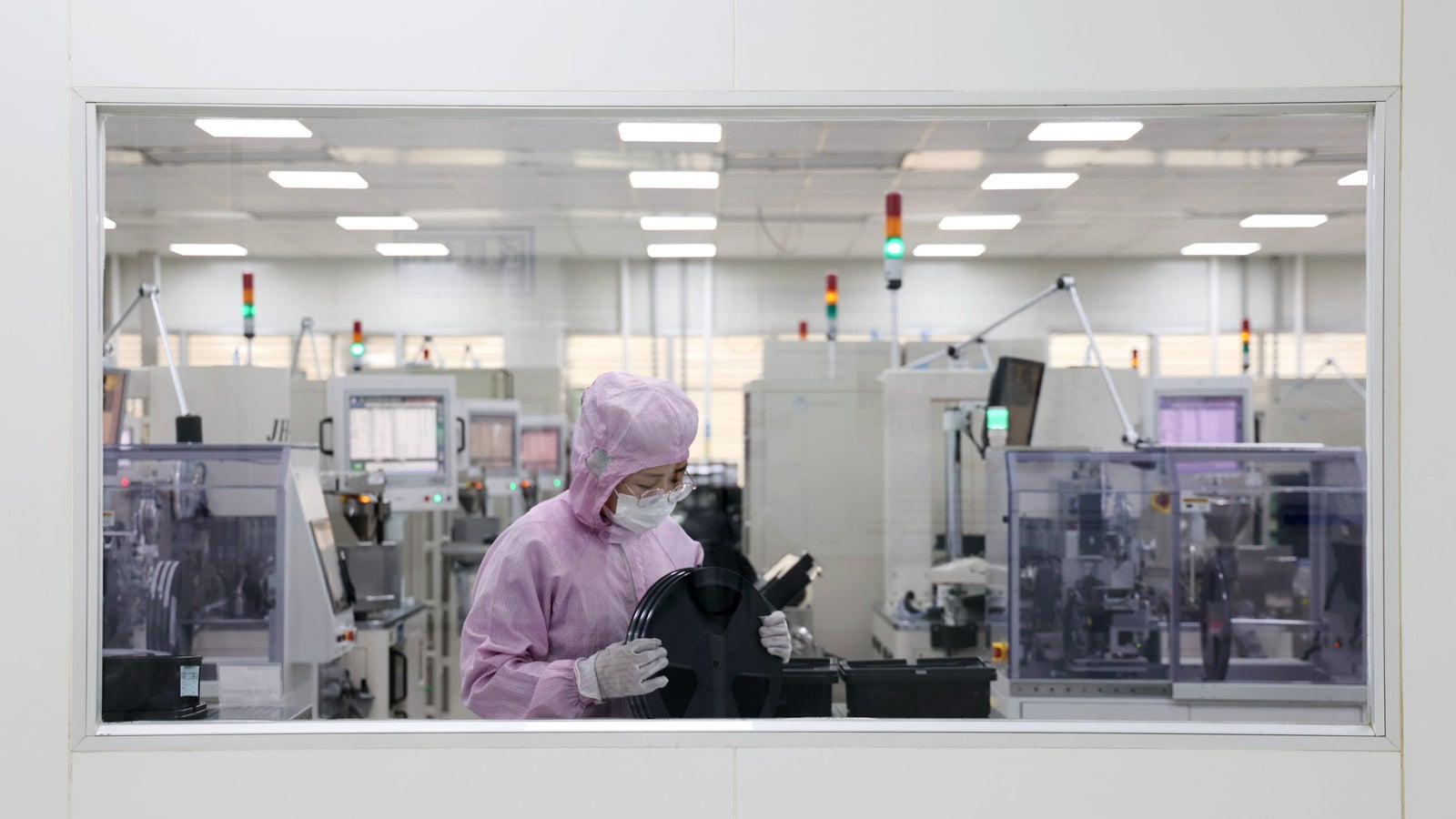
The Philippines has long been a hub for semiconductor manufacturing services — largely assembly, testing, and packaging. Now, the government is keen to go up the value chain with increased automation and an army of young engineers. That means lower-skilled workers, many of them women, are getting left behind.
The industry employs over 3 million workers, and accounts for about a fifth of the country’s GDP, according to the lobby body Semiconductor and Electronics Industries in the Philippines Inc. (SEIPI). Though the Philippines lacks the cachet of powerhouses Taiwan or South Korea, it was recently thrust onto the world stage after it was named as one of the beneficiaries of the U.S. CHIPS and Science Act.
To meet growing demand and move into more specialized areas such as integrated circuit design and fabrication, Philippine authorities aim to produce 128,000 engineers and skilled technicians by 2028. Some of the funds should also be used to upskill the existing workforce, Krista Yu, an industrial economics expert at De La Salle University, told Rest of World. “Most of the tasks done now, like assembly, are very susceptible to automation.”
We want improvements, but not at the expense of people’s jobs.”
Workers are already feeling the impact: At the Philippine unit of Nexperia, a Dutch chipmaker owned by Chinese company Wingtech Technology, about 500 workers have been laid off since September 2023. The company, which makes basic semiconductors such as diodes and transistors, cited poor market conditions and a move toward greater efficiency. Workers say the layoffs were a result of increased automation at the plant.
“I was in the middle of my night shift when my ID stopped working,” Heide Clerigo, who had worked on the assembly line at Nexperia for six years, told Rest of World. “I was a union member, but it was so easy for them to take away my job without any notice. We want improvements, but not at the expense of people’s jobs.”
More than 1,000 Nexperia workers threatened to go on strike in September to protest the layoffs, the first such labor action in the nation’s semiconductor industry. The strike was called off after negotiations between company officials and the Nexperia Philippines Inc. Workers’ Union (NPIWU). The company agreed to give better severance packages, rehire about a dozen union members, discuss higher wages, and suspend further layoffs until 2025.
The layoffs were a result of “specific capacities that ended in 2023, and current processes and market conditions,” a spokesperson for Nexperia in Cabuyao city, about 30 miles south of Manila, told Rest of World.
“The retrenchment, whilst regrettable, is in full compliance with local laws. Nexperia is committed to supporting those affected during this transition, and will be providing assistance to help them through this period,” they said.
The company declined to comment on plans for automation, and if it will result in further layoffs.
The Philippines accounts for about 10% of global semiconductor manufacturing services, with the output making up about 60% of its total exports last year, according to SEIPI. Drawn to its low wages and a young population proficient in English, about 500 semiconductor and electronics firms, including Texas Instruments, Philips, Hitachi, Toshiba, Fujitsu, and NEC have operations there.
While automation will “become more widespread,” the industry faces an uphill task in improving productivity, Gene Rodriguez, labor analyst and head of the Ecumenical Institute for Labor Education and Research, told Rest of World. So “companies will perhaps be driven to justify mass layoffs to cut costs,” she said.

The strike threat at Nexperia — backed by many of the country’s biggest labor unions — is a warning to the industry as it seeks to upgrade without taking its low-skilled workers on board, according to Rodriguez. “It sets a precedent for the entire semiconductor sector. If all semiconductor workers went on strike,” the economy would take a big hit, she said.
The labor action at Nexperia comes on the heels of an unprecedented strike in South Korea by workers at Samsung Electronics, one of the world’s biggest memory chipmakers. Their action points to growing worker discontent as tech firms worldwide embrace automation to boost productivity and cut costs, labor experts said.
With labor unions declining, and labor laws being diluted to favor casual employment, workers have few protections. The Philippines is ranked among the worst places in the world to be a worker. In addition to low wages, there are “significant obstacles when attempting to form trade unions [in] a climate of fear and persecution,” the International Trade Union Confederation said.
The Nexperia workers’ actions, therefore, are “a triumph for labor rights and a testament to the power of collective action,” Congresswoman Arlene Brosas told Rest of World.
“We must continue to champion the cause of low-skilled workers who face precarious employment conditions,” said Brosas, who had sought a congressional probe into the layoffs at Nexperia.
The NPIWU faced down threats and intimidation to back its members. The settlement with Nexperia can serve as a template for other workers in the country’s semiconductor industry who are at risk from increased automation, Mary Ann Castillo, president of the 1,300-member union, told Rest of World.
“Automation is a management prerogative. What they’re doing is cost reduction, we are collateral damage,” said Castillo. “We will support anything that improves production. But improvements should not come at the expense of our jobs.”
Clerigo, who is a member of the workers’ union, can be rehired at Nexperia next year, according to the terms agreed to by the company. But she remains wary.
Clerigo was so distraught at her sacking last year, that she collapsed outside the plant’s gates, and had to be taken home by her coworkers, she recalled. “The company robbed us of our dignity,” she said. “We cannot be sure that the management won’t betray the workers again.”