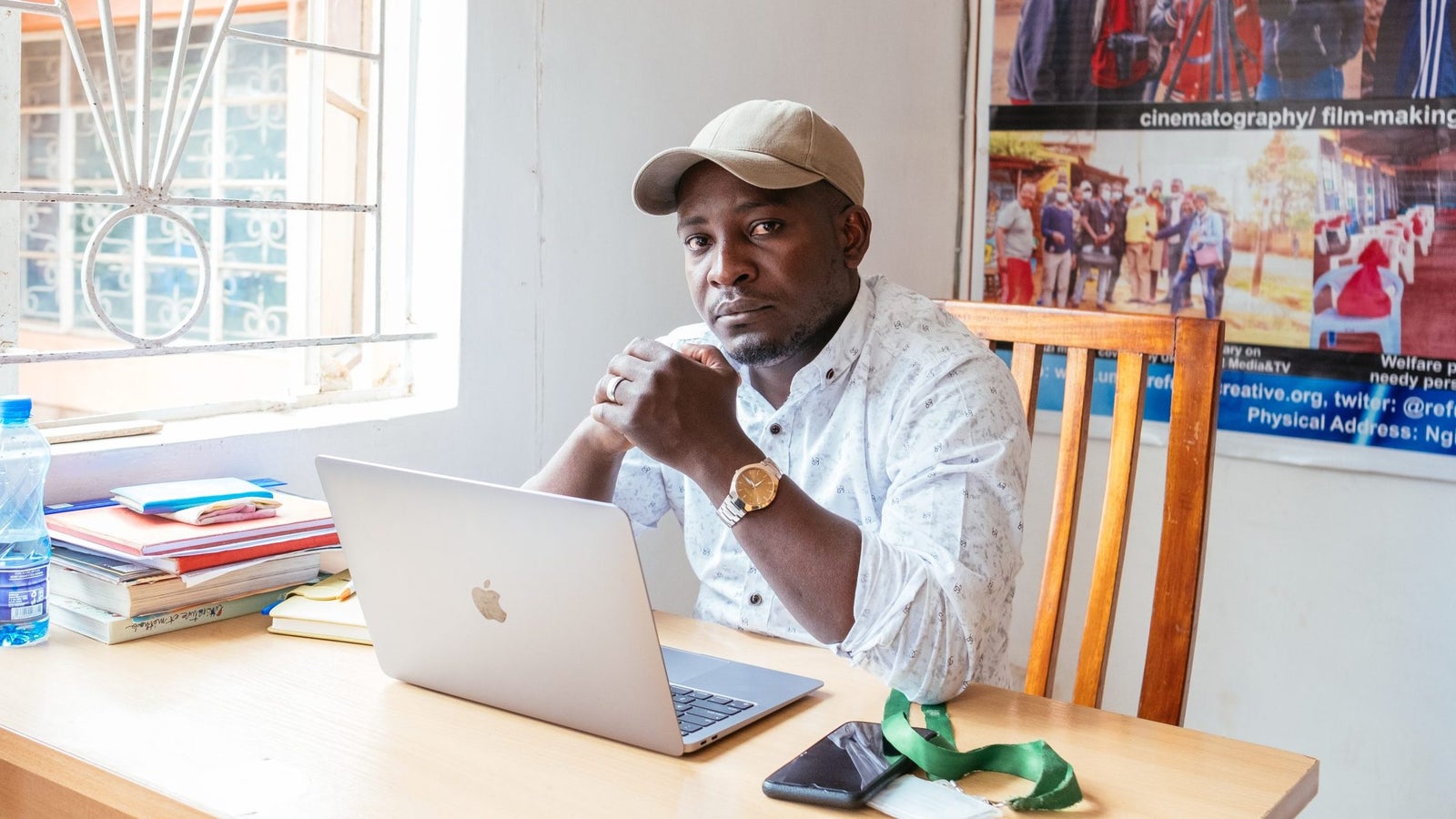
For the past eight months, Nathan Nkunzimana has been making a living by selling packaged water from a stall in Lavington, a residential suburb of Kenya’s capital, Nairobi. He runs his business from 8 a.m. to 5 p.m. every weekday, offering doorstep deliveries for orders worth over 1,000 Kenyan shillings ($6.52). This routine is a big shift for Nkunzimana, who had worked as a content moderator at Sama — Meta’s former moderation partner in Africa — for two years until April 2023.
At Sama, the 34-year-old sat at a desk inside an air-conditioned office for up to nine hours a day, reviewing posts on Instagram and Facebook, and deleting content that violated the platforms’ guidelines.
In April, Sama decided to discontinue content moderation work and did not renew the contracts of its 249 moderators, including Nkunzimana. “The company promised us heaven and earth when we were employed, but all of a sudden, we got laid off. It’s been frustrating,” he told Rest of World.
Besides running his packaged-water shop, Nkunzimana has spent the last eight months organizing his former colleagues to get Sama to reinstate their jobs.

In May, Nkunzimana tried to formally register a union — the Kenyan Content Moderators’ Union — to lobby for the rights of content moderators in the country. The union has not yet been registered but a group of about 160 former Sama moderators, including Nkunzimana, have partnered with the Communication Workers Union of Kenya. “We want to push for content moderators to be recognized and for better remuneration because they are paid peanuts compared to the magnitude of work that they do,” he said. “The process of registering a union has been tough and has taken a lot of time.”
The group regularly meets and mobilizes resources for its members. They have held sit-in protests against Sama, and raised $4,098 from 76 donors through a Go Get Funding petition to support the laid-off workers. Nkunzimana is also among those coordinating with lawyers for a court case registered by the Kenya Human Rights Commission against Sama. “Our crowdfunding campaign has been a great help and we managed to distribute the money among our moderators to help with rent and food. The court case has, however, taken too long,” Nkunzimana said. The group has also paid for the flight tickets of some non-Kenyan members who had to return to their home countries in Africa.
We are hoping that the Kenyan justice system will not slide and allow bullying by big tech companies.”
“[Nkunzimana] has worked hard for us, in coordinating events and activities geared towards helping us get justice,” Naftali Andati Wambalo, one of the laid-off Sama moderators, told Rest of World. “He has been vital for us thus far.”
Nkunzimana’s advocacy for his peers started several months before Sama terminated their employment. In January 2023, he teamed up with other moderators at the company to advocate for better working conditions. They organized protests demanding higher remuneration and work hours being reduced from nine to six. “We wanted to have a collective voice because it was easy for the employer to divide so they could rule,” Nkunzimana said. “The only way to stop them was to come together as employees.”
Nkunzimana believes Kenya’s labor laws are not designed to protect content moderators because it’s a new field of work. “This is a very different work where our rights are being violated in a digital way,” he said. Muchangi Karemba, the Kenyan National Assembly’s chairman of labor and social affairs, told Rest of World via a text message that he was not aware of the content moderators’ case, and did not respond to further requests for comment.
In June, a Kenyan court restrained Sama from terminating the content moderators’ jobs and ordered for their contracts to be extended until the final ruling in the case. It also ordered all parties to engage in out-of-court negotiations to find solutions. Nkunzimana said Sama has not yet done this.


Sama spokesperson Cheryl Wassenaar told Rest of World over email that the company had complied with court orders and reached a mutually agreed-upon resolution with 60 former moderators, while talks with the others remain unresolved. “There has been a lot of misinformation about what the court order requires, and we look forward to that being cleared up by the courts in coming weeks,” Wassenaar wrote. “All moderators with valid contracts have been/are being paid as per the court orders.”
The content moderators’ contracts had been based on the project needs of Sama’s clients, which had been communicated and agreed upon during the hiring process, the spokesperson wrote.
According to Nkunzimana, even though Sama first informed the content moderators about the termination of their contracts in January, most workers failed to find alternate employment because they were still hoping to be reinstated. Most of the laid-off moderators are migrants from countries like South Africa and Nigeria, whose work visas have now expired, leaving them unable to find work in Kenya. Many cannot afford food, pay rent, or access medical care, Nkunzimana said.
Wambalo said he survived the last eight months by borrowing money from family and friends, as there aren’t many job opportunities available in Kenya for his skill set. He said he hoped the group’s efforts would be successful so that he could go back to work.
Also hopeful is 33-year-old Sonia Ngomo, who returned home to South Africa in August but wants to go back to working as a content moderator in Kenya again. She has been struggling since getting laid off. “We are hoping that the Kenyan justice system will not slide and allow bullying by big tech companies,” Ngomo told Rest of World. “Justice will prevail, and they will be held accountable.”
Meanwhile, Nkunzimana is still recovering from the mental toll of his content moderator job. His work at Sama had exposed him to violent images and videos of all kinds — pornography, terrorists killing people, deaths by suicide, and child abuse. “We worked long hours without leaving the desk, watching graphic material, causing mental health problems,” Nkunzimana said. He said he still needs counseling but can no longer afford it.