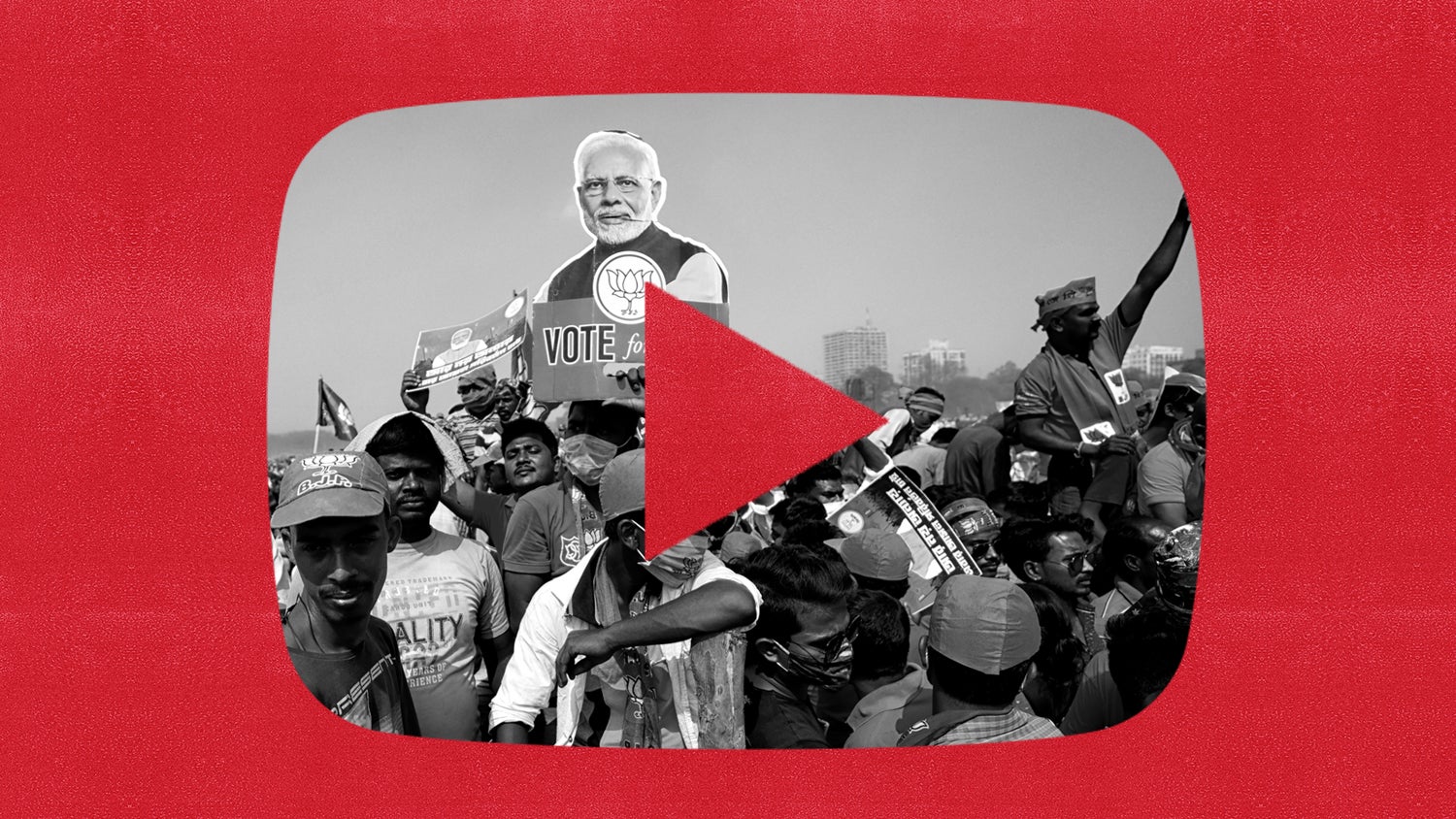
On September 27, 2023, YouTube celebrated the 15th anniversary of its presence in India. The event started with a video address by Prime Minister Narendra Modi, who said YouTube could “awaken the nation” and “initiate a movement.” He called himself a YouTuber in his speech, ending with the quintessential influencer sign-off: “Subscribe to my channel and hit the bell icon to receive all my updates.”
Being influential on YouTube is essential for Modi as India gears up for general elections later this year, where the 73-year-old is seeking a third consecutive term. The Google-owned video-sharing platform has emerged as a strong tool for political messaging in the country, partly due to its large user base: YouTube has 467 million users, while Facebook has 314 million and X (previously Twitter) has 27 million, according to digital insights platform DataReportal.
As many as 87% of YouTube users in India rely on the platform during national news events, according to a 2021 Oxford Economics research report commissioned by YouTube.
The 2024 general election will be a “YouTube election,” especially in “urban areas,” Apar Gupta, tech lawyer and co-founder of digital rights advocacy group Internet Freedom Foundation, told Rest of World.
“YouTube is where [the] voter is consuming content. They might not read a newspaper but they are watching YouTube,” Ruchira Chaturvedi, national convenor for social media and digital communications at the Indian National Congress — the country’s main opposition party — told Rest of World. “YouTube is our core focus area in the run-up to 2024, which means that we have been expanding our footprints on the platform. A lot more content is YouTube-focused.”
Managers of four high-profile political campaigns in 2023 told Rest of World that growing their YouTube user base has been a priority as it helps them connect with diverse voter groups. Each said they had increased spending on Google AdSense and on hiring crews to tailor content for YouTube. Rest of World also analyzed the YouTube channels of two dozen Indian politicians, and found a dramatic increase in subscribers and views over the past six months in the run-up to election season.
In May 2023, eight months before the central Indian state of Madhya Pradesh headed for elections, Shivraj Singh Chouhan, the then chief minister from the ruling Bharatiya Janata Party, hired private consulting firms to change his political image. A big part of this endeavor was executed on YouTube, Raman Mamgain, the principal consultant for Chouhan’s campaign, told Rest of World.
“We relied on YouTube to bring forth his real personality. We tailored content to suit [our] campaign on YouTube and changed the language,” Mamgain said. The campaign used YouTube to livestream election rallies, and shared the links widely across other social media, he said.
Before the YouTube push, Chouhan’s channel on the platform was mostly stagnant. In the first week of May 2023, he had 400 new subscribers, according to social media analytics company Social Blade. But by December, the channel had nearly 27,000 subscribers a week, with total views jumping from 3 million in May to 48 million. “Content is king, but distribution is god,” Mamgain said, adding that YouTube is about building brand value over time. “Anything can be made to go viral but it will not be a permanent trend.”
Though Chouhan’s party won the state elections with 163 seats out of 230, he did not continue as chief minister.
Nearly 600 miles away, in the southern state of Telangana — which went to polls in late November — campaign managers for the Congress party's Revanth Reddy set up YouTube livestreams with GoPro cameras and tripods. Reddy also hired a manager trained in search engine optimization to focus on YouTube "for maximum results," a person who worked closely with the campaign told Rest of World, requesting anonymity as they are not authorized to speak to the press.
“Reddy’s YouTube channel was also made the primary source for disseminating messages in further constituencies,” they said. “As the election campaign heated up, Reddy was positioned as an alternative leader to the policy failures of the sitting government by YouTube channels. We also made his channel the primary source for video inputs for the media.”
The number of new weekly subscribers for Reddy’s channel rose from around 200 in May 2023 to over 30,000 in December 2023, according to Social Blade. In December, he was appointed the new chief minister of Telangana.
Between June 2023 and January 2024, Telangana’s political parties ran 22,750 ads on YouTube, worth 24.9 crore rupees (nearly $3 million), according to data from Google’s Ads Transparency Center. Reddy’s party spent 9.43 crore rupees (over $1 million) on YouTube ads, while its opponent, Bharat Rashtra Samithi, spent 11.9 crore rupees ($1.43 million).
$1.2 million The BJP's spend on YouTube ads between June 2023 and January 2024, as per Google’s Ads Transparency Center.
“How you construct the message and narrative on YouTube will make the difference,” Vinay Kumar, a political consultant at Stratmark Consulting, which assisted with Reddy’s campaign, told Rest of World. Stratmark has also run multiple other winning campaigns in the Telangana elections. “When it comes to elections, two things work out via YouTube: That is publicity and propaganda,” Kumar said.
The importance of YouTube as a reliable visual medium has grown in recent years as television news becomes more prone to political and business biases. Several erstwhile television journalists in India have moved to YouTube in search of a more equitable platform.
Communicating through YouTube also allows politicians to reach voters without fear that their words will be misrepresented by the media, Prashant Chari, co-founder of marketing agency Teen Bandar, told Rest of World. “For budding politicians, YouTube becomes an avenue where you can have people talk about you and get noticed.”
In 2023, Rahul Gandhi, India’s main opposition leader, embarked on his famed “Bharat Jodo Yatra,” an over-3,000-kilometer-long walk across the country. His party, Indian National Congress, publicized it online. Over the 145 days of the walk, Gandhi was constantly seen engaging with YouTube influencers, giving them free-flowing interviews — all the while shunning traditional media.
“Mainstream national media is completely compromised in India,” Srivatsa YB, the Congress party’s national campaign head and the head of communications for Gandhi, told Rest of World. “[Gandhi] puts out a lot of content to directly talk to people via his YouTube platform. In any election, communication via social media — especially YouTube because of its user size — is extremely important to build narrative and perception.”
During his talk at Harvard University on December 15, Gandhi said his “YouTube is under control,” referring to alleged shadow bans placed on his social media accounts. On October 11, India’s opposition alliance wrote to Google, accusing it of “algorithmic moderation and suppression of Opposition leaders’ content” on YouTube.
Rest of World reached out to YouTube for comment on these allegations, but did not receive a response by the time of publishing.
According to Sanjay Kumar, a professor at the Centre for the Study of Developing Societies, YouTube’s role in a political verdict involves how it influences existing political and social views — often validating them. A fence-sitting Hindu voter, who likes the idea of their community having “a better place under this government,” for instance, could be swayed by a YouTube video that affirms this viewpoint, said Kumar.
“YouTube is not shaping people’s opinion towards nationalism; YouTube is only reinforcing that,” he said. “It is an echo chamber, and if you don’t come out of it, you don’t get a sense of the other view.”