“We don’t give support to beginners,” is the first automated message one receives on joining a popular Telegram group for microworkers in Brazil. Microwork is a form of gig work consisting of simple tasks that can be completed online in a short time. Available on platforms like Appen, Amazon Mechanical Turk, and UHRS, the tasks range from typing out an entire spreadsheet to reviewing social media content moderation decisions. More recently, a popular microwork gig involves tagging objects in images to train artificial intelligence.
The hours may be long but pay is adequate, Sônia Coêlho, a Brazilian microworker, told Rest of World, so long as novice “turkers” — as microworkers are informally known — are kept at bay. Turkers like Coêlho blame newcomers for triggering a drop in rates paid by microwork platforms. The community is bracing for a flood of new jobs that they believe are inevitable given the rise of AI, and experienced turkers have been trying to keep those future opportunities to themselves.
Microworkers are spread across the world (Coêlho is from the remote city of Foz do Iguaçu, on the triple border dividing Brazil, Argentina, and Paraguay), so they typically communicate, gossip, and share tips and grievances in online spaces. On social media platforms like Facebook, there are dozens of public groups for Brazilian turkers. On Telegram and WhatsApp, microworkers constantly create new private groups based on geographical location, microwork platform, or type of project.
Over time, the camaraderie across these forums has given way to competition and hostility. The private Telegram group with an unfriendly introductory message — accessed by Rest of World — also has policies aimed at dissuading newcomers from joining. One includes a ban on sharing cheat sheets to tests that give microworkers access to more gigs — those are reserved for a select few in a different, more exclusive chat group. Violations result in bans.
“The more people that join, the harder it is for us to get work,” Coêlho said. “Before, the groups were more collaborative, but not anymore. Now there is this widespread distrust. What if I help you but you end up selling the information?”
The turker chats have gradually grown more exclusionary, and hostile to outsiders. Most of the animosity has been targeted at newcomers, according to Matheus Viana Braz, psychology professor at the State University of Minas Gerais, who has spent years studying microworker communities. This antagonism is based in microworkers’ fear that new arrivals would not only compete for their jobs but also bring down the rates offered by the platforms. Braz said these concerns were not entirely unfounded, given dwindling rates and instances where platforms had closed registrations due to the amount of applications from Brazilians.
The more people that join, the harder it is for us to get work.”
“Remuneration on these platforms has progressively fallen in the past years, especially after the pandemic,” Braz told Rest of World Projects that used to pay $10 an hour a decade ago are now offered for $3.50, she said.
Even though there is no hard evidence proving that an excess of labor is the reason rates have gone down, seasoned turkers are not taking any chances and are increasingly excluding novices from microwork forums.
Julio Kraemer has been a full-time turker in Bauru, a city in the state of São Paulo, since 2018. He witnessed the emergence of this growing hostility firsthand from 2018 to 2019, when he was an admin of a WhatsApp group with around 200 members. He decided to create a more restricted “VIP group” with 40 of the most active and helpful participants. Those same VIPs worked to expel a man from the public group — he had been using content extracted from conversations to make YouTube videos, where he’d promote microwork as an easy way to make fast money, Kraemer told Rest of World.
In the past, microwork afforded Coêlho, the worker from Foz do Iguaçu, a middle-class life — she was able to buy a car and a motorbike with the money she made. Even though she has seen her income dwindle over the past few years, she is still hopeful, as are her fellow turkers. Despite the increasing frustration, microworkers feel their line of work might get a second wind from the rise of AI.
As AI goes mainstream, titanic amounts of data are being processed manually by armies of online gig workers. Unlike most microwork gigs, this new batch of AI work often requires language- and culture-specific knowledge. Coêlho said that one such project required her to record simple voice prompts in Portuguese, such as “Good morning, will it rain today?” For every 500 phrases she recorded, Coêlho would receive 50 reais ($10.55). Similar jobs are now being offered to Brazilians in specific states based on their regional accents. Coêlho believes these recordings are likely being used to train AI voice assistants.
I was probably training the algorithm for a self-driving car.”
At least one projection suggests the worldwide generative AI market will expand to more than $1 trillion by 2033. “An absurd amount of data will be necessary [to train AI tools like ChatGPT],” said one member, identified only as Lola, in a Brazilian microworkers’ Telegram group. “We have lots of work ahead of us.”
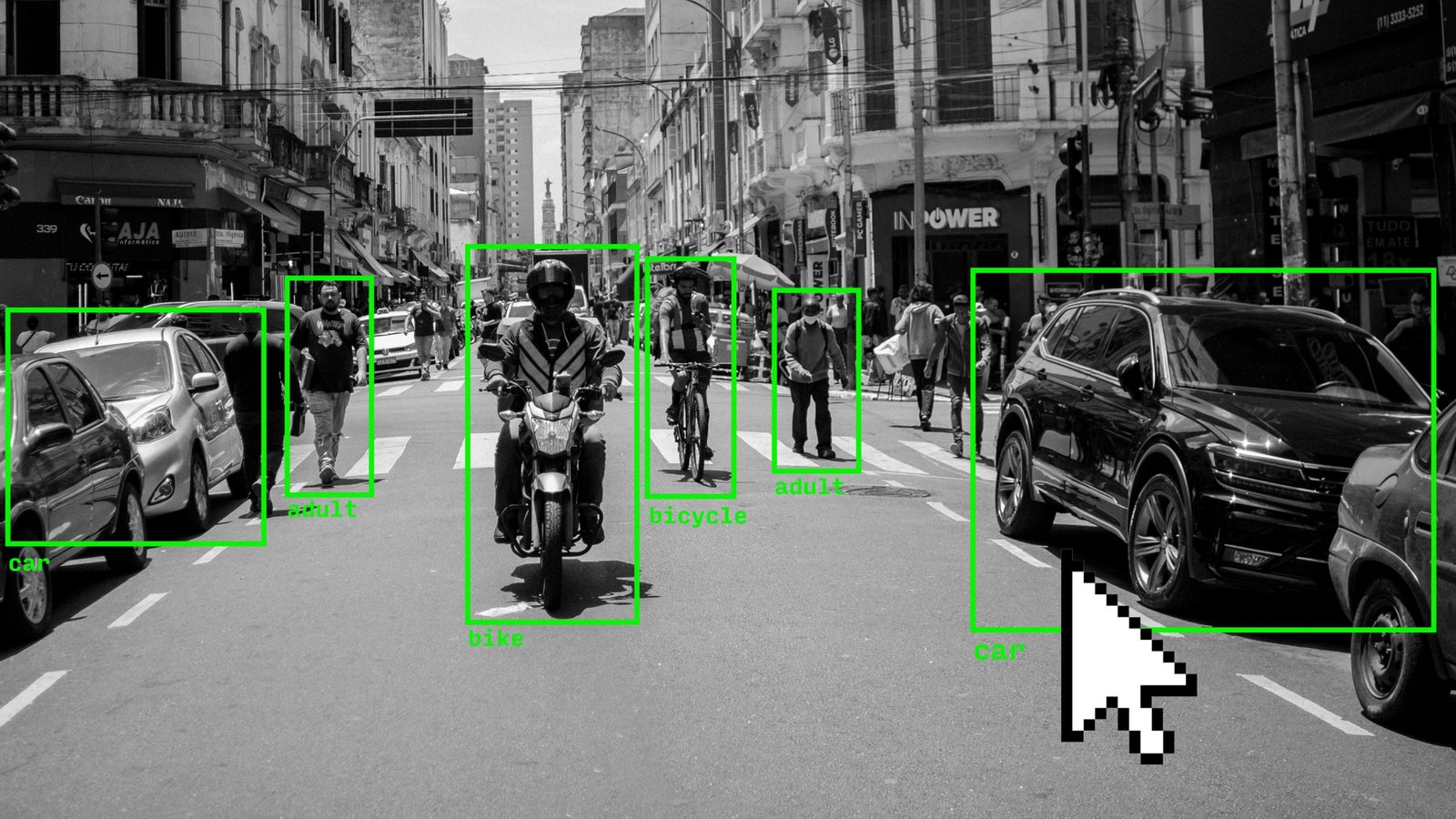
Turkers told Rest of World most projects are not clearly labeled as AI gigs, with workers only figuring it out more than midway through their tasks. Kraemer, the microworker from Bauru, spent days on a project that involved watching seconds-long videos of street traffic. He’d then have to suggest the likelihood of a pedestrian crossing in front of a car. “I was probably training the algorithm for a self-driving car,” he said.
Despite this ambiguity, Brazilian microworkers feel they’ve already had a visible impact on AI. Kraemer said he had once “recorded a bunch of sentences in Portuguese” for a gig. “I’d have to say ‘Alexa, do this,’ ‘Alexa, do that.’” Soon after the project was over, the Brazilian Portuguese version of Alexa was released, he said, “I realized, of course, I’d been training her, but nobody actually told me that’s what I’d been doing.”
These language-specific projects can sometimes pay more. Microtasks on Amazon Mechanical Turk currently pay, on average, less than 1o cents per task, though rates can vary widely between microwork platforms. However, Kraemer said a recent project he’d completed in Brazilian Portuguese offered $2 per task.
Microworkers also said they were particularly keen to defend projects in Brazilian Portuguese from foreigners, who they felt lacked the necessary knowledge of local contexts. Some, they claimed, couldn’t even speak Portuguese, resorting to Google Translate to complete tasks.
In these cases, the protectionism of Brazilian Portuguese microwork by Brazilian turkers from non-native speakers may protect the quality of the AI they are training, said Braz. This is because tools like Google Translate lack the necessary cultural knowledge for which Brazilian turkers were being hired.
Coêlho is less concerned with the final product and more with what the shoddy work done by others might do to her livelihood. “If the quality of work goes down, so do rates,” she said.