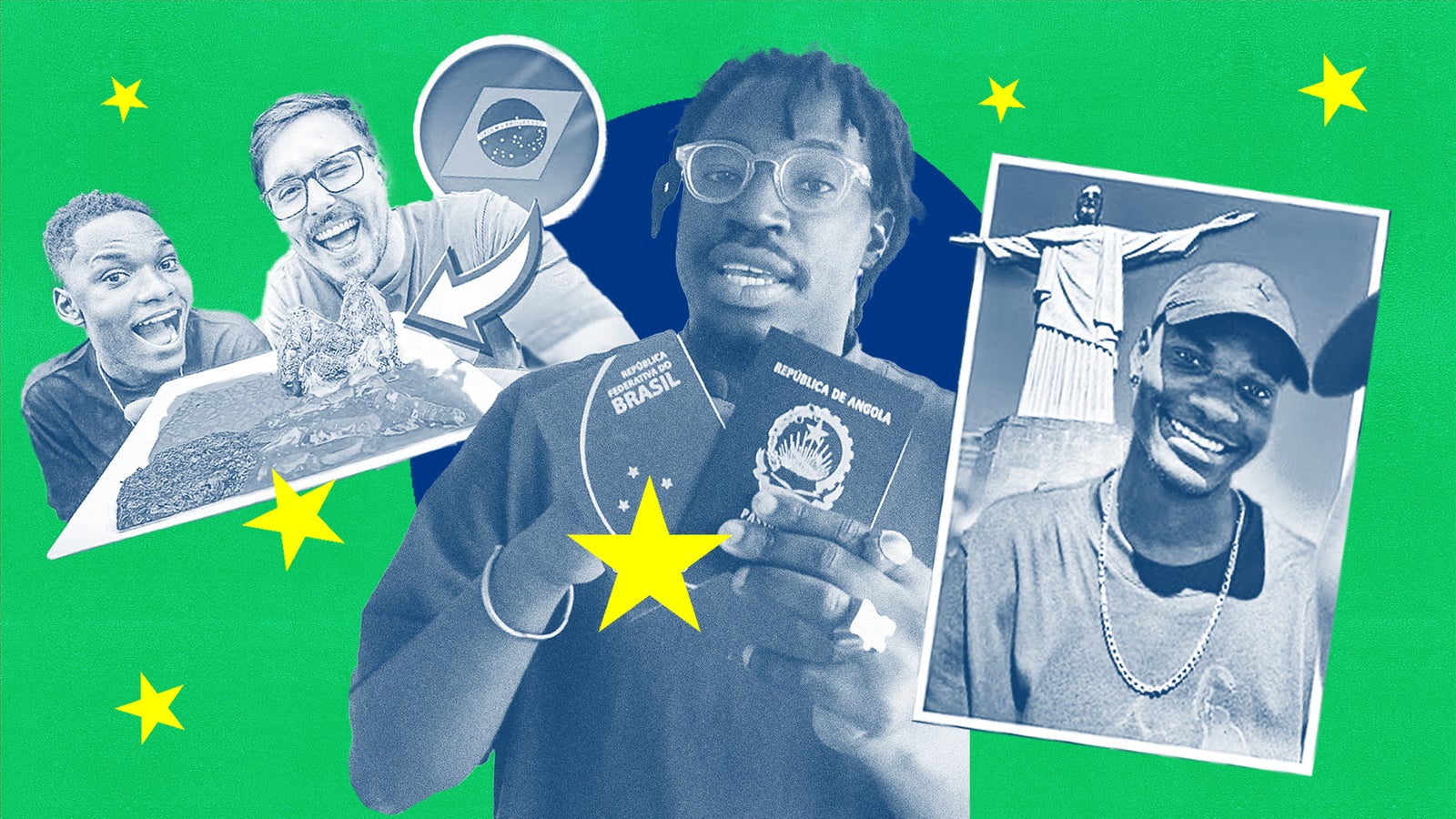
As a child, Baptista Miranda marveled at Brazil, learning about it through lavish soap operas that made the faraway country’s colorful metropolises come alive on screen. From his hometown of Lobito, an Angolan city of about half a million people, he dreamed of visiting Brazil one day.
In 2017, Miranda started a YouTube channel dedicated to showing how Brazil was perceived in Angola — both countries were once colonized by Portugal, and continue to share an official language. His initial videos — most of which he recorded on his friends’ devices since he didn’t own a phone — slowly gained popularity.
Five years later, when Miranda’s channel reached about 600,000 followers, his dream came true. A major Brazilian YouTube creator group called Flow Studios invited him to visit the country, all expenses paid. Miranda was elated. “We think of Brazil as the country where things happen. I’ve always said it’s Hollywood for Angolan people,” he told Rest of World.
Miranda received a warm welcome from Brazilian YouTubers and podcasters, with several proposing collaborations. Four months later — and to the disbelief of his relatives in Angola — he signed his first advertising contract: a campaign for Guaraná Antarctica, a popular Brazilian soft drink.
Miranda has since amassed 6 million followers across YouTube, TikTok, and Instagram, and is now the most-followed Angolan on social media. The bulk of his followers are from Brazil. His income comes exclusively from the online content he produces, particularly through local brand partnerships on Instagram and the millions of views he monetizes on YouTube.

Like Miranda, several other Portuguese-speaking Africans are claiming a piece of Brazil’s lucrative digital creator pie and all the opportunities that come with it. Rest of World found over a dozen African creators who are making content from Brazil — the largest Portuguese-speaking country in the world, with the fifth-biggest social media market of more than 165 million users. According to YouPix, a São Paulo-based consultancy, an estimated 20 million people in Brazil make money in the creator economy — a far cry from many of the African countries the recently transplanted creators come from.
“The creator economy in Guinea-Bissau practically does not exist, and if it does, it’s right at the beginning,” Nabillah Sedar, a model from the West African country, told Rest of World. He moved to Brazil in 2015 as a student, and started making online content in 2022. Portuguese-speaking countries, including Guinea-Bissau, Angola, and Cape Verde, have strong ties to Brazil, where half the population has African ancestry as a result of the slave trade.
One reason behind the creator economy’s slow growth in Africa is the high cost of connection. “It’s extremely hard for creators to have a wide audience where the cost of data is too expensive,” Nelson Fagbemi, a digital creator manager based in Lagos, told Rest of World. “That’s where the big [Portuguese-speaking] market of Brazil comes into play.” The average price of 1GB of data in Brazil is 40 cents, compared to $1.01 in Angola and $2.72 in Guinea-Bissau.
We think of Brazil as the country where things happen. I’ve always said it’s Hollywood for Angolan people.”
The arrival of African creators in Brazil is fostering a symbiotic relationship on both sides of the Atlantic. “I want to replicate in Angola many things about the creator economy that I’ve learned in Brazil,” said Miranda. He knows he’ll have to be patient — many companies in Angola still refuse to pay creators for partnerships.
Brazil’s advanced creator economy offers the new entrants appealing opportunities to monetize — especially on Instagram. The country has about 119 million Instagram users; according to data from Nielsen, 10.5 million of them have more than 1,000 followers, making Brazil the country with the largest number of influencers on the platform.
Meta offers a broad list of tools and resources to Brazilian content creators on Instagram, some of which are not available across Africa. These include Gifts, a tool that allows fans to send money to creators’ Instagram reels; Stars, which are awarded by fans to creators and can be redeemed for cash; and Live Badges, which let creators receive money from their fans and communities during a live broadcast.
In a 2023 survey of Brazilian creators, more than 80% of the 570 respondents said they had made money from their online work. The survey — conducted by YouPix and Brunch, another consultancy firm in Brazil — also showed that half the respondents monetized their content through brand partnerships, with more than 60% making between $400–$2,010 per month.
“Since 2022, [African creators in Brazil] are becoming more prominent in the scene and attracting attention from local brands,” Rafaella Lotto, head of YouPix, told Rest of World.

Miranda said he sends money to his family in Angola every month. His long-term goal is to buy his mother a house — an ambition that has shocked his friends and family back home. “People in Angola don’t believe I’m able to make a living from [what they call] ‘internet money,’” he said.
Miranda’s success story has become a blueprint for many aspiring African influencers. When he moved from Angola to Brazil in 2014, Esmael Nzuzi dos Santos Gabriel was astonished to learn that many Brazilians didn’t know Angolans spoke Portuguese. “We’re known as countries that have a fraternal relationship,” Nzuzi dos Santos Gabriel told Rest of World. His Instagram page, launched in 2020 and named África do Jeito que Nunca Viu (“Africa the way you’ve never seen it”), has amassed over 350,000 followers. Although his monthly earnings vary according to the demand for his content, Nzuzi dos Santos Gabriel said the Instagram page has become an important source of income.
But despite the opportunities for creators in Brazil, and the enviable success of social media celebrities like Miranda and Nzuzi dos Santos Gabriel, Black creators still face considerable challenges. Only about 16% of all creators in Brazil are Black or mixed-race, and few African women have found a clear path forward as creators in the country, according to Miranda. Yuran Tinta, who creates wholesome content and often mentions his Angolan nationality, told Rest of World he gets racist and xenophobic comments on his posts every day.
“What keeps me going is the amount of people who want to learn from myself and my content,” Tinta said. He has been building an online content creation course, aimed at African creators. “I want more people in both Brazil and Angola to learn how they can make money from their online content,” he said.