On a sweltering June day, an artificial intelligence-powered humanoid robot built by Chinese firm Ubtech entertained a crowd of hundreds waiting to enter the China pavilion at the Osaka World Expo.
Robotics is just one of several industries where Chinese companies are challenging their Western rivals — Ubtech’s latest model can speed-walk, scan barcodes, and handle receptionist tasks. But rather than presenting a cold futuristic ambience, the design of the 3,500-square-meter pavilion embraced traditional materials and culture: bamboo panels etched with poetry, wooden displays, and augmented reality experiences where visitors can toss virtual snowballs and rake autumn leaves.
The serene setting highlighted Chinese prowess and masked any potential tension regarding tech firms entangled in U.S. sanctions and the broader geopolitical rivalry over AI.
Staff throughout the pavilion used handheld radios from Hytera, a Chinese walkie-talkie maker that has admitted conspiring to steal trade secrets from Motorola and faces a potential injunction restricting global sales. Hytera proudly demonstrated its products at the expo, emphasizing that their durability and extended battery life can play a role in protecting public safety.
An interactive AI display, featuring the Monkey King from the classic tale Journey to the West, showcased technology from iFlytek, a partly state-owned company making voice recognition software and AI translation tools. The U.S. had sanctioned iFlytek in 2019 and 2021 for “actively cooperating” in Beijing’s repression of ethnic and religious minority groups and working against U.S. foreign policy interests. A senior executive said the sanctions have hurt global partnerships, and that iFlytek is seeking business in Japan. In 2019, China’s foreign ministry called the sanctions interference and denied human rights abuses.
More broadly, Chinese tech companies face mounting barriers from tariffs and expanded export controls on microchips, aimed at curbing their ability to advance in AI and high-performance computing. In recent years, Chinese firms have rapidly scaled their businesses in non-Western markets, according to an Atlantic Council study.
Rest of World visited the Osaka World Expo to understand how Chinese technology companies are marketing themselves to a global audience.


-
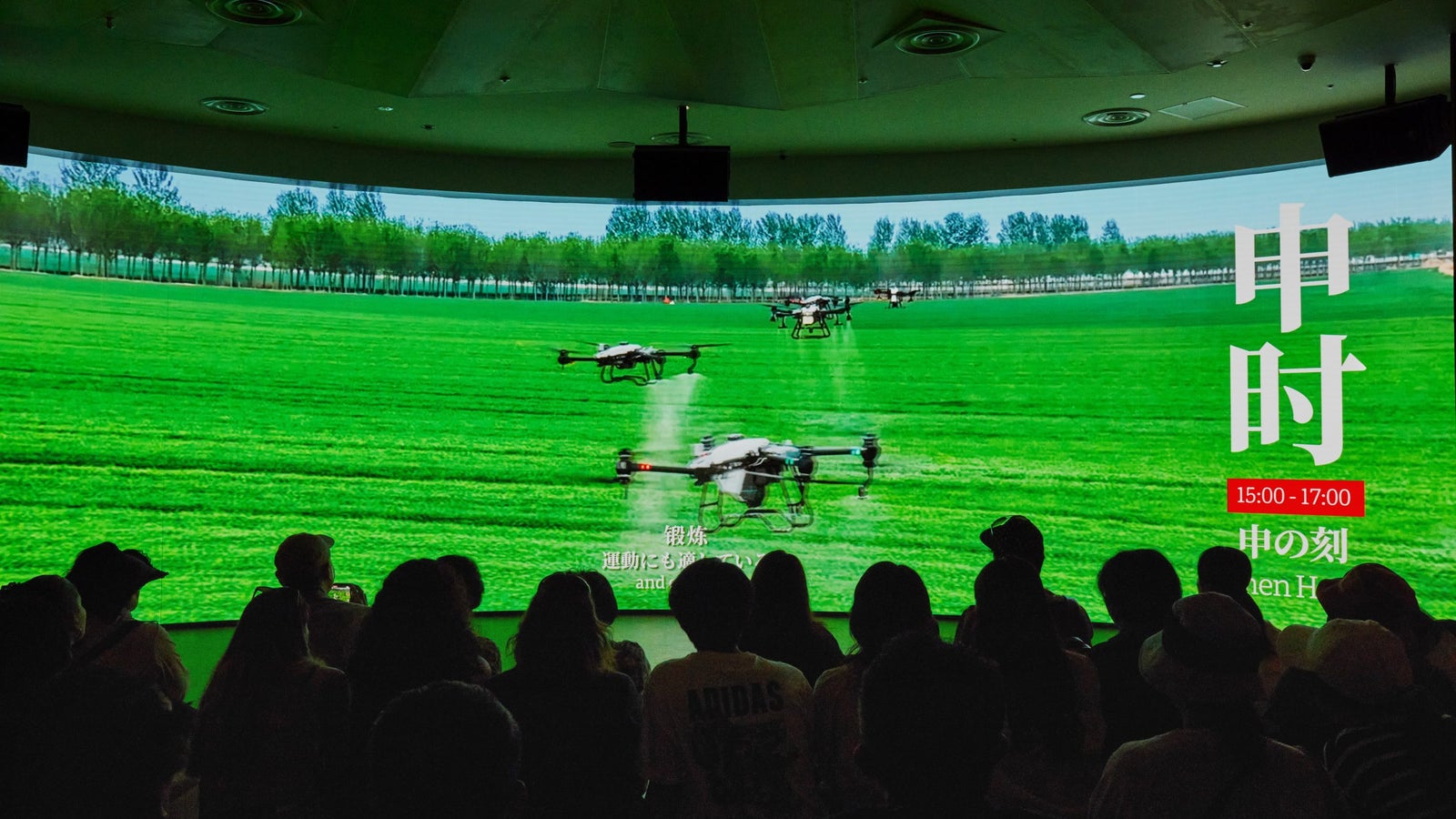
Inside, laser video projections display Chinese artwork, calligraphy, digital scrolls, and landscapes, using technology from Chinese firm Appotronics.

-
Participants at the China pavilion include Hytera and iFlytek. -
-
Visitors interacted with astronauts on China’s Tiangong space station. -