
Grace Mumo started working with Remotasks after she lost her job in 2020. To the single mother caring for three children, the remote clickwork service offered a way to make money by annotating images or labeling Lidar data.
But on March 7, she was abruptly cut off from the service — along with all other Remotasks workers in Kenya — without any explanation of what had happened. Mumo is now left scrambling to make ends meet. “As I speak, I am wondering what the children will have for dinner because I have no money,” she told Rest of World.
Remotasks has shut down entirely in Kenya, Nigeria, and Pakistan over the last month, Rest of World has learned. The platform has stopped accepting new sign-ups in Thailand, Vietnam, and Poland. (Given the global scope of Scale AI’s operations, these may not be the only countries affected, but are the only ones verified by Rest of World.) Through it all, the changes have been sudden and largely unexplained, driving home the precarity of clickwork.
A Scale AI representative declined to say which countries had been dropped from the platform. “Remotasks remains fully available to existing contractors in Poland, India, Thailand, and Vietnam,” the representative told Rest of World. “However, due to enhanced security protocols, Remotasks was recently discontinued in some other locations.”
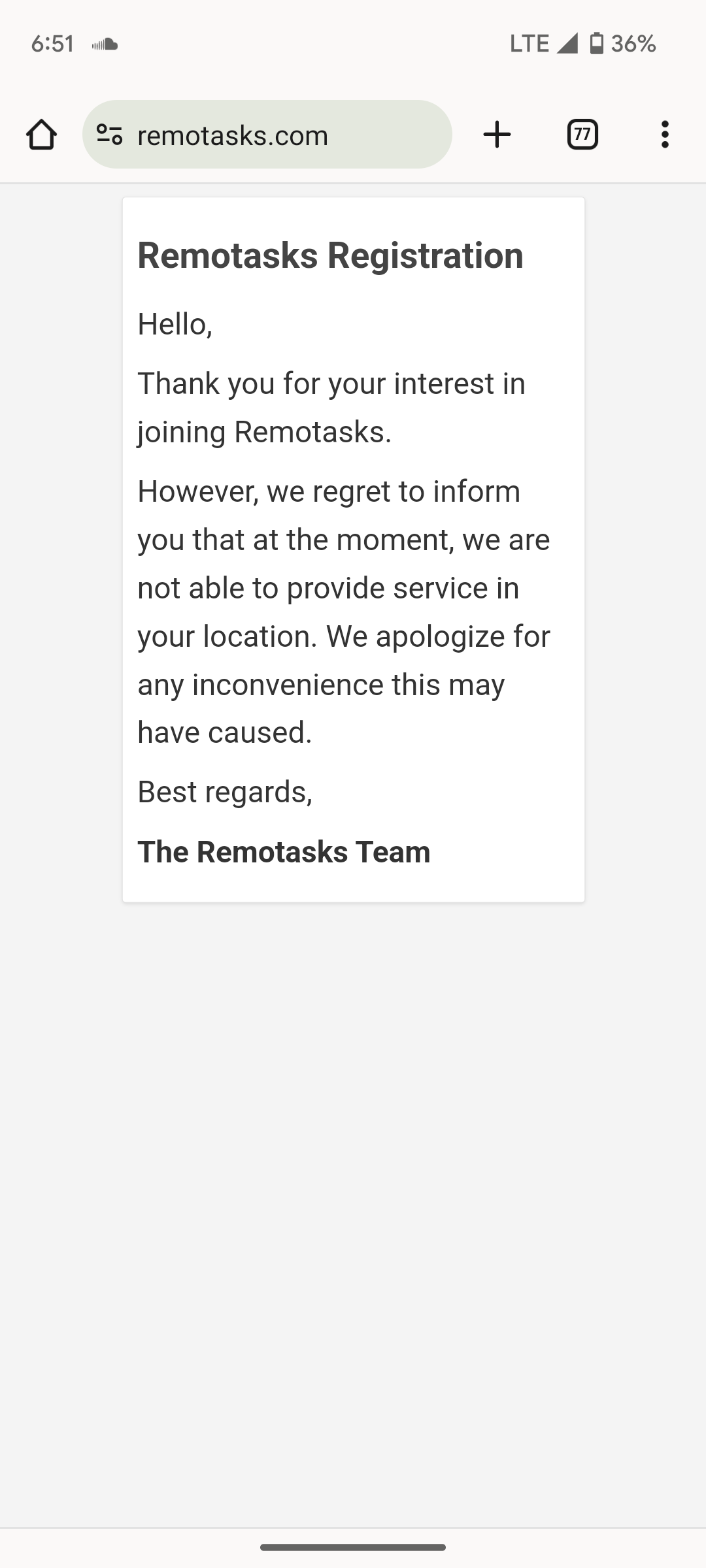
The representative claimed an administrative error was to blame for the lack of notice provided to contractors in Kenya. “While notices were sent three weeks in advance of the change, unfortunately, contractors in Kenya did not receive the notice due to operational errors. We apologize for the error, and our operations team is reaching out to those impacted,” the representative said.
Based in San Francisco, Scale AI has been one of the success stories of the recent artificial intelligence boom, drawing clients like Meta, Microsoft, and OpenAI. Scale AI has also found significant success as a U.S. defense contractor, landing a string of four Pentagon contracts worth more than $80 million. The largest of those contracts ended earlier this year.
Much of Scale AI’s work is done through its subsidiary, Remotasks, which pays workers on a task-to-task basis without any contract binding them to the company. This leaves employees in a precarious situation, and can result in wild variations in work volume and quality, even as the overall platform remains stable.
The remote nature of the work also means workers often have few reliable ways to contact supervisors or escalate complaints. Scale AI maintains hotlines where workers can report anonymous complaints, but most direct contact takes place through Slack channels.
This meant many workers only discovered the recent block when their connection to the service abruptly froze. That was the experience of Usama Ali in Pakistan, who had worked on Python coding tasks for Remotasks since August 2023. “Initially, I thought it was an error or a glitch, so I waited. And then I got an email, stating that my account was ‘under review,’” Ali told Rest of World. “After that, I was unable to access my account.” When he refreshed the page, he was shown a message saying the platform was blocked.
Many Remotasks workers had experienced versions of this problem even before the nationwide exits, as demand for particular services has waxed and waned. Last June, Nigerian language translator Onyekachi Ogbu began working on a project that trained AI in the Igbo language. After working on five such projects, which took more than 20 hours altogether, Ogbu told Rest of World he had less than a dollar to show for it. By August, he had been kicked off the group with the rest of the workers.
“The guy coordinating Igbo language was the first to be removed and when we asked what happened, they said it was an error and our coordinator will still be added back,” Ogbu said. “But before we knew what happened, every single person was removed from Slack.”
In some countries, the block has prevented new users from signing up, leaving existing user accounts untouched. In Vietnam, new sign-ups have been blocked for several weeks, even as Remotasks continues to publicly advertise and invite locals to join its workforce.
For workers who have spent years on the platform, the sudden block has called the whole prospect of remote gig work into question. Kellion Mrego, a 29-year-old worker in Kenya, had worked for Remotasks since 2018, when he was still in college. He mostly worked on Lidar-related projects, and stuck with the platform through declining wages and work shortages — only to get booted off earlier this month without explanation.
“Sometimes I feel like [Remotasks] never cared about us, because if they did, they could not have closed abruptly,” Mrego told Rest of World. “It has messed me up, my whole life has changed. It’s now the second week — I feel like I have been in this situation for a year.”