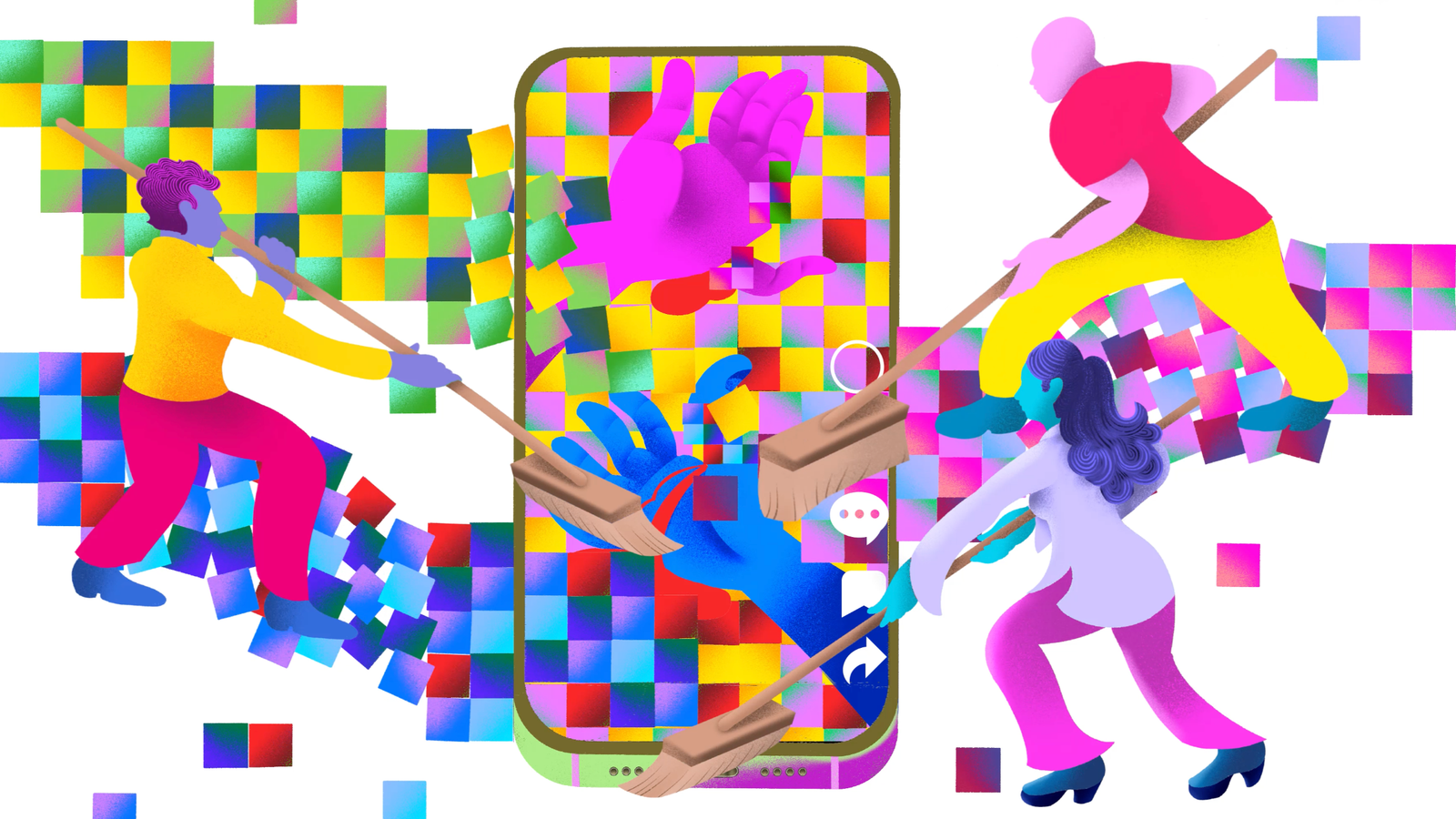
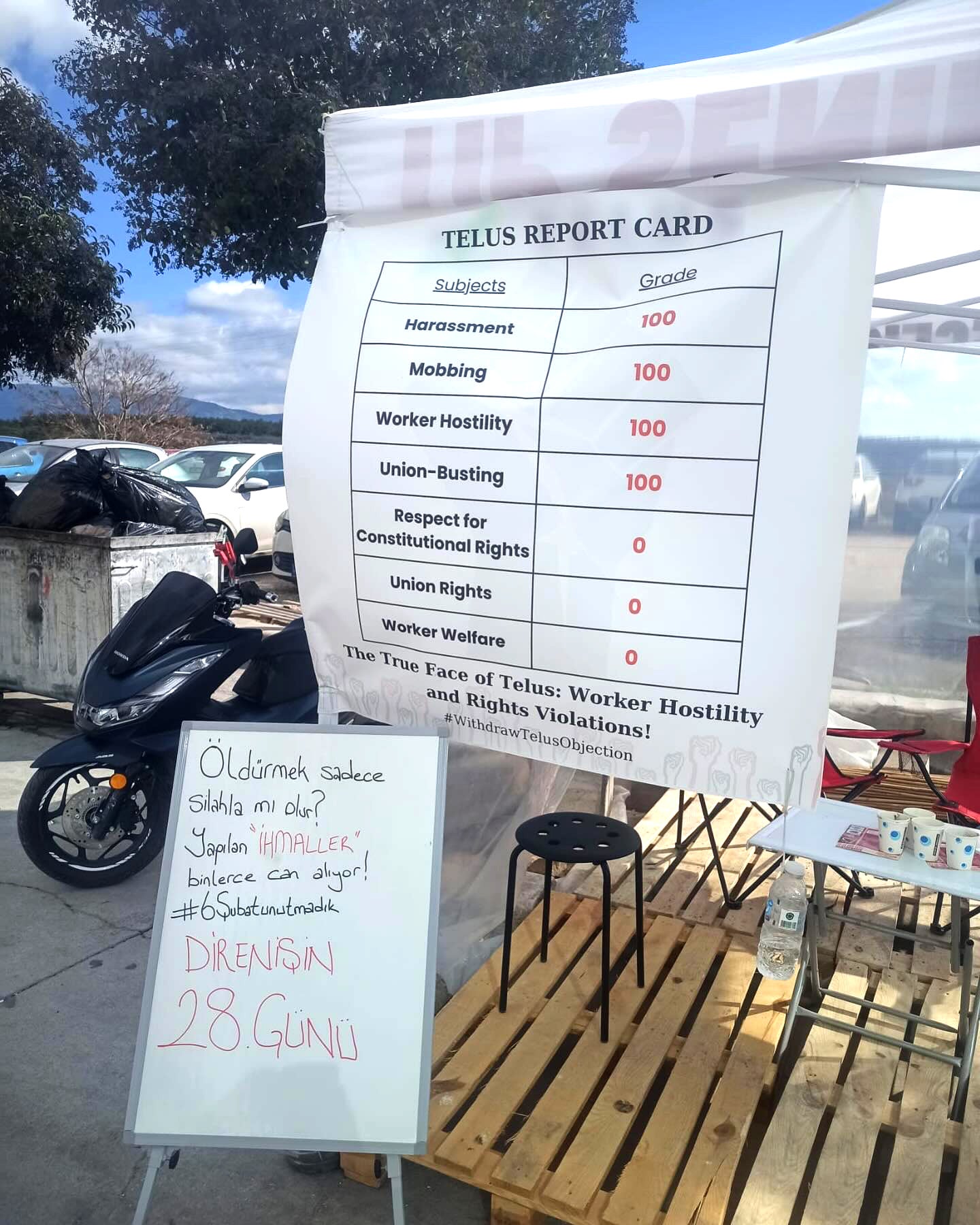
Hasan Hüseyin Yavuz sat in an unpaved parking lot among protest posters, trying to draw attention to the human toll of trending TikToks.
Across the street from his former employer in the coastal Turkish city of Izmir, he told former coworkers and other passersby about the struggles of content moderators, who have been denied union representation.
He said he was fired for trying to launch a union for the tech workers who scour social media for violent, racist, and sexual posts. The specialists grapple with overwork, stress, and psychological problems to keep users’ feeds safe, he said, and don’t receive the support and compensation they deserve for this dirty work.

“We have to dig through and pick out the garbage,” he told Rest of World. “People think I watch sports videos, cooking and cake-making videos every day. None of these exist in what I look at for moderation. There is blood, suicide, harassment, and sexual content.”
Yavuz is at the forefront of an international movement to demand better recognition, rewards, and working conditions for a growing global army of social media moderators. Artificial intelligence and other technologies are becoming increasingly effective at identifying and removing questionable content. Still, the sheer volume of posts means human eyeballs are needed.
In April, the first-ever trade union alliance for content moderators was launched in Kenya, with members in Turkey, India, and other countries that have become hubs for moderators. The Global Trade Union Alliance of Content Moderators was established to support this special segment of the worldwide workforce, which is often from regions with lower labor costs.
“The pressure to review thousands of horrific videos each day — beheadings, child abuse, torture — takes a devastating toll on our mental health,” Michał Szmagaj, a former content moderator who is now helping workers form a union in Poland, said in a statement. “But it’s not the only source of strain. Precarious contracts and constant surveillance at work add more stress.”
The moderators don’t always work for the tech giants. Many international companies, including Yavuz’s former employer Telus Digital, mediate the moderation work. When workers attempt to unionize to defend their well-being, trouble often ensues.
Rest of World interviewed employees of the Izmir branch of Telus Digital — a Canadian company that handles outsourcing moderation for ByteDanceByteDanceByteDance is a Chinese internet technology company that owns TikTok and Douyin, a Chinese version of TikTok with a successful e-commerce arm.READ MORE, the Chinese owner of TikTok — to explore the intersections of content moderation work, mental health, and unionization attempts. The workers requested that their names not be used, fearing retaliation.
We have to dig through and pick out the garbage…There is blood, suicide, harassment, and sexual content.”
With offices in Izmir and Istanbul, Telus Digital employs around 1,800 people. It was originally registered as a call center. During the global pandemic, most of its employees worked remotely. As they started returning to the office in the second half of last year, more than 900 employees asked to be represented by a union.
Turkey’s Ministry of Labor and Social Security approved the request in August. The company countered that it wasn’t sure about the number of employees who supported the union. It also changed the classification of its business, which, in effect, blocked the union. In recent months, dozens of workers have been dismissed and around 15 have sued the company to get their jobs back.
The stories of Turkish content moderators follow a similar trajectory. What started as a high-paying, enjoyable job done from home turned psychologically grueling as workers felt increasingly surveilled and pressured. The workers say they are now overworked and not given sufficient support. When they attempted to organize and fight for their rights, they say their efforts were shut down.
Telus Digital says it cares about the well-being of its employees, and although there may be an increase in workload and restrictions, it has an infrastructure and counselors in place to help employees who struggle. The company says no terminations were based on union affiliation and it has “a long standing tradition” in working collaboratively with trade unions and workers councils.
“We are proud of our team in Izmir and the professional environment we have built together,” a Telus spokesperson told Rest of World in an email. The latest terminations among moderators were “due to documented misconduct (e.g., vandalism, threats), performance, or restructuring,” not unionization attempts, the spokesperson said.
One Telus employee, who asked to be called Hazal, used to love her job at the company moderating TikTok posts. When she first started, Hazal had a light workload and worked from home. Her mother used to bring her warm cookies as she worked.
Her 45-hour workweek “felt like a blessing,” she told Rest of World.
Another employee, who asked to be called Can, agreed that the job used to be easy.
“The real work only took one and a half hours at most,” he told Rest of World. “I’d view and tag a video, and there would be a pause.”
That changed in 2023 with a surge in the volume and the violence in the posts, moderators said. They said their workload skyrocketed from dozens to hundreds of posts a day.
“They turned on the tap,” Can said. “After that, it just became nonstop as the pool of videos blew up.”
The company measures employees’ productivity by clocking the average handling time for each post. Those who fail to handle their responsibilities adequately may be reprimanded, placed on a performance improvement plan, and ultimately terminated. Moderators started speeding up videos to 1.5 times the normal speed to keep up. “All performance expectations are set based on role suitability and adjusted based on ability,” a company spokesperson said. “Tools such as variable playback speed are available to support efficiency but are never used to compromise quality or human judgment. Team member well-being remains a core priority.”
The content of videos became more extreme, said Hazal. She said she had to watch disturbing images of corpses and bombed buildings. Yavuz said he has seen videos of incest and extreme violence that have given him nightmares.
In June 2024, moderators were instructed to return to the office and faced new restrictions. They weren’t allowed to have their phones or food at their desks, or even put their coats on the back of their chairs. When their average handling times rose, they would be contacted by their bosses. The pressure and the content were leading to stress and depression, employees said.
“You grow impatient. You don’t want to listen to people,” said Can, who sometimes dreams he is cycling through terrible TikTok videos. “You feel constant burnout, your mind is constantly overwhelmed.”
While the company offers time off and counseling for struggling employees, hundreds decided in 2024 that they needed a union for protection.
Soon after the union was approved, Telus Digital changed its declared industry to “office work” from “communications,” which effectively blocked the union as it now needed the signatures of many more people outside of Telus to get official approval. The status of the union has since been up in the air.
If you let workers believe that AI will soon replace them, they are going to try as much as they can to hold on to their jobs.”
The unique and worsening problems of content moderators are a global phenomenon. Thousands of workers worldwide moderate content for outsourcing companies that have contracts to do some of the moderation for social media platforms such as Facebook, TikTok, and Instagram. In recent years, content moderators from Kenya to India have protested against their working conditions, complaining of low wages and the lack of mental health support or resources.
Milagros Miceli, a Berlin-based sociologist and computer scientist, studied the mental health struggles and coping mechanisms for content moderators and found a jump in drug abuse and self-harm.
The workers are bound by nondisclosure agreements and are concerned that they can be replaced at any time by AI, so they are less likely to speak up about their problems, Miceli told Rest of World.
“If you let workers believe that AI will soon replace them, they are going to try as much as they can to hold on to their jobs, do everything the boss says and behave so that they are not going to be fired,” she said.
Telus Digital said it has a robust system in place to support its workers in Turkey. Employees have access to wellness breaks and counseling when needed. It noted that while workloads may have increased in recent years and the company is increasingly using AI, it does not penalize employees who have tried to unionize in Turkey.
“Since returning to office, we have continuously invested in enhancing our office environment, focusing on: creating comfortable and modern workspaces, adding convenience-focused amenities, prioritizing team member wellbeing by implementing new benefits,” the company spokesperson said.
Telus has a “longstanding commitment to employee well-being and labor rights,” the spokesperson said in a statement.
Yavuz continues to protest from his perch outside the company. He is working with other former and current Telus Digital employees in an underground effort to get the union recognized again. The case is still going through Turkish courts.
“We have a constitutional right to join labor unions,” Yavuz said. “If the bosses won’t grant us that right, which is already ours, we have to fight and take it from their hands.”