In the 2000s, it seemed as if there was an internet cafe on practically every Lagos street corner. Inside, young people spent their days looking at pictures of their favorite hip-hop artists, playing online games, tapping away on pay-to-click (PTC) websites, or chatting over Yahoo Messenger. The demand for internet access was so great that eventually cafes sold internet access in bulk. More access meant faster connectivity and increased productivity.
But it also created a springboard for Nigeria’s scammer industry. By the late 2000s, spending long hours at internet cafes became associated with “yahoo yahoo,” local shorthand for Nigerian internet fraudsters who used Yahoo Messenger to swindle unsuspecting foreigners.
In the mid-2000s, Nigerian telecom companies started offering mobile-browsing packages, and the purchase of internet-enabled mobile phones jumped. Suddenly, there was an alternative to the long queues, overstuffed rooms, lack of privacy, and risk of arrest that characterized cybercafes.
More than half of Nigerians use the internet, but only 30% of them own a personal computer, and data can still be prohibitively expensive. That means there’s still a market for internet cafes among low-income families and those who need to print paperwork.
D-TEE Cyber Cafe
Ikorodu Garage
D-TEE is located down a dusty street in Ikorodu Garage, a motor park-turned-business district in a Lagos suburb. Getting there means wading through crowds of people, bank agents, and street vendors blocking the path.
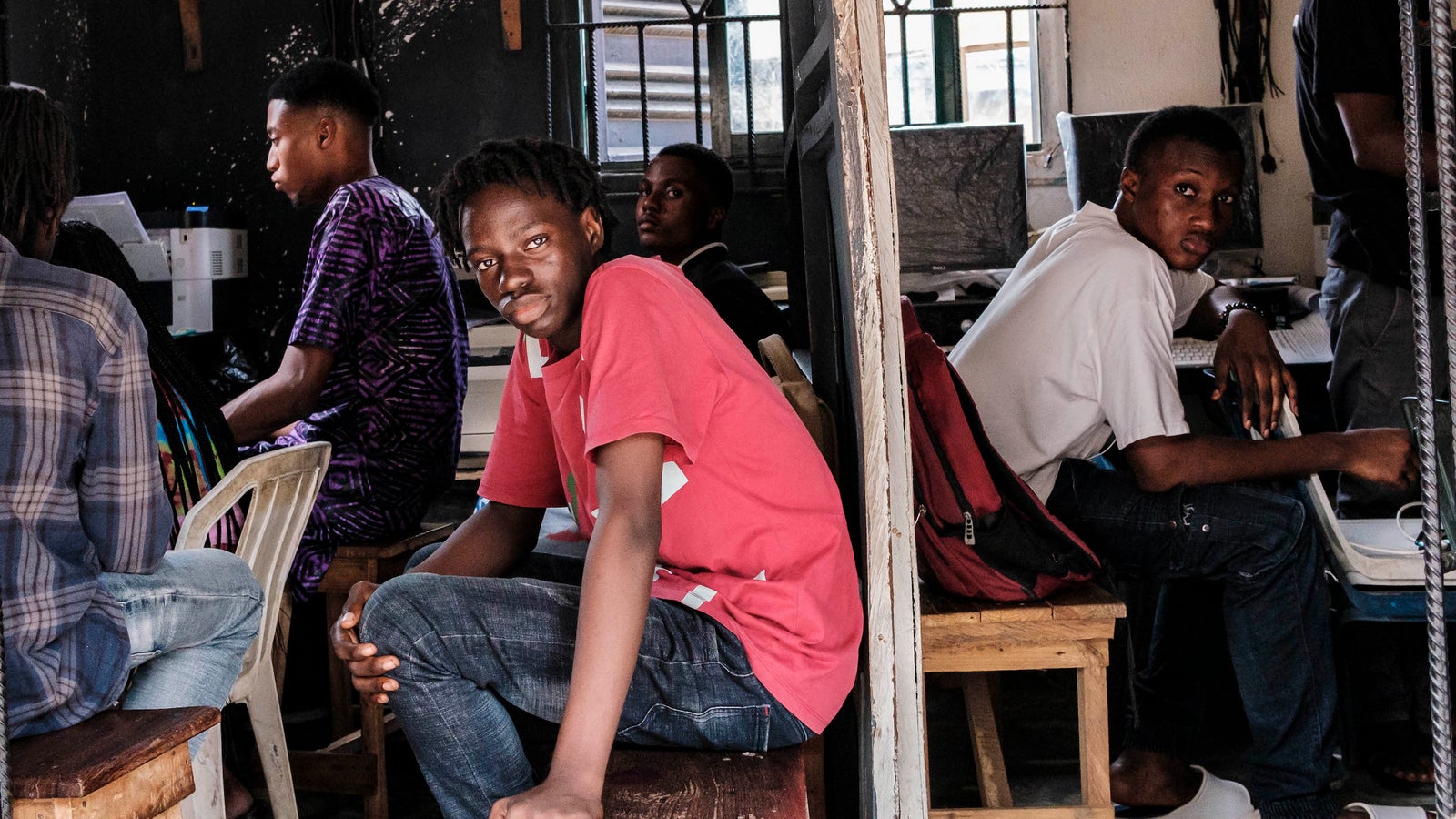
Some customers show up as early as 9 a.m. They’re greeted by Olorunseye Michael, 19, who started at D-TEE as an “apprentice” and is now spending a year here as an employee. Despite the growing prevalence of smartphones and cheap internet access, low-income families without personal computers send their children to internet cafes like D-TEE to learn basic computer skills such as typing, browsing, filling forms online, and designing graphics. These apprentices leave with a skill that helps them make a living. “I decided to learn computer skills because I have an interest in it,” Michael told Rest of World. “Now, people give me design jobs, I do them and they pay me.”
Owner Mustapha Babatunde started working in internet cafes after finishing high school in 2007, and founded D-TEE three years later. “Back in the day, if you wanted to do anything, you must enter a cybercafe. People bought time for the entire day, betting and playing games online,” he told Rest of World.
Babatunde said that over 50 students have graduated from his apprenticeship program. He also trains bank staff on software, prints banners for the local church, and registers high school students for university qualifying exams.
He knows the glory days of internet cafes are over. “Now that there are smartphones, everything is going down. It’s not that they don’t buy time now — they are still buying time — but it’s not like before,” he said.
Even though D-TEE still gets roughly 50 customers daily, Babatunde said that business is declining — and not just because of cheap mobile data. Some of his biggest problems are an unreliable power supply and rising fuel prices. “We barely have electricity. In a day, we get an hour or two of power and some days, we don’t get any at all,” he said. “But when fuel was around 120 naira [13 cents], we were still coping, but now it’s over 500 naira [64 cents] per liter and it is very difficult to get by. I can’t turn on the generator for people that want to use the internet for only an hour or two.”


-
Olutunde keeps fuel around to power the generator when the electricity goes out. -
Customers wait in the cafe for their passport photos. -
A man hauls goods outside the cafe.


Jef Authentic Associates
Ojo
Ozioma Ezeofor, a mother of three, starts her day at 5 a.m. She feeds, dresses, and prepares her children for school, then gets to her internet cafe by 8 a.m., where university students are already waiting to be let in.
After working for a university ICT center in eastern Nigeria, Ezeofor founded Jef Authentic Associates, an internet cafe inside Lagos State University, in 2015. Since then, the cafe has served university students, staff, locals, and residents of the nearby post-service army housing development. Jef sits among a cluster of similar internet cafes, as well as a canteen, a stationery store, and a concessions stand.
Internet cafes are a mainstay in Nigerian public universities for students who need printing and photocopying services. They also serve as useful backups: When the power goes out at the university, the staff come to the internet cafes.
Even though there are eight other internet cafes in the vicinity, Ezeofor told Rest of World her cafe still pulls in about 30 customers every day. Stable electricity from the university means she spends less on alternative power supplies. But she has other struggles, such as unreliable mobile data connections. “There are some times I will have customers but I will be having issues with your data connection,” she said. Financing a 250,000-naira ($320) Epson color printer is also challenging.
Ezeofor doesn’t feel threatened by the uptick in mobile phone ownership — she said it makes her job easier. “Now that [they] can use [their] smartphone to send files, the business has improved. It makes my work faster and easier,” she said. “Most of them still don’t own a printer; they can use their phone to do some of the things but when it comes to printing, they will still run to us.”
Although she acknowledges the internet cafe industry is past its prime, she believes there will always be a space for them in Nigeria. “Even if these customers reduce, some people will still rely on us for our services,” she said.

-
Two students wait for their turn to use computers at the cafe. -