María Fretes, a Paraguayan social worker, had long wondered about the lives of imprisoned women in the country. Then, one day in November, many of her questions were answered by Eva, an artificial intelligence-powered chatbot based on a woman in prison she’d never met.
Eva, created by El Surtidor, an independent multimedia news outlet in Paraguay, is trained to respond to questions from people like Fretes by a team of journalists and user experience designers. Since its launch in September, Eva has logged more than 15,500 interactions in Paraguay.
“I enjoyed asking it intimate questions — things I’d never dare to ask anyone in person, like why she is in prison or why she did what she did,” Fretes told Rest of World.
The initiative highlights the technical and legal challenges of entwining AI with an ongoing criminal case. The woman who inspired the Eva chatbot is awaiting sentencing for international trafficking and organized crime; the El Surtidor team withheld her name and any identifying details to protect her safety and privacy.

Eva is also a test to see if an AI chatbot can help shine a light on the plight of imprisoned women in the country — many of whom are portrayed by local media as hardened criminals, and neglected by society. The bot could help expedite justice by drawing attention to the cases of incarcerated women who are either ignored or disparaged by mainstream media, human rights experts and defense attorneys told Rest of World.
“We wanted to build empathy between the audience and a segment of the population that’s largely invisible and excluded from mainstream media,” Juliana Quintana, a reporter at El Surtidor who worked on the project, told Rest of World. “It was a challenge.”
In Paraguay, women make up more than 5% of the incarcerated population. Of these, 41% are serving sentences for drug-related offenses, according to the Mechanism for the Prevention of Torture, a state-funded agency that operates independently, and oversees prisons and detention centers in the country. Many of the women come from impoverished communities, and some are single mothers, but all “are the final link in the drug trafficking chain,” says the website for Eva.
Often, women living in extreme poverty in Paraguay — one of the largest producers of marijuana in the southern hemisphere and a smuggling haven for cigarettes — have little choice but to ferry drugs for large criminal syndicates, human rights experts told Rest of World.
In 2022, Quintana visited El Buen Pastor, a former convent-turned-women’s prison in Asunción, Paraguay’s capital, while investigating incarcerated women and drug trafficking. There, she met the person who would later become the inspiration for the chatbot. Quintana spent three months interviewing her, recording details about her daily life behind bars: where she slept, what she ate, how she filled her time.

Quintana, who was interested in whether Eva faced abuse from the guards, and if she was able to access basic rights such as good nutrition, health care, education, and family visits, recorded answers to 54 questions. She organized these into narrower categories, and then into a flowchart — a visual representation of the story’s branching narrative, according to Sebastián Hacher, who was part of the team that developed the UX design for the chatbot.
Hacher, an Argentine journalist who has spent the last five years developing chatbots, used a low-code tool that enables the chatbot to understand what the user is asking, and automate responses. This allows Eva to understand nearly anything a user might ask, he told Rest of World.
Eva “is the most accurately reflected interview of my career,” Hacher said.
The bot is equipped with 54 preprogrammed responses to user inquiries. With the help of ChatGPT, Eva can interpret up to 24 different ways of phrasing questions on certain topics, Hacher said.
“AI is there to help Eva understand the user,” he said.
The team decided not to let the bot generate its own responses in order to avoid hallucinations — a term used to describe AI models fabricating details, or drawing conclusions inconsistent with reality or the protagonist’s actual experiences.
“It’s a snapshot of [Eva’s] case. It doesn’t evolve,” said Quintana. “AI isn’t the star here — Eva’s story is, along with the irony of the absurd war on drugs,” she said, referring to the decadeslong fight against the production, smuggling, and sale of illicit substances, which has led to the incarceration of thousands of women on trafficking charges, while those running criminal syndicates regularly elude the law.
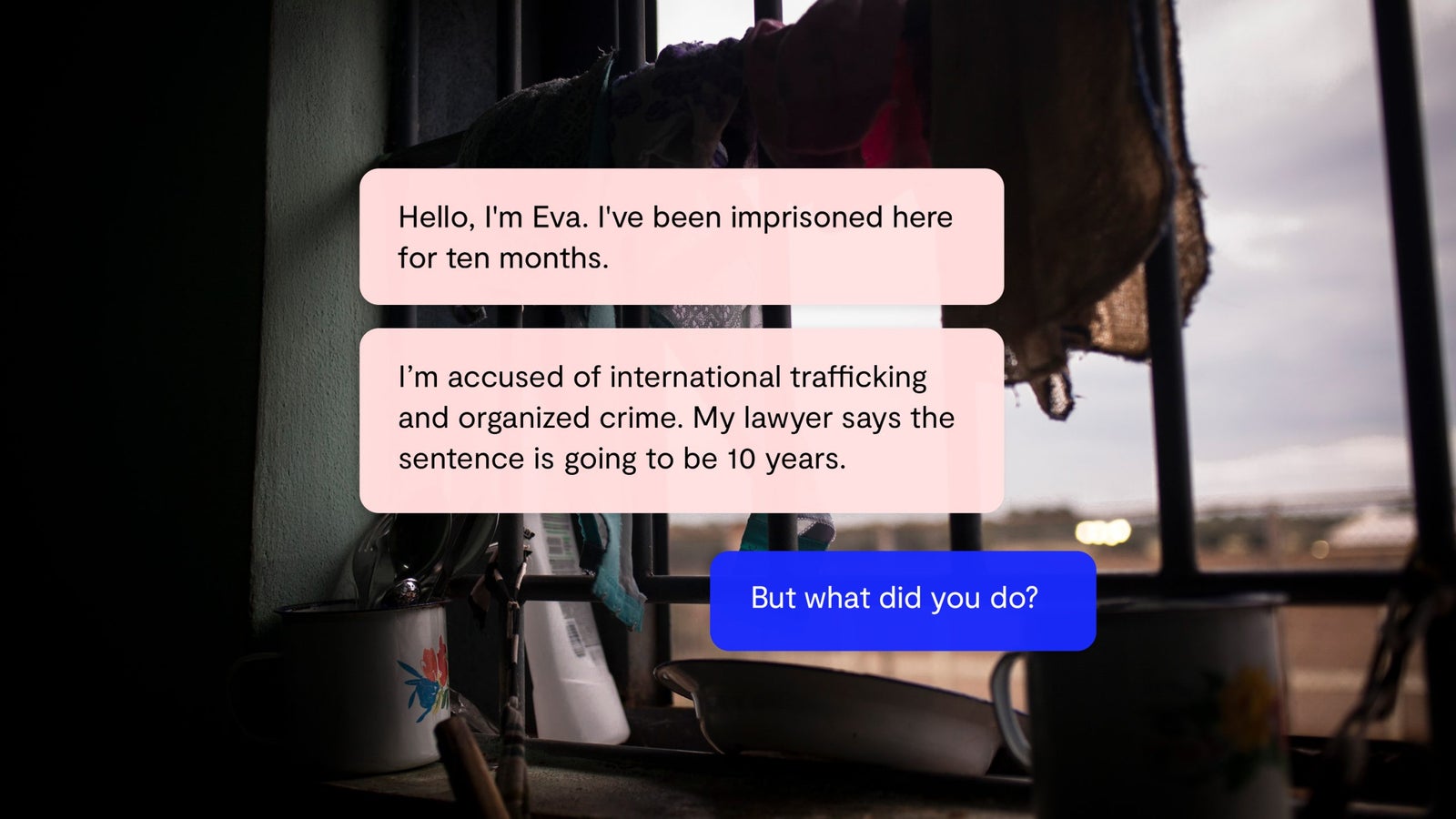
Eva is direct, polite, and emotional, Fretes said. She introduces herself by saying she’s accused of international trafficking and organized crime, but that she “can’t accept something that doesn’t belong to me.”

If a user uses insults, the chatbot encourages respectful dialogue. After a third insult, however, the chatbot ends the dialogue, saying she prefers to avoid “hurtful comments.” If a person displays renewed interest in her story, Eva continues, sharing that she is studying law and hopes to “fight for women’s rights, as well as their responsibilities.”
Eva is different from other AI-powered chatbots that have mushroomed worldwide.
“Most chatbots are designed to serve big corporations or the state,” Maricarmen Sequera, a Paraguayan lawyer and member of the nonprofit Tedic, which specializes in the intersection of human rights and technology, told Rest of World. Eva, she said, is meant “to spread knowledge.”
Elsewhere in the region, AI has been used to generate adult images of hundreds of children who were kidnapped by the military dictatorship in Argentina, while courts in Buenos Aires use ChatGPT to help draft rulings.
The way that Eva is used “serves to enrich public debate, moving away from the stigmas and stereotypes that surround coverage of the drug issue,” Miguel Montes Camacho, director of the Gabo Foundation’s Fund for Research and New Narratives on Drugs, told Rest of World.
The team at El Surtidor used a $5,000 grant from the Gabo Foundation to build Eva. It is currently working on a bot with details of lands captured during Paraguay’s dictatorship from 1954–1989, when the military regime handed over around 8 million hectares — roughly the size of Panama — to allies and officers’ relatives. The bot has been automatically replicating information from the database on its X account every day.
Eva, meanwhile, continues to have an impact: In December, the Paraguayan Ministry of Public Defense and the EU’s cooperation programme with Latin America on drug policies announced new measures to protect women incarcerated for minor drug offenses.
For Quintana, the response to Eva has been surprising.
“We wanted to challenge the big stigmas, like the assumption of guilt,” she said. “We expected comments like, ‘She deserves to be there for what she did,’ but the overwhelming majority of interactions delved deeper into her story and followed it to the end.”