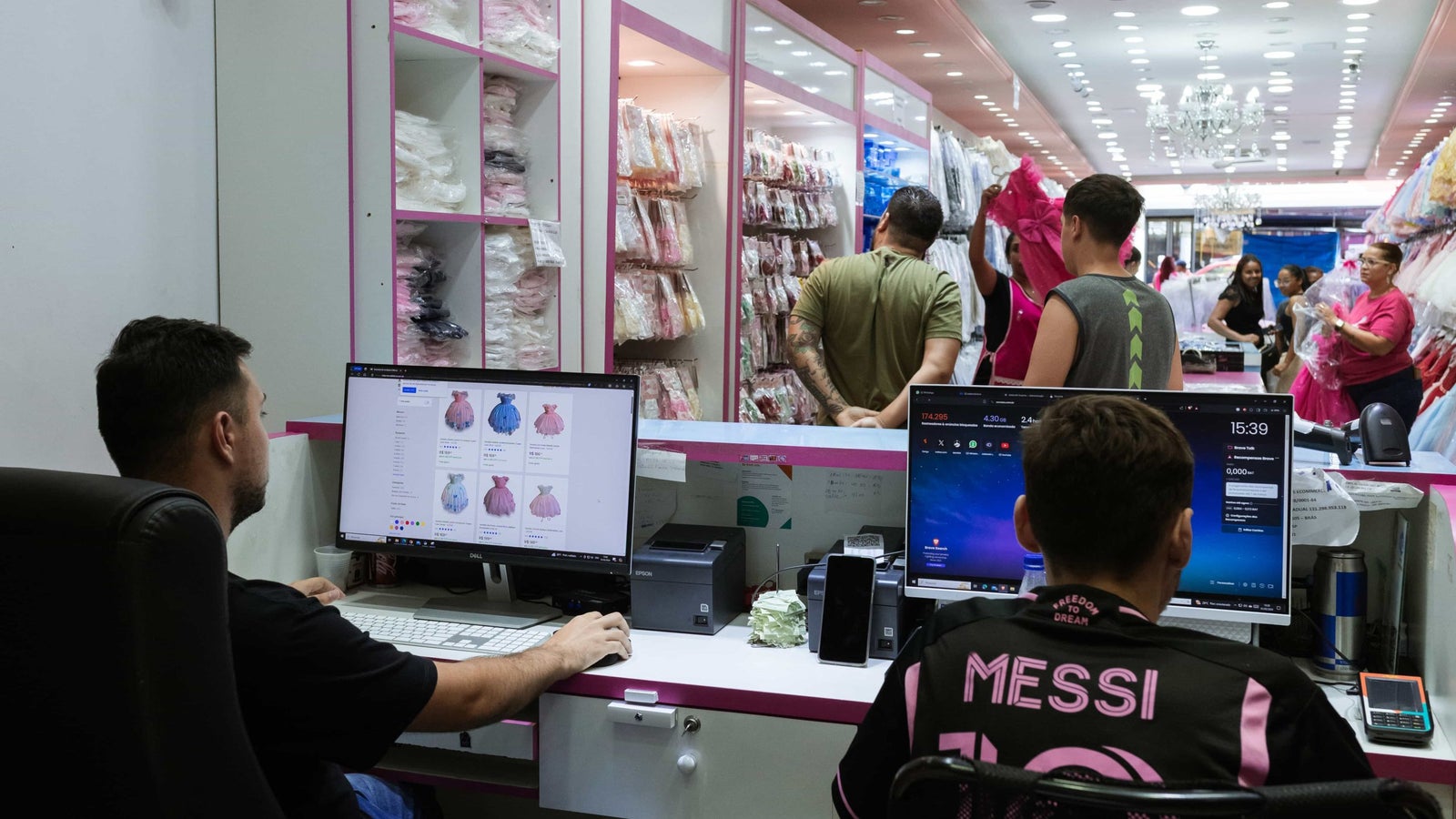
One morning last July, Silmara Alves was working at her apparel shop in Brás, Brazil’s largest garment district, when an unusual visitor showed up. The man, who described himself as a SheinSheinFounded in China in 2008 and headquartered in Singapore, Shein is a fast fashion brand that grew rapidly through exposure on social media.READ MORE employee, said he had an irresistible offer.
Would she be interested in selling her products on the Chinese fast-fashion retailer’s marketplace? If she said yes, the stranger said, she’d be entitled to 90 commission-free days. Having struggled to take her business back to pre-pandemic levels, Alves signed up.
A few months later, a representative from MercadoLibreMercadoLibreFounded in Argentina in 1999, MercadoLibre is an online marketplace that also owns Mercado Pago, a leading payment and financial services app in Mexico and Argentina.READ MORE, an Argentine online retailer, also stopped by her counter to say the platform would be taking on new vendors soon. He promised to come back with more information.
Alves is one of hundreds of vendors at Brás — a massive cluster of 5,000 stores spread out across 55 streets in central São Paulo — who are being courted by the two e-commerce giants eager for a slice of the markets’ multibillion-dollar annual cash flow. For MercadoLibre and Shein, Brás has become a testing ground for vendor recruitment, with the companies increasingly embellishing their onboarding packages to lure more merchants.


As many as 65% of Brás’ vendors have not yet started selling online, according to a representative from the association of Brás vendors who told Rest of World there is a $3 billion annual financial turnover at the district. The untapped market remains immense. “Brás is under dispute,” Lauro Pimenta, who manages his family’s 30-year-old business at Brás, told Rest of World, referring to the race between the two online marketplaces.
During peak shopping seasons, such as Christmas and Mother’s Day, the market sees some 300,000 buyers daily. For decades, vendors — many of them immigrants from South Korea, China, and Bolivia — sold their products face-to-face. When the pandemic hit and the local government ordered stores to shut their doors, most sellers were caught off guard, and reluctant to sell online.
Forced to look for online avenues, however, some vendors turned to WhatsApp, selling to customers with whom they already had a relationship. Others experimented with Instagram. A few looked into launching websites. Soon, foreign marketplaces discovered Brás’ untapped potential.


Shein arrived first. In 2022, it announced a pilot project for its online marketplace in Brazil, which was officially launched the following year, according to a company spokesperson. By November 2023, Shein had drawn 10,000 Brazilian sellers across the country onto the platform, the company said. It grew rapidly inside the garment district by sending recruiters to stores and offering vendors attractive commercial conditions, such as an initial 60-day commission-free period.
The platform currently offers no commission on sales during the first 30 days, a 16% commission afterward, and free delivery for orders above $14. It also gives vendors guidance and training for sales optimization and an “exposure boost” for the first 21 days a product is on the platform. Shein holds regular sessions inside the garment district to attract new sellers.


Last month, Lucas Nascimento, Shein’s commercial manager for marketplaces, gave a talk at the district titled “From Brás to Brazil — how to become a successful vendor on Shein.”
Mercado Livre, the Brazilian branch of Argentina’s MercadoLibre, landed at Brás in June last year. Not to be outdone by its rival, the company began offering vendors access to an in-person consultant for a three-month period, high-quality pictures of products, free delivery for orders above $16, and also facilitated drop-off points, according to a company spokesperson.
The company also set up a facility inside the garment district where vendors who sell their products on its platform can speak to e-commerce consultants and drop off garments to be professionally photographed at a studio with a model, stylist, and makeup artist.


“They’re giving us lots of assistance; you can drop off the looks, and they take standardized pictures,” said Pimenta, adding that Mercado Libre also helps vendors with ads.
Neither Shein nor Mercado Livre responded to questions about the number of vendors each company has at Brás.
The offers from the two companies are so competitive that some vendors have given up trying to decide between marketplaces and joined both. Paulo Terensi, who sells children’s clothing, has listed his products on Mercado Livre, Shein, Shopee, Magazine Luiza, and Americanas. His online and in-store sales are now nearly identical, he told Rest of World. “It was what kept us afloat.”

In October, the Brazilian government launched a new tax compliance program in response to local retailers’ complaints of unfair competition from foreign rivals. Under the program, taxes on imported products paid by consumers were standardized, and purchases below $50 became tax-free for the companies that adhered to the program. Shein opted to cover the taxes its consumers would have to pay. While the program was meant to level the playing field, Shein gained a competitive advantage through it, said Pimenta.
Meanwhile, the pressure to digitize grows — while conditions for veteran vendors deteriorate.
After Shein’s initial offer lapsed, apparel shop owner Alves said her costs increased substantially. Worse, she added, the Chinese retailer recently introduced an auction where vendors haggle with the platform to set the price of a garment. “There are offers I can accept, but some are below my cost of production,” she said.
Despite slow sales in March, her products remain for sale on Shein. For now, Alves is not planning on joining other marketplaces, even if they offer her enticing terms. She simply doesn’t have the time. “Everyone thinks you just upload a picture of your product, and it’s done,” she said. “You have to learn the strategy of the platforms.”