A Vietnamese military-owned company has quietly become one of the most ambitious state-backed technology firms in the world.
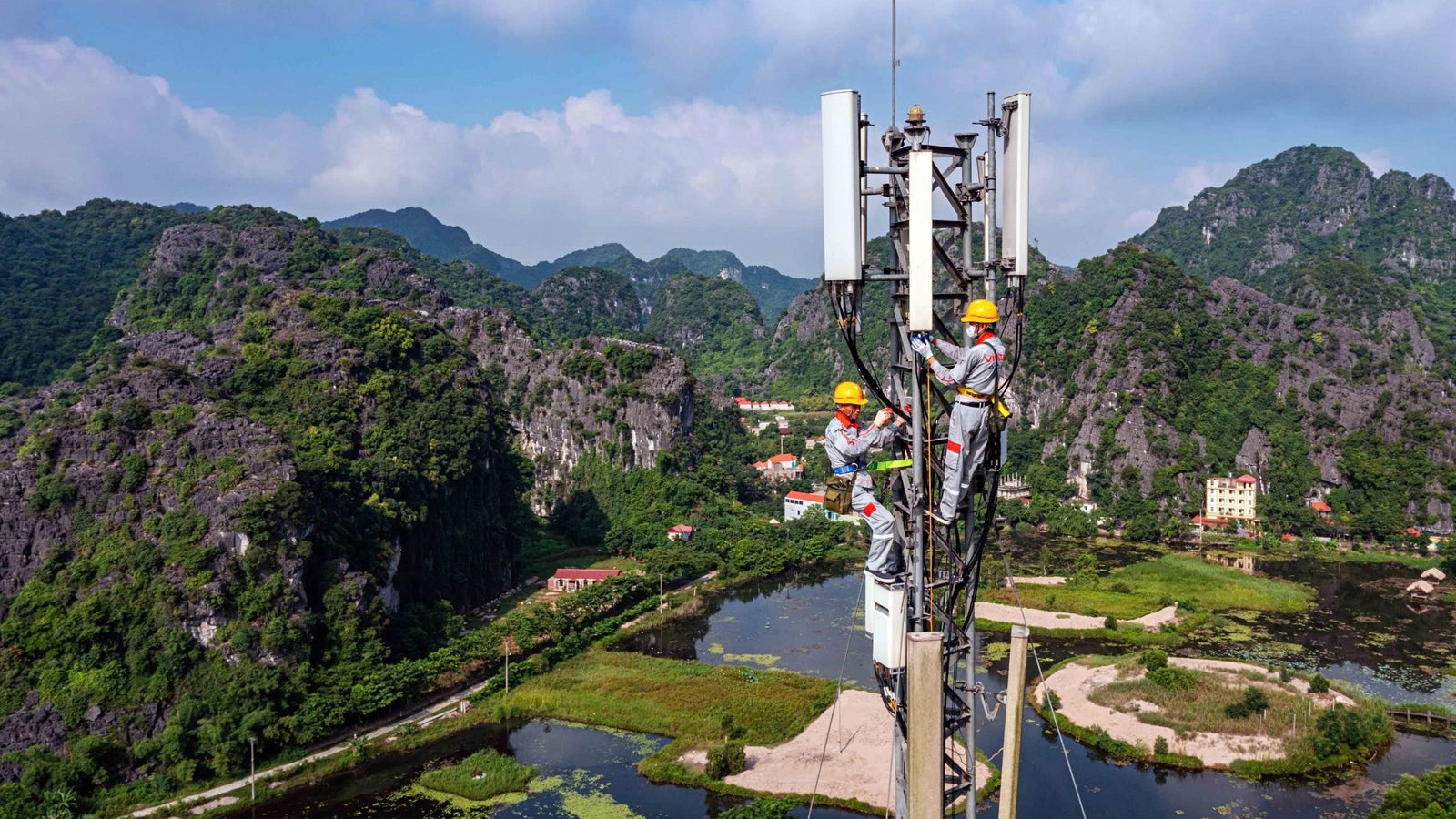
Viettel, launched by Vietnam’s Ministry of National Defense in 1989 to build antenna towers, is now the country’s largest telecommunications firm. Its businesses include 5G hardware, surveillance technologies, affordable mobile phones, and even robotics. In 2024, its revenue was $7.2 billion.
Viettel holds 30 U.S. patents and operates subsidiaries in 11 countries across Asia, Africa, and Latin America. Now, it’s leading Vietnam into the artificial intelligence era.
On August 11, Viettel signed a partnership with South Korean telecommunications major KT Corporation to promote the research and application of AI in Southeast Asia. The partnership includes a plan to develop a Vietnamese AI language model.
While much of Viettel’s success is often attributed to its proximity to the Vietnamese military, experts say the company’s early push into rural markets, focus on R&D, and its ability to retain talent make it a contender in the global race for chipmaking, AI, and electronics manufacturing.
“Viettel is making Vietnam a significant player in the global tech arena and truly a household name,” Lynne Gadkowski, economic counselor at the U.S. Embassy in Vietnam, said at an event last November.
When it first launched, Viettel was named Sigelco. The company built antenna towers and installed microwave transmission lines, laying the foundation for Vietnam’s telecom industry. By 1995, it became Vietnam’s second telecom operator, following state-owned enterprise VNPT, and was renamed Viettel.
Over the years, Viettel’s expansion went hand in hand with Vietnam’s growing telecoms and internet infrastructure. In 2000, the company began offering voice-over-internet services. Two years later, it became an internet service provider. In 2003, Viettel added landline telephony, and launched its mobile network the following year, helping popularize mobile phone usage across Vietnam.
In 2011, Viettel’s pre-tax profit reached nearly $1 billion. A year later, it overtook VNPT to become Vietnam’s top telecommunications company by revenue.
Viettel has captured the biggest market share in the telecom market not only in Vietnam but also in Myanmar, Cambodia, Laos, East Timor, Burundi, Haiti, and Mozambique. Viettel Global, the international business arm, earned $1.3 billion in revenue in 2024, and reached a breakeven point in six markets.
This growth, however, has come with a pinch of skepticism. Viettel’s Myanmar subsidiary, MyTel, has been criticized for allegedly acting as a tool of surveillance for the military junta. A human rights group, Justice for Myanmar, has accused MyTel of providing the military “a lucrative source of off-budget revenue and a means to access international communications technology and credit.” Viettel did not respond to Rest of World’s request for comment on the allegation.
Viettel has launched mobile money solutions in Mozambique, Burundi, Myanmar, and other countries. As of 2024, 23.2 million people worldwide use its e-wallets. The company says it has helped restore damaged telecom infrastructure and offered relief after natural disasters, like the recent earthquake in Myanmar and Cyclone Idai that struck Mozambique in 2019.
Viettel serves a “vital defense and security function” for the Vietnamese military establishment, Carlyle A. Thayer, a Vietnam scholar at the University of New South Wales, told Rest of World.

Viettel supplies military-grade communication devices, drones, and missile systems to the Vietnamese army. The company attributes its progress to the “Make in Vietnam” strategy, prioritizing high-tech research and partnerships with foreign companies that are “ready to transfer their technology,” Viettel High Tech, the company’s R&D subsidiary, told Rest of World in a statement.
“Viettel plays a pioneering role [in Vietnam’s tech sector] by building an internal research and development model, mastering core technology and connecting the business community to spread the spirit of innovation and technological autonomy in Vietnam,” the statement said.
The company’s leadership and generous salaries have helped it retain talent, while the gradual opening of Vietnam’s telecoms market to domestic and foreign competition has further contributed to its rise, Christine Ngoc Ngo, an economist who has studied Viettel, said in a research paper published by the Vietnam Institute for Economic and Policy Research.
The company’s success can also be attributed to its focus on reaching the rural areas of Vietnam, where the majority of the population resides.
Viettel’s heavy investment in technology and infrastructure, at a time when hardware costs were falling, has allowed it to remain competitive on price while reaching remote, rural populations, according to research by Nguyen Manh Hai, senior researcher at the Central Institute for Economic Management in Hanoi, and Michael O’Donnell, a professor of human resource management at UNSW Canberra.
“This enhanced its reputation for service, quality, and cost among the rural population, who account for approximately 70% of the total in Vietnam,” they wrote.
Since 2006, Viettel has applied the same strategy internationally in countries with an underdeveloped telecom infrastructure.
“Instead of starting in the big cities, they went to the countryside,” where most people did not have telecom services, according to Francisco Mobila, a telecoms engineer who has studied Movitel, Viettel’s telecoms subsidiary in Mozambique. “So by doing that, they managed to, in very few years, have more customers than the two other companies together,” he told Rest of World.
Viettel “operates in some of the most difficult and challenging markets in the world,” Julian Gorman, head of Asia-Pacific at GSMA Intelligence, a global trade body representing mobile network operators, told Rest of World at a press conference in Hanoi. “Viettel has shown that it is not just a large-level operator, but it is a successful operator in some of the harshest operating conditions in the world.”
Viettel’s international expansion has been big enough to allow it to “test, evaluate and consume our products,” and the exports have “formed the basis for Viettel to confidently affirm its position in the global supply chain,” Viettel High Tech said in its statement.
In 2022, Viettel High Tech started developing an open radio access network for 5G, based on U.S. company Qualcomm’s chipset. Viettel and Qualcomm engineers collaborated to research, design, and set up 5G base stations in 2.5 years — half the industry standard and considered a record. The “Open RAN” system allows companies to build 5G networks with parts sourced from different suppliers rather than one company.
Viettel’s 5G launch in November last year was the first for Qualcomm in the 5G Open RAN segment. According to Gadkowski, “the United States is dedicated to supporting Vietnam’s digital ambitions,” and a partnership like Qualcomm and Viettel’s “strengthens the bonds between our two countries.”
The deal exemplifies Viettel’s diverse choice of partners. In June, Viettel signed a strategic agreement with HuaweiHuaweiHuawei is a Chinese technology company focused on mobile phones and telecommunications, and is seen as a poster child for China’s global tech ambitions.READ MORE, and plans to work on developing 5G and 6G networks — a significant shift from 2019, when the company told Bloomberg it had avoided working with the Chinese telecom giant over safety issues. Simultaneously, Viettel continues to collaborate with Qualcomm and European firms Nokia and Ericsson in telecom and other tech sectors.
Viettel’s 5G base stations have already made their way overseas: The company said it has signed million-dollar contracts with clients in India, the Philippines, and the United Arab Emirates.
Qualcomm’s strategy is to support Viettel in its international expansion. “We will give the priority to Viettel and Vietnam to introduce their solutions for the emerging countries,” O.H. Kwon, senior vice president and president for Asia-Pacific at Qualcomm, told the media at Viettel’s 5G launch in Hanoi last year.