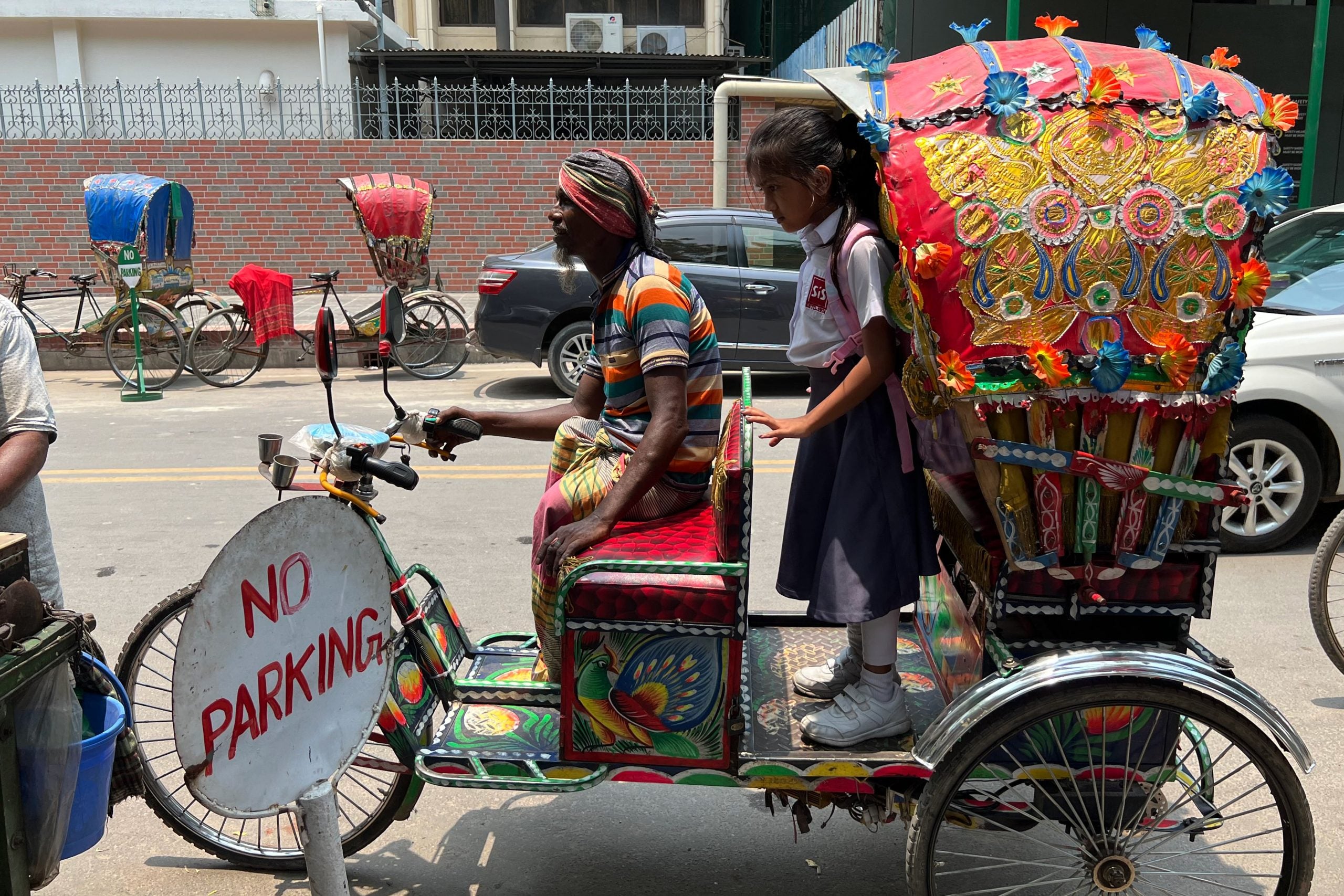
On a scorching summer day last month, dozens of electric three-wheel vehicles — adorned with their signature bright canopies and vibrant paints — flooded the streets of central Dhaka.
This was a “victory rally,” Kamal Hossain, 39, who participated in the event, told Rest of World. It marked the end of a “hard-fought” battle, he said. The crowd was celebrating Prime Minister Sheikh Hasina’s decision to introduce laws to govern the battery-powered three-wheel vehicle, locally called an e-rickshaw.
For the past six years, Hossain has been making a living by driving passengers in his e-rickshaw. But he constantly faces the threat of being fined by traffic police or having his e-rickshaw impounded because the vehicles are illegal in the country.
In 2014, the Bangladesh High Court rejected a plea to legalize e-rickshaws. More recently, in May, Minister of Road Transport and Bridges Obaidul Quader ordered authorities to remove all e-rickshaws from Dhaka.
Quader’s order triggered protests by owners and drivers of the vehicles in the capital city, and, a day later, the government changed its stance.
“We have long been asking to make these e-rickshaws legal,” Hossain said. “They are fast, and, most importantly, they spare us the sheer physical strain of pedaling a traditional cycle rickshaw.”
There are between 2 million and 4 million e-rickshaws in the country, which have operated without any regulations or monitoring. Once the new regulations come, e-rickshaws will rule Bangladesh’s roads, according to experts who have studied the vehicle’s usage. However, the government must set standards for its design to ensure passengers’ safety and address the issue of illegal charging infrastructure.
“In a country like Bangladesh, and in a city like Dhaka, it is not possible or feasible to remove rickshaws from roads,” Saimum Kabir, an assistant professor of architecture at Brac University, who has conducted several studies on rickshaw architecture, told Rest of World. “E-rickshaws are obviously an improved version of traditional manual ones, and it’s better to concentrate on how to make these rickshaws safer and more sustainable instead of banning them, which will not work.”
Minister Quader told Rest of World that his team is finalizing policies to regulate e-rickshaws. “Every problem has its solution,” Quader said. “Millions of people are engaged in pulling these e-rickshaws, and our prime minister now permits them to operate on humanitarian grounds. Therefore, we will soon establish laws to regulate them.”
The upcoming policy must specify the distances and areas that e-rickshaws can operate in to reduce risks for passengers, transportation expert Shamsul Hoque, former director of the Accident Research Institute of the Bangladesh University of Engineering and Technology, told Rest of World.
On main thoroughfares and highways, they appear as nuisances because of their slow speed and fragile frames.”
The vehicles are designed to ferry people over short distances, “but if you are using it for long distances, then they pose an accident hazard,” Hoque said. “Also on main thoroughfares and highways, they appear as nuisances because of their slow speed and fragile frames. So the policy must mention in which areas they can operate.”
He added that the policy should also set a design standard for e-rickshaws. “We see regular cycle rickshaws are converted into e-rickshaws with a battery and a motor,” Hoque said. “These rickshaw chassis weren’t engineered to withstand the high speeds at which battery rickshaws are often driven, increasing the risk of accidents.”
The lack of laws has led to e-rickshaws being manufactured at makeshift workshops by untrained mechanics. This has priced out organized manufacturers in recent years.
Beevatech, a pioneer in e-rickshaw manufacturing in Bangladesh, started selling these vehicles 14 years ago. Lately, the company has reduced e-rickshaw production, as it cannot compete with the low prices that unorganized players offer, Saidur Rahman, Beevatech’s managing director, told Rest of World.
The company’s models cost at least double a similar vehicle made in an informal workshop, he added. The company is now focused on selling electric minivans, golf carts, and small trucks.
Rahman said the new regulations will “formalize the sector” and “a lot of large manufacturing companies will come into the business, and this will be good for the whole economy.”
Mustafiz, who did not wish to disclose his last name, to protect his privacy, runs a makeshift e-rickshaw workshop in Basila on the outskirts of Dhaka. His workshop, which churns out 70 to 80 e-rickshaws each month, is bare-bones: nearly concealed behind a cattle farm, with a few sets of Chinese welding machines, air compressors, hydraulic jacks, and battery analyzers.
An e-rickshaw made in this workshop sells for around 90,000 takas (roughly $760), Mustafiz told Rest of World, adding that the workers at his facility have learned how to make these vehicles through old manuals and YouTube videos.
“Building these rickshaws isn’t difficult,” Mustafiz said. “We’ve been making cycle rickshaws for years and are now adapting that design, making it a bit larger, wider, and stronger to handle the higher speeds.” Mustafiz’s e-rickshaw can go as fast as 25 kilometers per hour.
One reason why manufacturers like Mustafiz can sell their vehicles cheaper than Beevatech is that their workshops run on electricity connections that have been illegally obtained by paying bribes to local utility officials, he said.
Getting a new commercial electricity line requires a lot of paperwork and a proper license, which Mustafiz cannot get because e-rickshaws are illegal, he added. But once the battery-run rickshaws are legalized, he will opt for a larger workshop, Mustafiz said. “I will expand my business, as there will be a lot of demand [for] new rickshaws. I will also apply for commercial electricity lines,” he said.
For thousands of workers who make a living by driving e-rickshaws, the new policy would be a “lifesaver,” Khorshed Alam, owner of e-rickshaw workshop Jihan Motors, who also leads an association of e-rickshaw owners in Dhaka, told Rest of World.
For Mohammad Kalu Mia, a former mini-truck driver who lost both legs in an accident six years ago, e-rickshaws have been a boon. “My only skill was driving. But without legs, I thought that was impossible,” he told Rest of World. The e-rickshaw is “perfect,” the 54-year-old said, because it’s all about hand controls.