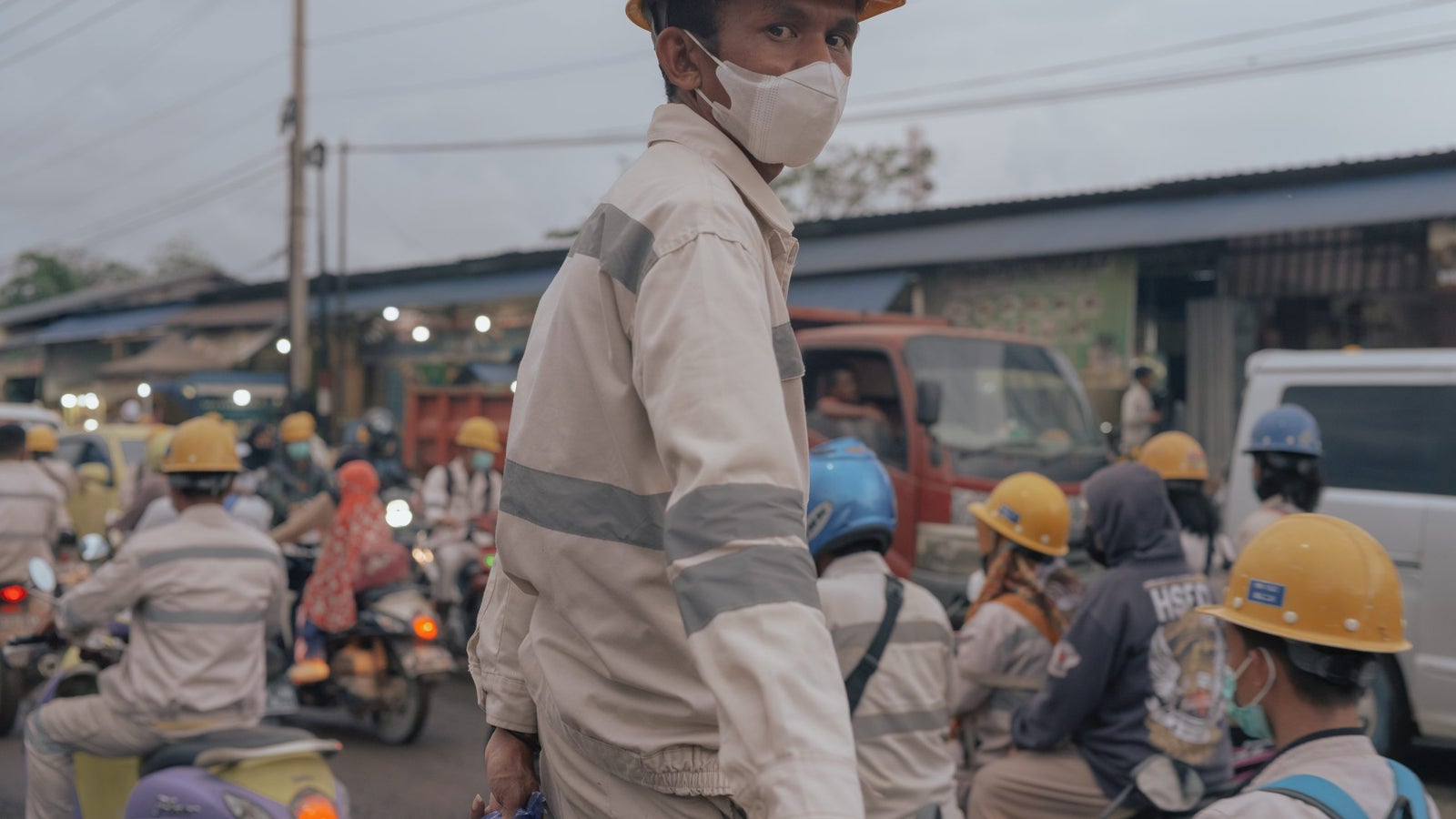
At 6 a.m. on January 14, the sun was starting to rise over North Morowali’s forested, nickel-rich hills. As Arif arrived at the sprawling nickel smelter where he worked, a handful of his co-workers had gathered to protest against their working conditions. The trigger had occurred a month earlier, when a furnace had blown up, engulfing a crane in flames and killing two workers trapped in the cabin. Arif felt a tug of sympathy at the strikers’ demands. But as a non-union member, he only paused before continuing through the gates.
By the afternoon, however, the protest exploded. The management at Gunbuster Nickel Industry (GNI), a local unit of the China-based Jiangsu Delong Nickel Industry, had refused a meeting, and protestors began to throw stones at the buildings. By the time some 500 local police and military personnel had descended to quell the riot, the Chinese workers’ dormitories, along with a number of vehicles, were ablaze. As Arif tried to get back to his living quarters, he felt his eyes begin to burn: tear gas. “After the police released the tear gas, my eyes couldn’t take it any more,” Arif told Rest of World, speaking under a pseudonym as he feared reprisal from his employer.
By the end of the day, two workers were dead — one Chinese, one Indonesian — and more injured, with dozens of Arif’s colleagues arrested.
These incidents are rising in Indonesia’s nickel heartland as workers do a dirty, hazardous job, battling the fear of death by industrial accident on the poorly monitored fringes of Indonesian territory. Recent news reports have documented a rising death toll across the mines and smelters of Sulawesi province. In March, four more miners who worked for Total Prima Indonesia were smothered in a landslide; in April, two people were buried under nickel waste at a processing plant at the massive Indonesia Morowali Industrial Park. These grisly deaths are a culmination of exhausting work conditions and weak safety measures, experts and four current and former workers told Rest of World.


“It’s like a ticking bomb that can explode at any time,” said Melky Nahar, an activist with Mining Advocacy Network. “We’re creating a ticking time bomb because we let these problems build up.”
GNI declined to comment on questions from Rest of World, while a spokesperson for Indonesia Morowali Industrial Park did not respond. A press statement from the park’s management in March said that “safety and health is the first priority.”
If China is the leading light for what the electric vehicle industry could be — mass-produced cars, effective policies, and a seamless supply chain — then Indonesia aims to provide the fuel that keeps that light burning. Nickel is a key ingredient for making stainless steel and EV batteries, and Indonesia holds some of the world’s largest reserves, mostly located in the remote islands of Sulawesi and Halmahera. In just three years, Indonesia has signed more than a dozen deals worth more than $15 billion for battery and EV production, including with Chinese suppliers for EV giants like Tesla, Hyundai Motor Company, LG Group, and Foxconn. More, like Volkswagen, are seeking to secure their EV futures by jumping into the fray.
Under the Belt and Road policy, Chinese companies developed ports and roads into Morowali to secure nickel supply, while Indonesian President Joko Widodo, keen to display the country’s business-friendly reforms and wring value out of its mineral reserves, leaped at the chance to sign foreign investment agreements. Nickel production in Indonesia more than doubled between 2020 and 2022 to 1.6 million tonnes — more than 48% of the world’s entire supply.
This growth, however, has trumped safety. Between 2015 and 2022, Indonesian energy nonprofit Trend Asia counted 47 workplace-related deaths and 76 injuries across various nickel-mining sites in the country — not including the 10 Chinese workers who died of suspected suicide. Many of these incidents occurred in Indonesia Morowali Industrial Park, a vast joint venture with China’s Tsingshan Holding Group where 18 companies operate over 4,000 hectares, powered by around 71,000 Indonesian and 11,000 foreign workers. President Jokowi aims to turn the industrial park into the “world’s epicenter for nickel production.”

“If you look at it, Indonesia seems to have a very high desire to prioritize business,” said Muhammad Zulfikar Rakhmat, an expert on Chinese-Indonesian relations with the think tank Center of Economic and Law Studies. “Everything else is number two, or even three.”
Chinese ownership in the Indonesian nickel industry is extensive, though exact figures are disputed, with claims ranging from 61% to 99%. But that ownership hasn’t exempted Chinese workers from concerning treatment, either. Over February and March, five Chinese workers filed claims to Indonesia’s human rights commission, alleging human rights violations in Morowali Industrial Park and in PT Virtue Dragon Nickel Industry, an Indonesian-Chinese nickel joint venture.
Airlangga Julio, the lawyer representing the Chinese workers, told Rest of World that the workers allege exploitative working conditions, detailing grueling 12-hour days with no time off, and wages withheld by employers for months on end — not to mention their passports being held so they could not leave. According to Julio, they claimed that enduring high temperatures and air pollution degraded their health, causing their lungs to feel congested, their heartbeats to race, and even memory loss.
The workers “endured a lot of physical, psychological, and financial damage,” said a statement from Amar Law Firm & Public Interest Law Office. Rest of World could not speak to the Chinese workers directly due to the ongoing nature of the case. Indonesia’s National Commission on Human Rights has conducted field investigations and will soon publish its recommendations, commissioner Anis Hidayah told Rest of World.
The rights violations claims follow a report from China Labor Watch, published in November last year. Zhou, a Chinese construction worker building a mine site in Morowali Industrial Park, was among those interviewed by the organization. He told Rest of World his year there was “hard” and full of “suffering.” He worked 11 hours a day, through bad weather and bouts of fever, despite his contract detailing a nine-hour workday. “There were no people in the mountains, and there were many mosquitos and venomous snakes. As soon as it rained, we had nowhere to hide,” Zhou said.
Every time he was sick and absent from work, including from Covid-19, his managers cut his wages, he claimed. “My salary was always in arrears.” Zhou asked to use a pseudonym due to fear of reprisal from the company.

After the January incident at GNI, Arnold Firdaus Bandu, head of the Central Sulawesi Manpower Office, met with Jiangsu Delong’s management board in Shanghai. “In January, they said they would comply with occupational health and safety norms,” Firdaus told Rest of World. “We did monitoring in April and it seems there has been progress.” He added that the company is obliged to report periodically to the labor office.
According to Arif, who still works at GNI, improvement at the smelter has been slight. “The improvement is only about 20%. They only provide additional personal safety equipment. It [otherwise] hasn’t met the standards,” he said. “We are always intimidated with threats of contract termination, so it’s hard to speak up.”
Indonesia’s command over global nickel supply could rise to over 60% by the end of the decade, according to energy consultancy Benchmark Mineral Intelligence. And the 18 companies currently operating at Morowali Industrial Park could swell to 40 by 2025, forecasts the park’s management. The “time bomb,” as Nahar from the Mining Advocacy Network called it, is still ticking.
“If it explodes one day, the risk will be borne by many parties, not just the workers,” he said.