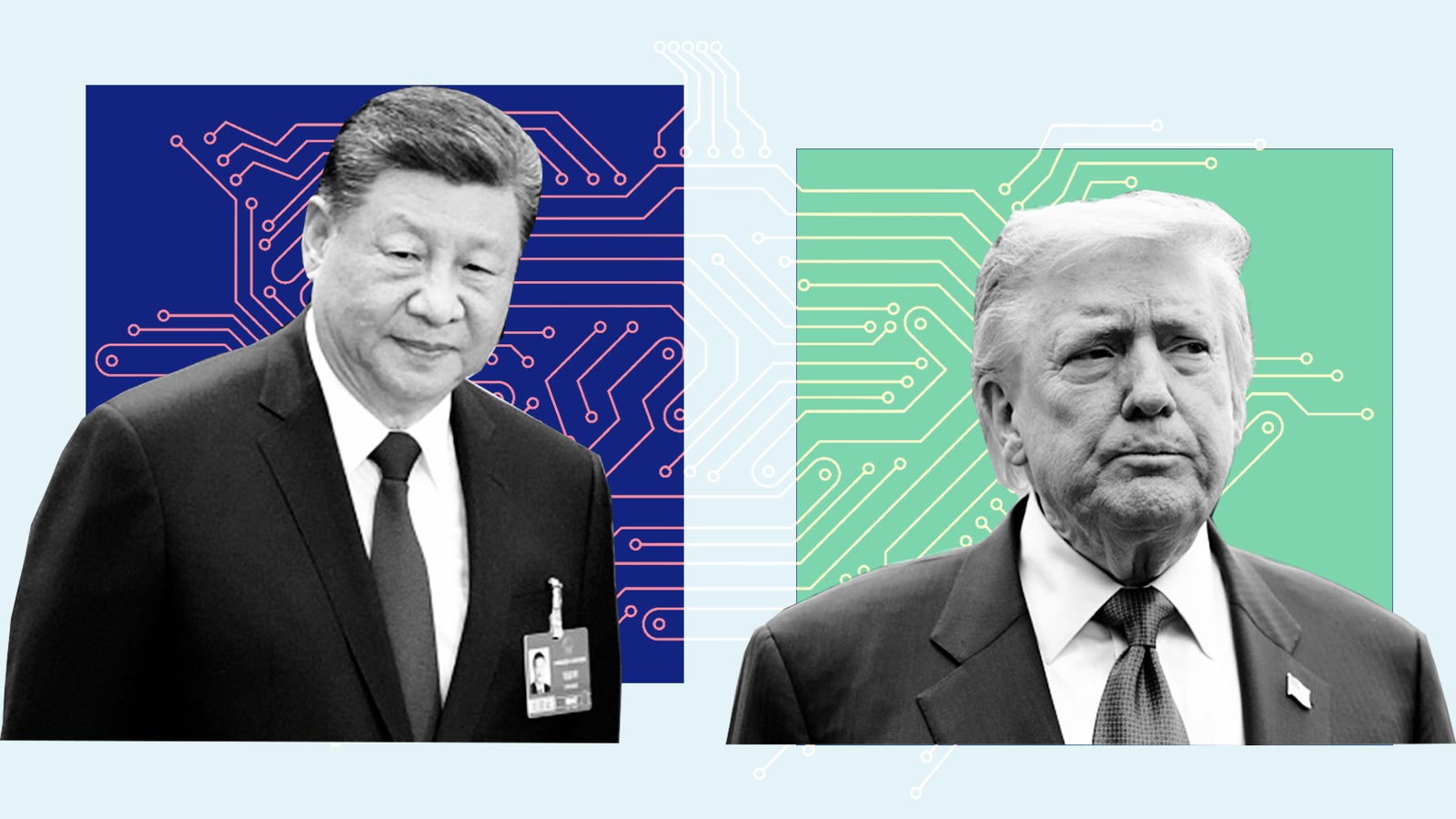
Every government aiming for sovereign artificial intelligence has roughly the same mantra: build their own ChatGPT, leapfrog into AI leadership, and be free of foreign dependence. It’s a compelling narrative, but one that’s arguably unrealistic, as a handful of American and Chinese tech firms control the AI infrastructure — from chips and large language models to cloud services and data centers.
Rising tensions between the U.S. and China, alongside fears of being left behind in the AI race, have spurred governments from Seoul to São Paulo to prioritize sovereign AI — the ability to produce AI with their own data, infrastructure, workforce, and networks — which officials say is critical to national security.
Big tech companies have responded by offering sovereignty as a service. Nvidia has made deals with countries including Thailand, Vietnam and the United Arab Emirates, while Microsoft has agreements with the UAE and others, and Amazon Web Services has a European “sovereign cloud.” Huawei, meanwhile, is courting Peru, Indonesia, and other Chinese allies.
But in entering these deals, nations risk locking themselves into long-term dependencies on foreign architectures, chips, and other export-controlled technologies that can undermine their sovereignty and their ambition, Rui-Jie Yew, a doctoral student at Brown University who researches AI policy, told Rest of World.
“There is definitely worth and merit in what the tech companies provide,” said Yew. Nvidia’s chip design, for example, is a genuine technological innovation that is valuable for countries ramping up AI infrastructure. But “are you selling your chips and calling it a day, or are you using your dominant position to bundle additional services that rope your clients into ongoing dependencies?” she said.
The bundling strategy is deliberate. The tech companies promise benefits such as faster economic growth, tighter data governance, and preservation of local languages. But they control the chips, the data pipelines, and the vast labor networks required to build the architecture.
Are you selling your chips and calling it a day, or are you using your dominant position to bundle additional services?”
For most states, sovereign AI is “a very, very expensive proposition,” Sam Winter-Levy, a fellow at the Carnegie Endowment for International Peace think tank, told Rest of World.
“States should think very carefully about what they actually want to get out of this before spending hundreds of billions of dollars trying to indigenize the entire AI stack,” said Winter-Levy, who researches emerging technology and national security. “You still won’t be able to eliminate dependencies and vulnerabilities on foreign states.”
Nvidia’s graphics processing units are the most powerful tools to train AI models, and countries are scrambling to get their hands on them. At a conference with UAE lawmakers in Dubai last year, CEO Jensen Huang said, “Nvidia GPU is the only platform that’s available to everybody,” and that the chips allowed countries to “own [their] own data.” But the chipmaker is also an essential part of U.S. President Donald Trump’s AI action plan, which is pushing American companies to export the “full AI technology stack” — software, hardware, models, applications, and standards.
Similarly, OpenAI for Countries promises to help “governments build sovereign AI capability in coordination with the U.S. government.” It has already found takers including the UAE and Estonia. Chinese heavyweight Huawei comes with its own entanglement with the government.
Few countries can afford to build comprehensive sovereign AI without these big tech firms, but some are trying. Like South Korea. With one of the most robust tech industries in the world, Korean consortiums including SK Telecom, LG, Naver, and Samsung are building AI infrastructure using predominantly domestic technology.
Yet even Korea currently trains its AI models on Nvidia GPUs and develops AI data centers with AWS. The country is investing heavily to reduce these dependencies over time, Genya Smagin, a senior AI manager at a Korean tech conglomerate, told Rest of World.
“Korea has shown the ability to execute national strategies in tech — 5G, broadband, chip industry,” said Smagin. “The same playbook can be applied to AI sovereignty.”
Other countries use their reliance on the U.S. as a tactical tool. The UAE, for example, has invested more in sovereign AI initiatives than almost any other country, pouring hundreds of billions of dollars into projects, including several in partnership with U.S. companies. An earlier move to align with both American and Chinese tech firms was derailed after the U.S. placed the UAE on an export restriction list.
In May this year, the UAE announced that it would support Stargate UAE, a collaboration between Nvidia, OpenAI, Oracle, and Emirati tech conglomerate G42, on a sovereign cloud project. The UAE uses its strategic advantages in data centers for greater leverage with the U.S., Winter-Levy said.
“It benefits from cheap energy, a permissive regulatory environment, easy access to capital, and the capacity to build quickly,” he said. By physically hosting so many American supercomputers and investing directly in companies such as OpenAI, “the UAE has managed to carve out a unique role.”
This week, the UAE released a small open-source AI model, K2 Think, backed by G42, and built on Alibaba’s Qwen LLM and powered by chips from American tech firm Cerebras.
You still won’t be able to eliminate dependencies and vulnerabilities on foreign states.”
Not all countries are as successful at deal making. Kazakhstan’s first supercomputer was delayed because the export license from the U.S. government for Nvidia’s shipments was held up. Malaysia retracted a statement in May about building “sovereign AI infrastructure” with Huawei chips, under pressure from the U.S., according to analysts. It recently unveiled its own, less powerful edge AI chip.
For countries pursuing sovereign AI, being in the good graces of both AI superpowers requires a delicate balancing act. And instead of building the entire AI stack, a more feasible solution may be to focus on just one part of the stack, Winter-Levy said.
“For most states, the smarter play is to find a niche in the supply chain where they can insert themselves,” he said. “That gives them a choke point, some leverage, a comparative advantage, rather than trying to compete across the board.”
India is a case in point. Its goal is to make chips, but having failed to get a fully integrated semiconductor industry up and running, it is betting largely on a single layer of the AI stack: LLMs focused on local languages, with applications in a few key sectors.
“India’s current strategy is about reaping the socioeconomic benefits of AI by applying the capabilities to solve real and intractable problems in areas like agriculture, health care, and education — even if these models are built elsewhere,” Amlan Mohanty, a tech policy adviser in India, told Rest of World.
“With this framing, the real winner [of the AI race] is the country that ensures AI is actually benefiting its people.”