
Argentina is known for its beef and soy exports. Now, in the age of artificial intelligence, it is also shipping talent overseas.
Last year, Agustín Martínez, a researcher focused on AI safety, finished his doctorate program at the University of Buenos Aires. He looked for a postgraduate research position to specialize further, but couldn’t find one in the country. Martínez then applied to universities in the U.S. and Europe, and landed a position earlier this year at one of the world’s leading AI safety centers in Oxford, England.
“When I started looking into where this research was happening, I realized the only opportunities were abroad,” Martínez told Rest of World. “There isn’t a developed ecosystem around AI safety back home — we are just starting to build it.”
Martínez’s decision to leave Argentina reflects the dilemma many young scientists in the South American nation face: stay and fight an uphill battle to find jobs, support, and funding, or seek opportunities abroad, where research communities, cutting-edge infrastructure, and higher-paying salaries are more accessible. Even as President Javier Milei promises to turn Argentina into an AI powerhouse, many of the country’s best-trained engineers are quietly packing their bags.
“The prospects for scientific development in Argentina today are really bleak,” Sebastián Uchitel, who leads one of the country’s main data science centers at the University of Buenos Aires, told Rest of World. While salaries abroad can be up to 10 times higher and research projects more compelling, Uchitel said the biggest problem is structural. “The entire chain for retaining talent here is broken.”
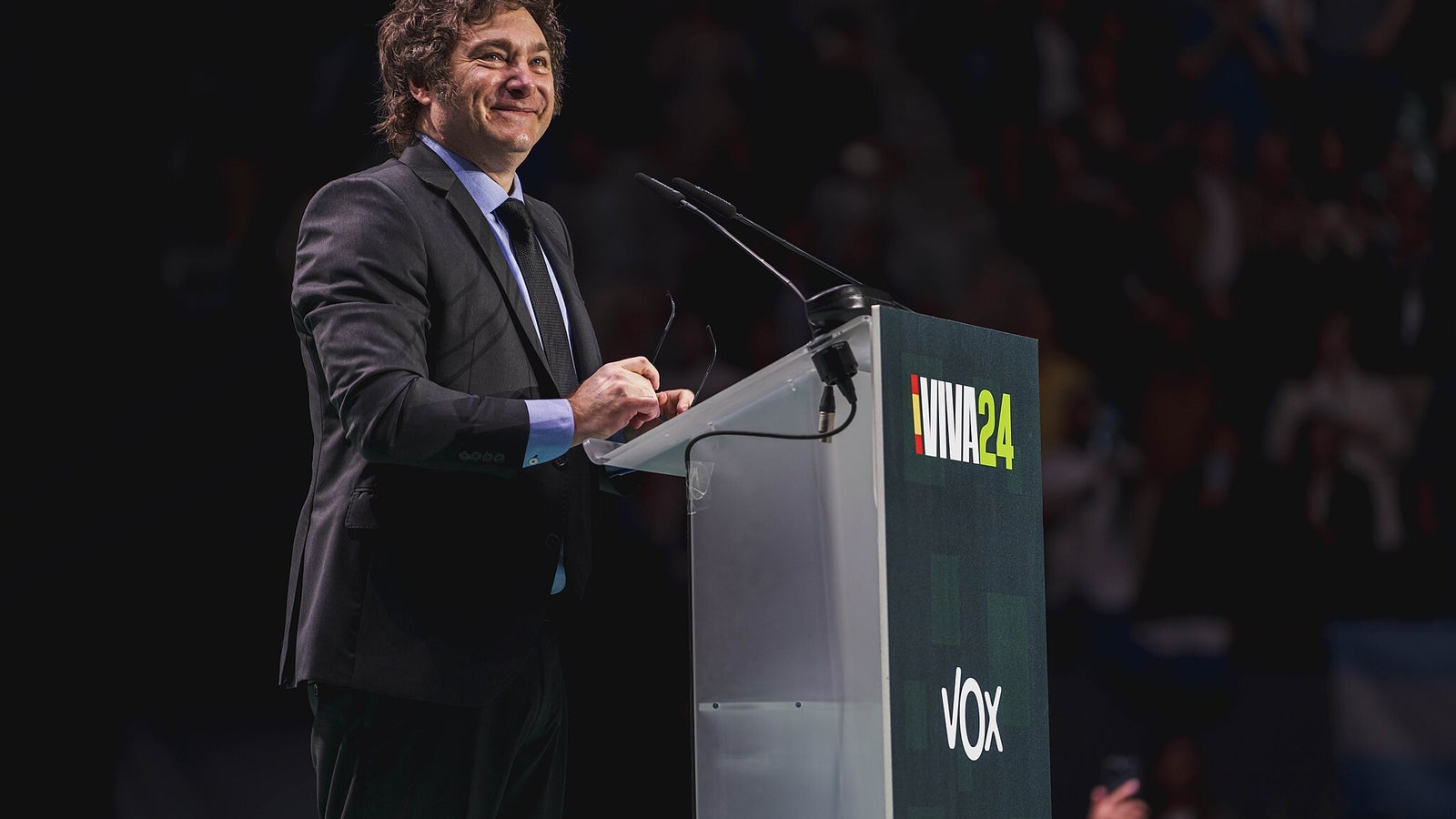
Milei has repeatedly pitched Argentina as a future global hub for AI. Since taking office in 2023, he’s courted Silicon Valley’s elite and built a social media rapport with Elon Musk. “Don’t be surprised if Argentina becomes the next [AI] global hub,” Milei said in an address in December. “It’s no coincidence that the world’s largest companies are evaluating projects here.”
But even as some major tech investments materialize, including a $500 million investment commitment from U.S. software giant Salesforce for the next five years, Argentina’s AI ecosystem is quietly fraying. Inflation has gutted researchers’ salaries, labs are running on outdated equipment, and what some scientists describe as government apathy — or outright hostility — toward public research has left many demoralized.
Argentina is not alone in losing its tech talent. From Nigeria to India to Brazil, AI researchers have been increasingly drawn to elite labs in North America and Europe, where funding, infrastructure, and career opportunities vastly outpace those at home. More than 40% of top-tier AI talent in the world comprises foreign nationals working in a different country, according to a 2023 report from the Chicago-based Paulson Institute. The U.S. is far and away the leading destination, followed by China and the U.K. Mid- and low-income countries are large contributors to this brain drain, studies show.
In Argentina, sweeping austerity under Milei’s “chainsaw” agenda of huge budget cuts to government programs has made the future even more uncertain. More than 52,000 jobs have been eliminated in the public sector since he took office, of which over 4,000 account for scientific research positions, according to a report by the Ibero-American Center for Research in Science, Technology, and Innovation, an opposition-led consultancy group.
Like everywhere else, demand for AI courses has exploded in the country, but schools are struggling to retain and recruit specialized faculty, as few graduates choose academia, according to Uchitel. “We did a study and found that half of our undergraduates already earn more than a starting professor. So how am I supposed to hire anyone? Seeing our talent leave [the country] is just devastating.”
Even as AI experts leave the country, Milei’s government is pushing an ambitious plan to scale up Argentina’s nuclear energy capabilities, aiming to develop small modular reactors to meet AI’s enormous energy demands. Officials see this as part of the same strategy: Use Argentina’s natural resources and engineering base to lure Big Tech.
But long‑term commitments from tech giants could be years away, and Milei’s own economic reforms will be put to the test in mid-term elections later this year. Meanwhile, tech giants like Meta, Google, Microsoft, Amazon, Tencent, and Huawei are pouring billions into AI talent and compute power, leaving Latin American countries scrambling for scarce computing resources.
Argentina’s AI infrastructure lags behind even regional peers: Latin America accounts for just 1.6% of global AI investment despite making up 6.3% of the world economy, according to a report by the United Nations Economic Commission for Latin America and the Caribbean, known as ECLAC. Brazil leads the region with $1.1 billion in AI spending, followed by Mexico, Chile, and Argentina. By comparison, the U.S. is spending roughly $76 billion on AI annually.
“The AI game is already over” for most developing countries, Raúl Katz, co‑author of the ECLAC study and director of business strategy research at Columbia University’s Institute for Tele‑Information, told Rest of World. Countries like Argentina should focus on AI adoption rather than trying to build cutting-edge AI technology, since their investments can’t come close to those of global powerhouses like the U.S. and China, he said.
“An AI hub is fine, but the real economic gain will come from companies [embracing AI],” said Katz.
Argentina’s Secretariat of Innovation, Science and Technology; the Argentine Nuclear Council; and the Subsecretary of the Knowledge Economy did not respond to requests for comment on Argentina’s AI national strategy.
The most glaring gap is in hardware. At the National University of Córdoba, home to one of Argentina’s leading AI labs, wires snake across aging chips and servers. The entire cluster amounts to the equivalent of just 20 Nvidia A100 GPUs. By comparison, Brazil’s Santos Dumont supercomputer runs on roughly 400 A100‑equivalent chips. Europe’s giants, like Leonardo in Italy — one of the world’s most powerful supercomputers, used for scientific research from climate modeling to AI training — operate on an entirely different scale, with over 13,000 GPUs. A single A100 chip can cost anywhere from $8,000 to over $20,000.
“Our capacity is really tiny,” Nicolás Wolovick, who heads the center in Córdoba, told Rest of World. His top students routinely leave for the U.S. or Europe, where they can work with cutting‑edge hardware, he said.
While the gap remains daunting, some in the private sector are guardedly optimistic.
“Can Argentina become an AI hub? Yes,” Leandro Mora Alfonsín, executive director at Argencon, a trade association for knowledge‑economy companies in the country, told Rest of World. “But it takes time.” Argencon is launching a training program this year to upskill 35,000 Argentine workers — mostly non-specialists from other fields — to use AI tools, he said.
Meanwhile, Martínez has found a way to collaborate with colleagues in Buenos Aires from across the Atlantic. He co-runs a small AI safety reading group, and helps fund a handful of scholarships to nurture local talent.
“Argentina risks becoming a digital farm, supplying cheap labor and raw data to train models that are owned and monetized abroad,” he said. “It’s like extractivism all over again — only this time with knowledge instead of lithium.”