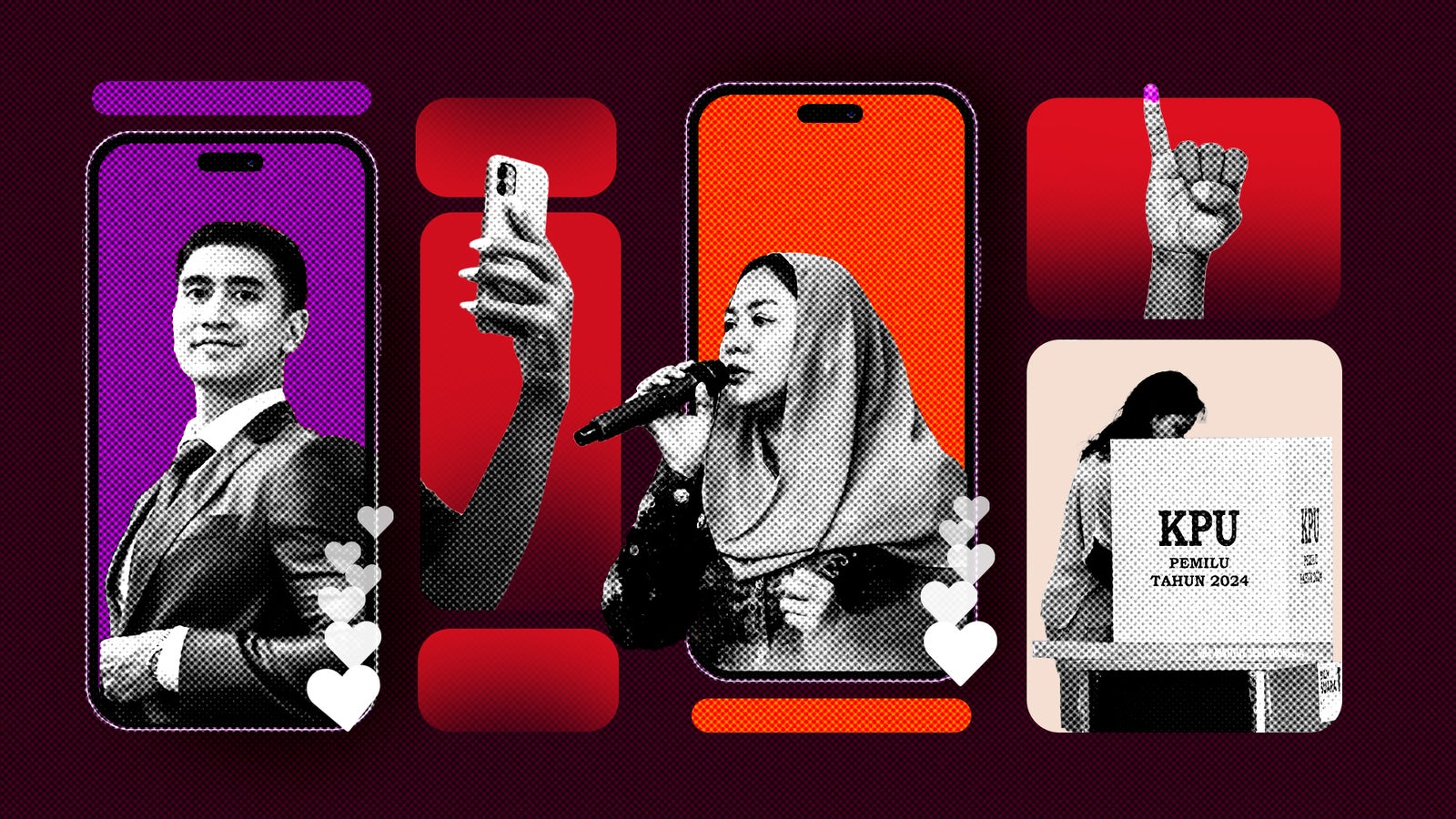
The social media feed of Indonesian singer and content creator Vicky Shu generally features her clothes, makeup, and family. But when she decided to run for the regional elections in November, her content quickly changed to show her meeting constituents and politicians, with Shu often wearing a headscarf.
Of the more than 3,000 candidates who ran for seats for provincial governors, city leaders, and regents across the country, more than a dozen were influencers. Shu, 37, has more than 200,000 followers on TikTok and about 2.8 million on Instagram. She has been a member of the NasDem Party since 2018, often seen at campaign rallies for party leaders. Still, it is through her social media platforms that voters in Cilacap in Central Java know her best.
Shu did not win, but she is among dozens of influencers in Indonesia trying to parlay their social media success into a career in politics. More than 20 influencers were elected to the Indonesian parliament in the national election in February, the highest number so far. That shows that influencers are gaining the trust of voters, Pradipa Rasidi, a digital anthropologist, told Rest of World.
“Spectacle is a crucial component; Indonesians listen to influencers,” he said. “The influencers are great at managing the audiences’ emotions and using language that makes people feel closer to them, which is something that politicians are typically not able to do.”
It’s not just Indonesia. Across Southeast Asia, content featuring influencers and celebrities is the second most widely consumed type of content, according to research firm Cube Asia. It accounts for about a third of the time users spend on social media. Indonesia, with a population of about 280 million people, is the region’s biggest market for platforms including Facebook, Instagram, YouTube, and TikTok. Officials have taken note, increasingly tapping influencers to join political parties, endorse candidates, and run for office.
People ultimately vote for familiar faces over politicians who they don’t know.”
While Indonesian political parties have a long history of recruiting famous people to boost their chances in polls, the fact that this has now become routine underlines a larger issue of the parties having “failed to foster a new generation of politicians,” Titi Anggraini, an advisory board member at the advocacy group Association for Elections and Democracy, told Rest of World.
With few strong candidates, “they have to increasingly rely on influencers to win elections,” she said. Politicians tend to pick celebrities because of their fame and following rather than their leadership qualities because “people ultimately vote for familiar faces over politicians who they don’t know.”
Candidates who run for office don’t need to have a political background or other relevant experience. But what is worrying is that even after being elected, “most celebrities and influencers don’t spend enough time learning and understanding the party’s ideologies … so they focus more on appealing to people’s emotions and less about educating them, or themselves, about the programs and policies,” Titi said.
There is also the matter of cost: Candidates for the Indonesian national election this year spent an average of 5 billion rupiah ($315,000), or almost eight times the annual salary of a legislator, according to research by the Westminster Foundation for Democracy. Much of the funding comes from the candidate’s personal wealth, and donations. The high cost excludes contenders without significant means and connections, with the elections becoming “more of a popularity contest … [leading to] a decline in the quality of democratic debate,” the researchers said.
In return for the money spent, influencers “have to be compensated, for instance, by getting a position in a government agency, or becoming part of the inner circle,” further entrenching them, said Pradipa.
Newly elected President Prabowo Subianto did just that, appointing Indonesia’s second biggest YouTube star, Raffi Ahmad, as a special envoy to oversee projects related to youth and culture. Ahmad had endorsed Prabowo and often featured his rallies ahead of the February election on his YouTube channel, which has more than 26 million followers.
Ahmad and his wife have a sprawling business empire that includes entertainment, fashion, and hospitality. This is his first political appointment; his social media content still includes product endorsements.
Influencers that gain traction on social media platforms are usually the ones that spread disinformation.”
Indonesia is not alone in believing celebrities make great politicians. Filipinos want their most popular YouTube star to be the country’s next president. While in Brazil, hundreds of police officers with massive social media followings ran for municipal elections this year, raising concern about the violent content for which they are known.
In Indonesia, where religious minorities are often the target of violence stemming from hate speech online, one of the concerns is that disinformation can spread faster when social media influencers are in positions of power, Ross Tapsell, a researcher at the Australian National University, told Rest of World.
“There’s nothing wrong with an influencer becoming a public official if they have a vision to uphold the values of democracy and rule of law,” said Tapsell, who wrote a book on the power of media in Indonesia. But “influencers that gain traction on social media platforms are usually the ones that spread disinformation.”
Indonesian authorities have recently introduced laws to force platforms to quickly remove content deemed as hate speech or misinformation. But when former President Joko Widodo hired influencers to spread the word about Nusantara, the nation’s new capital, they glossed over the fact that it was still under construction, and that its development had led to deforestation and displacement of Indigenous people, critics said.
Some Indonesians are calling out influencers like Verrell Bramasta, who became a member of parliament this year from West Java. The 28-year-old’s social media feed used to feature his travels and his attire. Now, he also posts pictures of meetings with constituents and of him attending parliament for his nearly 10 million followers on TikTok and more than 27 million on Instagram. Some of his followers don’t appreciate this.
“Great style, but people are waiting for your results,” said one comment, liked by many.
Uya Kaya, an influencer and first-time member of parliament, with nearly 5 million followers on YouTube, was recently criticized for his interview with a former communications minister, who was allegedly involved in online gambling. “Please make sure to produce content that’s neutral,” said one comment.
Ahmad, too, has been criticized for staying silent during nationwide protests earlier this year against proposed changes to the election law. That prompted some of his followers to call for a boycott of his businesses. “Please don’t support Raffi Ahmad and the gang. Tone-deaf and opportunistic,” said one commenter.
Meanwhile, the government has increased funding for social media influencers, spending more than 90 billion rupiah ($5.6 million) between 2017 and 2020, according to Indonesia Corruption Watch, an advocacy group. There are few details on how the influencers were selected or what they were hired for.
The lack of transparency has not stopped voters from electing influencers. Rano Karno, a former television actor, ran for the influential seat of vice governor for Jakarta in November. Rano, who was previously governor of Banten province, often posted videos in character on TikTok while campaigning. It paid off: He and running mate Pramono Anung won, beating a duo that had the backing of President Prabowo.
The election victories of influencers can “compromise political parties and weaken the parliament because they lack the competence to manage bureaucracies. As a result, they can’t represent people’s aspirations effectively,” said Titi. But the influencers will keep winning because “many Indonesians still lack a critical mindset, so they will choose candidates who are most familiar to them on social media.”