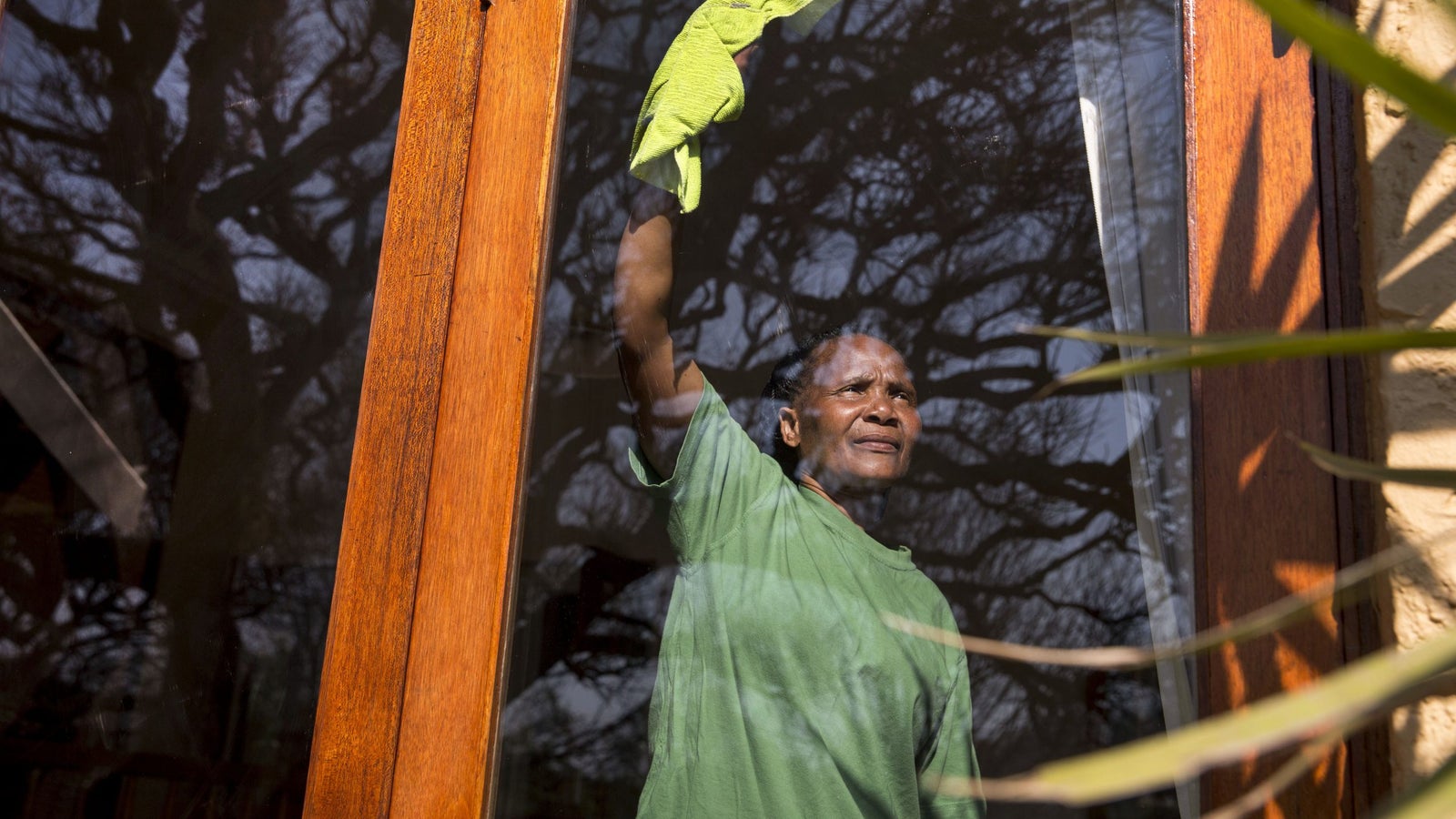
Christolina Uhlaleleni Ndlovu had worked as a domestic worker in Johannesburg’s Soweto township for over five years when she first heard about SweepSouth, an on-demand cleaning app, in 2021. Hoping to find better work, Ndlovu joined the app almost immediately and took the five-day mandatory training and entrance test.
Within the first two weeks, Ndlovu booked several gigs where clients paid her generous tips, something she had never experienced before. “At most, I would get home at 3 p.m. after starting work at 8 a.m.,” Ndlovu told Rest of World. “My future on the gig looked bright. Money was flowing in every week. For the first time in months, things stabilized.”
SweepSouth, launched in 2014 by Cape Town-based couple Aisha R. Pandor and Alen Ribić, has helped thousands of women like Ndlovu to participate in the booming gig economy. While less than 4% of Uber drivers in the country are female, of the more than 1.2 million workers registered on SweepSouth’s app, most are women.
Once hailed as the “Uber for domestic cleaning,” in 2016, SweepSouth became the first South African startup to join Silicon Valley’s prestigious 500 Global (formerly 500 Startups) program, whose alumni include Reddit, Chipper Cash, and Canva.
While the company has succeeded in opening the doors of the gig economy for women, it has yet to solve some inherent challenges that keep women away from the industry. Ten domestic cleaners who have worked with SweepSouth told Rest of World that clients frequently ask them to spend extra unpaid hours doing work that they did not book. They said they do not complain about such instances, fearing retribution from the company if clients complain.
Female gig workers doing unpaid work are prevalent in many parts of the world, according to a 2023 report by Fairwork, a company highlighting technology’s impact on labor.
“Women’s participation in the platform economy is highly visible in beauty, care, and domestic work. Historically, such ‘feminized’ work has taken place within private homes. Yet many platforms fail to successfully account for and fully monetize this work, leading to workers conducting unpaid work, and being inadequately protected from workplace harassment and abuse,” said the report, which is based on research into working conditions with online platforms, spanning four years, 38 countries, over 190 platforms, and interviews with more than 5,000 platform workers. The report included gig workers from South Africa.
Ndlovu said she was permanently blocked from the app in December 2022 after she refused a client’s request to work overtime for free. “I never got a chance to defend myself,” she said, adding that she had agreed to such requests at other times when clients asked her to do gardening work when they booked her for house cleaning.
Without commenting specifically about Ndlovu’s case, SweepSouth spokesperson Luke Kannemeyer told Rest of World that the company is aware of instances where clients underbook for the work required and reaches out to such customers to explain the parameters of the platform when these issues are reported. “Any additional hours will always be remunerated, even if the client refuses to pay,” he said in an email. He added that the company maintains several channels for workers to express any concerns or feedback. “This is baked into the very DNA of our company, as we were founded on the basis of disrupting the age-old practices of the domestic work industry in South Africa through technology and bringing about more fair, equitable, and dignified treatment of domestic workers,” Kannemeyer wrote.
Kannemeyer also said that the company tries to address general industry concerns by conducting annual surveys of its workers, which has allowed it to benchmark itself against the industry. The company has also participated in high-profile academic studies to help improve the experiences of its workers, he said.
There are times when we have tried to complain to the SweepSouth office…but the company refused responsibility.”
Maggie Nthombeni, president of Izwi Domestic Workers Alliance, an organization representing domestic workers in Johannesburg, told Rest of World that several SweepSouth workers have complained to her about the company prioritizing customer complaints over theirs. “There are times when we have tried to complain to the SweepSouth office about some of the issues their workers report to us, but the company refused responsibility, claiming that the women are independent contractors and that they should resolve the issues with the customers,” Nthombeni said.
At a meeting for domestic workers advocacy groups in 2021, Pinky Mashiane, founder of the United Domestic Workers Union in South Africa, raised concerns about the exploitation that app-based cleaners face. But she could not do much because these workers were not part of her union. “SweepSouth fires workers unlawfully … But because the workers are not union members, the company gets away with it. This new revolution of platform-based work is exposing our women workers to exploitation,” Mashiane told Rest of World.
Faith, a single mother of three, quit her full-time job as a factory cleaner in 2016 and decided to shift to domestic cleaning work. For the first two years, she struggled to find work. In 2018, she joined SweepSouth after a friend introduced her to the platform. Over the past five years, she has had “all kinds of experiences” with users, she told Rest of World, requesting to be identified using a pseudonym, fearing retribution from SweepSouth.
Some clients have made her wait for hours before starting work without any compensation, while others have asked her to do the laundry or clean their yards when she was hired only to clean the house. She has given in to such requests because she fears her refusal would lead them to complain against her, and she may be blocked from the app. “I’ve lost count of the number of times that clients have forced me to work relentless extra unpaid hours,” Faith told Rest of World.
Faith said she has stayed on the app because she feels she doesn’t have other options. “Even though we are unhappy, who do we report to because the company does not give us a chance to raise our grievances?” Faith said.
SweepSouth can be a good starting point for women who want to advance themselves, Siziwe Ncube, who has been working with the app since 2018, told Rest of World. “I have made progress in my university studies with the money I earn working with the platform for two days a week,” Ncube said. “I want to get a better-paying job and further my studies even more. It’s not an easy job, but I’m working for a better future, and that keeps me going.”