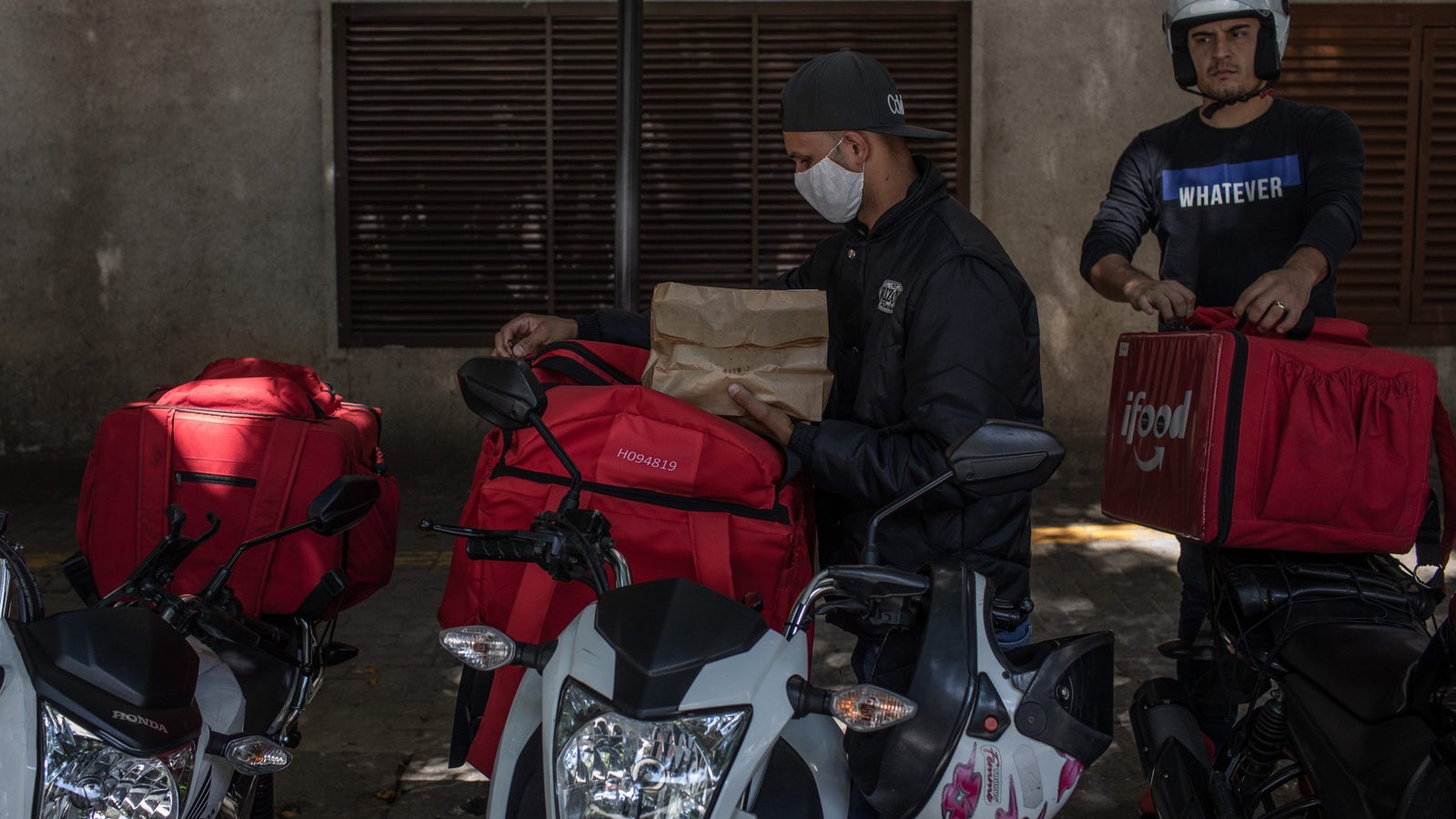
Behind an unmarked metal door, nestled between an optical shop and a grocery store in the suburbs of Rio de Janeiro, lies iFoodiFoodFounded in Brazil in 2011, iFood is one of the country’s leading last-mile food delivery platforms.READ MORE’s latest effort to protect its delivery workers: a safe space where they can access legal and psychological help.
The facility, launched in January by Brazil’s biggest food delivery company, is a nondescript room, with a few desks and beige-and-white couches. It was set up to provide support to iFood gig workers who have been assaulted, threatened, or harassed while making deliveries.
A month later, the facility has yet to receive its first visitor.
It is not for lack of need: There were 596 reports of attacks on delivery workers in Rio de Janeiro between August and October last year. IFood, which controls over 80% of the delivery market in Brazil, claims it is able to address up to 80 such cases per month in partnership with the nonprofit law firm Black Sisters in Law. But drivers told Rest of World that the help center — located in Vila da Penha, a remote area across town from where the bulk of their work is concentrated — is difficult to access.

Leblon, the neighborhood where most attacks against drivers have been reported, is 18 miles northwest of the facility, and biking over takes nearly two hours.
“We already work on the bike the entire day,” Gustavo, a worker who requested to be identified only by his first name because he feared reprisal from iFood, told Rest of World. “If we have a problem, we’d have to go all the way there.”
In June, iFood launched an in-app help feature for workers who had been attacked by customers, but the number of incidents continued to grow, spurring a series of protests. The facility was set up to offer workers a physical alternative to in-app support. IFood drivers told Rest of World the initiative is unlikely to succeed, unless the company takes additional steps.
Most attacks on iFood workers happen when customers demand they bring the deliveries to their door. The company, valued at $5.4 billion with 200,000 active delivery workers, has said that they are only obligated to deliver to the first point of contact — usually the apartment building’s entrance.
Tatiane Alves, social impact coordinator at iFood, told Rest of World the company has conducted workshops to spread awareness among building staff and residents about its delivery policy and best practices to help delivery workers. The workshops are organized in collaboration with an association that represents property managers from over 32,000 building complexes in Rio. But workers said the message has to be more widespread.
80% iFood’s share of the delivery market in Brazil.
“They should air [the campaign] on national television,” Amsterdan Sousa, president of a Rio de Janeiro-based association for delivery workers, told Rest of World. “They are sponsoring Big Brother Brazil — they should take advantage of the views the program has.”
This month, during the Carnaval festival, iFood launched a campaign in Rio de Janeiro asking customers to meet delivery workers downstairs. The company also roped in popular singer Preta Gil, who urged her Instagram followers to pick up deliveries at their building’s gate.
The facility in Vila da Penha has been designed as a 6-month pilot program. “It’s an opportunity for us to test and understand if this model helps us,” said Alves. But on a visit to the site, located on a busy avenue in a working-class neighborhood, Rest of World found no workers seeking support.
Alves said the company has been experimenting with in-app banners and awareness campaigns about their delivery policy, but has so far ruled out a nationwide effort because issues with worker harassment differ significantly by state.
The harassment meted out to gig workers, according to Nina Desgranges, a social scientist and researcher with the Federal University of Rio de Janeiro, is a result of discrimination, and is related to “Brazil’s racist, colonial, slaveholder history.” She recalled the case of Max Ângelo, a Black delivery worker who was whipped by a woman with a dog leash in April. “There’s nothing more symbolic of our slaveholder past than this,” Desgranges told Rest of World.
On January 18, the day after iFood opened the facility, Diego Barreto was sitting in front of a store, waiting to pick up a food order, when he saw a delivery worker being punched by a passerby. When Barreto stepped in to separate the two men, he was manhandled by a bystander, according to a report he filed with the police and shared with Rest of World.
Barreto had heard about the help center but didn’t consider going since he lives in Rocinha — on the opposite edge of the city from the facility. Instead, he filed a complaint with iFood through the app. According to Alves, iFood received an average of 20 support requests through its in-app help feature per month between June and November. The number has since doubled.
Once a driver reports an attack, iFood reviews whether the worker is eligible for legal and psychological support. If they are, the company forwards their case to Black Sisters in Law, whose offices are located in the same building as the facility.
People think we are slaves and that they are paying for room service.”
Shortly after Barreto requested support, a psychologist contacted him and offered him three sessions. Barreto waited to hear from a lawyer for three weeks. After Rest of World raised his case with iFood representatives, an attorney reached out to him.
Even though he remains shaken up by the incident, Barreto said he is still out making deliveries.
“We need [delivery workers] to report and to take the case to the end,” Dione Assis, founder of Black Sisters in Law, told Rest of World. “This is only possible by creating awareness among them that they will have no expenses and that there will be no reprisals from the platform.”
When iFood launched its in-app help feature last year, it had taken time to gain traction, said Assis. She believes the facility, too, will soon draw workers in. “Initially they are a bit more reluctant, but it’s a matter of time before they start coming in,” she said.
One of the cases that Assis’ law firm took on was settled in a civil court. “The assaulter compensated the worker and had his motorcycle repaired, allowing him to return to work,” she said. The other cases are either currently under police investigation or have been sent to the Public Prosecutor’s Office, where officials will decide if a formal complaint is warranted.
There is a growing realization among drivers that they will inevitably fall prey to an attack. At least one of Gustavo’s colleagues has a confrontation with customers every week, he said. “People think we are slaves and that they are paying for room service. They believe they have this power because we are poor.”
Back in Vila da Penha, the empty facility waits for the first gig worker in need to arrive.
“IFood should install [these help centers] where they are needed most,” said Barreto. “Where there’s more demand.”