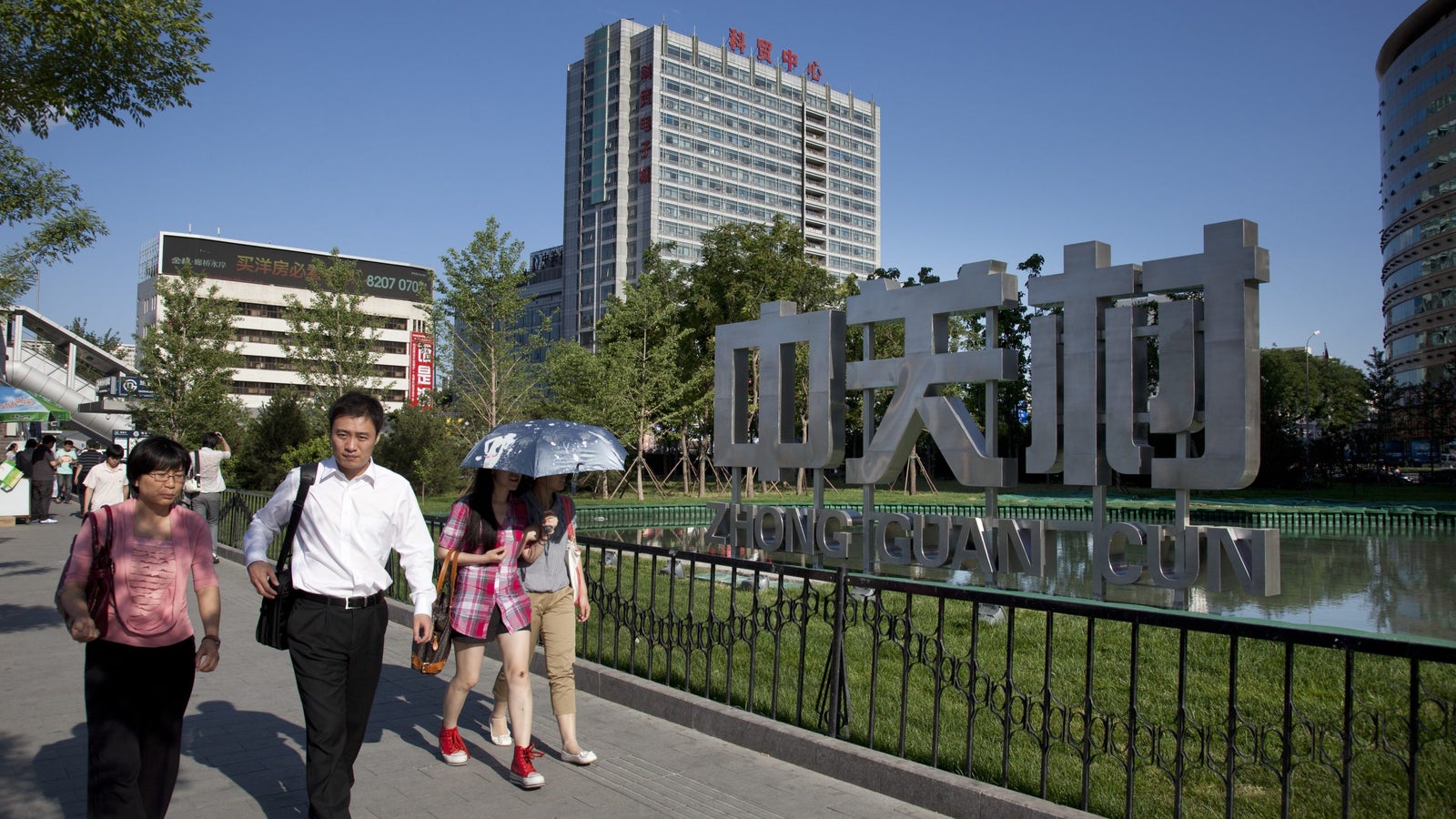
To college students and tech workers in Beijing, Tsinghua University Science Park (TusPark) is known as the “Center of the Universe.” The hub of tech startups, talent, and capital is nestled between Zhongguancun (also known as China’s Silicon Valley) and the elite Tsinghua and Peking University campuses. It’s home to Chinese internet giants like NetEase and Kuaishou, global companies such as Google and Microsoft, and more recently, China’s hottest new AI startups.
As ChatGPT fever hits China, TusPark has incubated a new wave of generative AI startups, such as DeepLang AI and Lightyear AI, that are competing for funding and vying for influence. Here is a list of four Chinese AI startups to watch:
DeepLang AI
Product: Chinese-language-trained large language models such as WantWords and Jiuge
Founders: Qi Fanchao and Li Xiaoxiang
Funding: Tencent, HongShan Seedfund, MiraclePlus, 1VC
Location: Dongsheng Plaza
Founded by two natural language processing researchers at Tsinghua University, DeepLang AI set out to create large language models better equipped to deal with Chinese-language content. DeepLang’s products include WantWords, a dictionary that suggests a list of words based on users’ descriptions; and Jiuge, a classical Chinese poetry generator. The company has received funding from notable investors such as Tencent and MiraclePlus, and is backed by Tsinghua NLP Lab and the government-affiliated Beijing Academy of Artificial Intelligence.
Zhipu AI
Product: ChatBLM, a large language model
Founder: Tang Jie
Funding: Qiming Venture Partners, Legend Capital, Tsinghua Holdings
Location: Sohu Internet Plaza
Zhipu AI also draws from Tsinghua University’s AI talent pool. Founded by Tang Jie, associate dean of the Beijing Academy of Artificial Intelligence, Zhipu AI developed a pre-trained large language model called ChatBLM. The company has also launched a partnership with internet security company Qihoo to collaborate on 360GLM — a large language model that can be integrated into Qihoo’s search engine.
Baichuan Intelligence
Product: Baichuan-7B, large language model trained in Chinese and English
Founder: Wang Xiaochuan and Ru Liyun
Funding: Unknown
Location: Saier Plaza
Tsinghua graduates and search company Sogou executives Wang Xiaochuan and Ru Liyun founded Baichuan Intelligence. The startup launched Baichuan-7B, an open-source, pre-trained model available in Chinese and English. Wang has worked on natural language processing services as early as 2019, when Sogou integrated an AI-powered word prediction function into its widely used Pinyin input software.
Lightyear AI
Product: Unreleased
Founder: Wang Huiwen
Funding: Wang’s personal funds
Location: Sohu Internet Plaza
We know nothing about what Lightyear AI is working on, but it’s attracting a lot of attention thanks to the big names behind it. Wang Huiwen, the founder of delivery giant Meituan, announced his new venture in a splashy social media post in February and pledged to contribute 50 million yuan ($7 million) of his personal funds to the company. Lightyear AI has reportedly received funding from Tencent, Kuaishou founder Su Hua, and venture capital firm Zhen Fund. It has also acquired OneFlow Technology, a Beijing-based deep-learning startup valued at 500 million yuan ($70 million). On Thursday, Lightyear AI’s story went through another plot twist: Meituan announced that it would acquire the company for 234 million yuan ($32 million) and Wang Huiwen resigned from all his corporate roles due to health reasons.