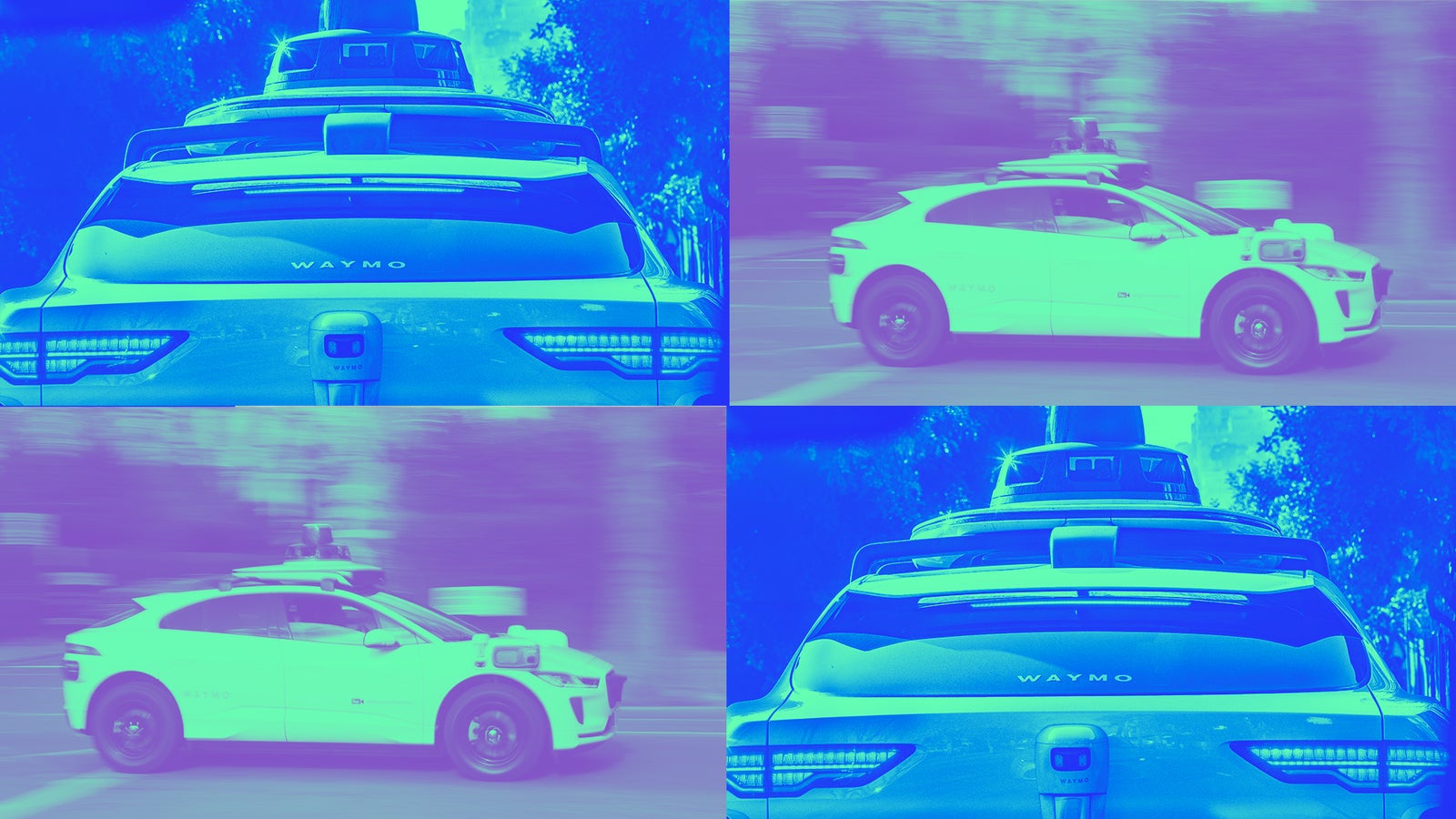
It can be a bit unnerving going on your first robotaxi ride. On my first ride in a Waymo in San Francisco recently, I unlocked the door with the app, listened to the brief safety announcement, marveled at the steering wheel turning by itself, then quickly forgot I was in a robotaxi. Arriving at my destination 25 minutes later, I realized how quiet it had been: no loud phone conversations by the driver or heated sports commentary. And the car was way cleaner than my recent Ubers.
There are about 3,000 Waymos in 10 U.S. cities, more than a third of them in the Bay Area. The Alphabet-owned company aims to complete more than 1 million driverless rides a week by the end of the year, and plans to expand overseas. In the U.S., the all-electric Waymo is ahead of Tesla and the toaster-shaped Zoox, owned by Amazon.
Waymo did not get off to a great start. Protesters concerned about surveillance, safety, and job loss vandalized several vehicles, and disabled cameras on some. Recently, during a mass power outage in San Francisco, several Waymos stalled at traffic intersections, holding up emergency vehicles. That raised concerns about what the vehicles would do during other emergencies, such as an earthquake. Waymo said it had updated its emergency preparedness to allow its vehicles to navigate “more decisively.”
Despite these incidents, there appears to be less resistance to robotaxis now, not just in the U.S. but elsewhere. In China, Baidu alone does about 250,000 rides a week, and is rapidly expanding overseas along with WeRide and Pony.Uber is launching in Hong Kong, its first Asian market, with Baidu. Uber and Baidu are also partnering in Dubai, and Uber is rolling out at least 1,200 robotaxis in Abu Dhabi, Dubai, and Riyadh with WeRide.
Robotaxis aren’t quite the political flashpoint that autonomous trucks are, but safety is still a concern. Last year, a Waymo ran over KitKat, a beloved corner-store feline in San Francisco, triggering a bit of a backlash. Waymo said the cat had “darted under the vehicle” as it was pulling away, and that they would make a donation to an animal rights organization in its honor. All told, over 100 injuries and two fatalities were reported in relation to Waymo from 2021 to 2025. That compares with an average of 40,000 motor vehicle crash deaths in the U.S. every year.
Autonomous vehicle makers have long argued that their technology — which combines Lidar, radar, sensors, and high-resolution cameras with AI — is far safer than drivers who may be drunk, distracted, sleepy, or plain mad. They are seen as so safe that parents in the Bay Area routinely use them for school drop-offs and pickups for unaccompanied kids. Still, self-driving cars can make mistakes that humans probably would not, such as driving into flood water or through an active crime scene. And I don’t see how they would manage more chaotic streets in, say, India or Nigeria.
Waymo recently admitted it occasionally uses remote workers in the Philippines, which led to questions on safety and security — questions that Chinese self-driving cars are also facing. Waymo has in-car cameras for the “rider’s safety,” a reminder that the human-in-the-loop is still a feature of many autonomous technologies.
As a single woman who often hesitates to take a cab at night in many countries, I can see how a robotaxi would be a safer, more preferable alternative to being constantly on guard, worrying about the driver peering at me in the rearview mirror, or worse, assaulting me. Uber is handling so many complaints of assault in the U.S. that it has expanded a feature to match female drivers with female riders. Drivers are also at risk of assault, and their earnings are low. Are robotaxis the answer? They can be a solution to safer streets and safer commutes. But they cannot be the solution.