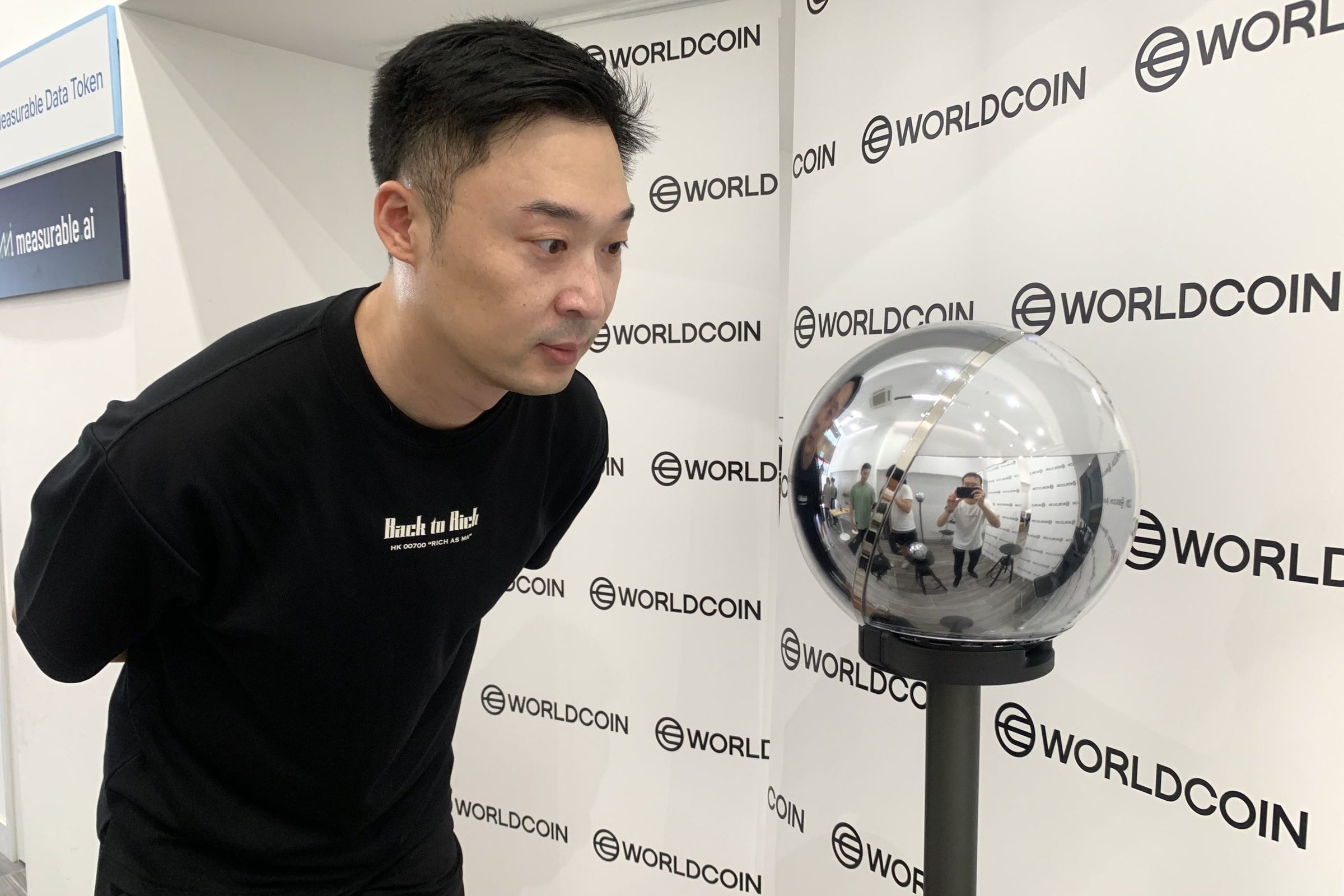
At Nairobi’s Imaara shopping mall on a quiet Thursday, two dozen people stood in line to have their irises scanned. It was the fourth day after the official launch of Worldcoin, a global blockchain project championed by OpenAI CEO Sam Altman. The line was made up of a mix of college students, artists, and boda boda drivers — all registering their biometrics to the blockchain to participate in “the world’s largest identity and financial public network,” as the Worldcoin founders describe it.
But the individuals in line weren’t drawn by Altman’s lofty ideals. Instead, they were there to collect the sign-up bonus of 25 worldcoins — roughly 7,100 Kenyan shillings, or $50.
“It’s been so busy the past two days,” said one attendant at the Worldcoin booth in Imaara, who asked not to be named because she isn’t authorized to speak to reporters. “I think it’s because more people are hearing about it … seeing Worldcoin trending on Twitter, WhatsApp.”
Announced at the height of the NFT craze, Worldcoin is one of the most ambitious projects to emerge from the blockchain boom, using a combination of cryptocurrency and biometric registration to create a new kind of global identity service. Worldcoin claims more than 2 million people have already registered for the service, but with the official launch on July 24, they’re trying to bring even more people on board, setting up booths in 20 new cities around the world where curious users can register.
Rest of World’s reporters visited Worldcoin booths in Nairobi, Bengaluru, and Hong Kong to get a better sense of who was signing up for the service and why. In all three cities, the surge of interest was driven primarily by the sign-up bonuses. Relatively few people were familiar with the goals of the project, and rarely did their enthusiasm for the bonuses translate to an enthusiasm for the Worldcoin project or cryptocurrency more broadly.

In each city, reporters described a rush of visitors eager to sign up for the service. The most intense interest came in Bengaluru, where sign-up locations in both the Vega City Mall and Mantri Square Mall had to be closed after overwhelming crowds became disruptive. Even after the locations stopped taking sign-ups, a steady stream of visitors arrived to try their luck.
Word of the sign-up bonuses has spread quickly, with little context. WhatsApp was particularly effective in driving interest in Kenya, as word of free money spread from group to group. “Those who haven’t gotten them [tokens] should visit these malls,” read one mass text viewed by Rest of World, sent to a group of 238 participants. “You’ll get a quickstart airdrop 25 WLD tokens. Easy $50.”

The overwhelming focus on sign-up bonuses has raised long-standing concerns about whether Worldcoin’s users really understand what they’re signing up for. Last April, twin reports from BuzzFeed News and MIT Technology Review found that the company was using deceptive marketing to induce sign-ups. In simple terms, many users had been drawn in by the promise of free money with little awareness of the broader project.
Alex Blania, CEO of the nonprofit that administers Worldcoin, has acknowledged that the initial rollout may have left some users confused. “In some places, communication, marketing, all of those things, could have been clearer and better,” Blania told BuzzFeed News in response to its reporting. “And we will improve that.”
WorldCoin did not respond to a request for comment on this article.
I’ve heard there’s money to be made here.”
Those concerns have led to regulatory action from governments in response to Worldcoin’s rollout this week. On Friday, France’s privacy regulator raised doubts about the legality of Worldcoin’s strategy, calling it “highly questionable.” On the same day, Kenya’s data protection commissioner called for vigilance from the public as it assessed the legality of the project.
But for many of the people waiting in line this past week, the privacy concerns were easy to dismiss in exchange for the bonus.
Nairobi in particular is currently suffering a cost of living crisis that has fueled anti-government protests in recent weeks. “I’ve heard there’s money to be made here,” said a recent sign-up named John Kazungu, who works at one of Nairobi’s bus terminals. “The money will help me. Right now life isn’t easy.”
-
People wait in line to use Worldcoin’s iris scanners in Tokyo, Japan. Anton Bridge/Reuters -
A booth attendant helps Mufti Alam, a 28-year-old student, sign up for Worldcoin at a mall in Bengaluru, India. Medha Singh/Reuters


Worldcoin’s launch has been particularly fraught in places where the legal status of cryptocurrency is still up for grabs. The project launched three sign-up booths in Hong Kong, where the government is in the midst of rolling out a licensing regime for cryptocurrency. But according to the volunteers who staffed the booths, the majority of the sign-ups came from Mandarin-speaking visitors from mainland China, where crypto transactions have been banned, but underground trading remains active.
On Wednesday, Xu Bing, a 57-year-old retired school administrator, traveled to Hong Kong from the neighboring city of Shenzhen just to get Worldcoin tokens. She did not know about Sam Altman or OpenAI, but friends had sent her short videos about how promising the project was. “I like new things, especially high-tech stuff,” Xu said.
Privacy concerns were on the minds of many visitors to the Hong Kong booths as well, although the lure of the bonus coins was enough to make the risk worthwhile.
Shuki Wong, a 32-year-old who works in cryptocurrency, brought his 62-year-old mother to get her iris scans, with an eye toward the reward. “At least you get money from it,” Wong said. “Do you know how often people lose their data without getting anything back? That’s the reality.”