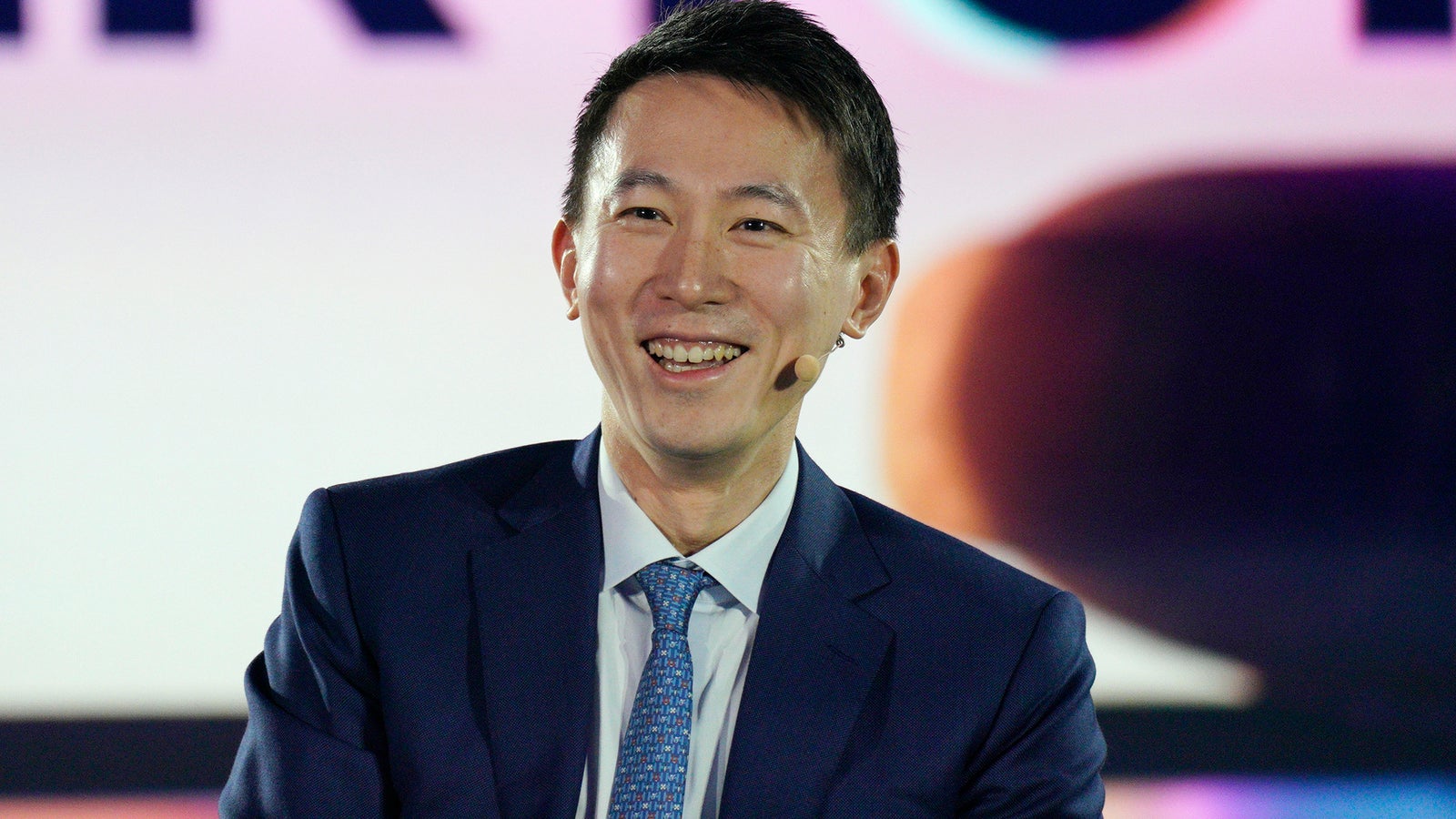
When TikTok CEO Shou Zi Chew arrived at the King Abdulaziz International Conference Center in October 2024, he had no intention of criticizing the Saudi government. He was there at its invitation, as a keynote speaker at a conference hosted by the crown prince’s Future Investment Institute (FII), a glitzy annual event billed by its hosts as “Davos in the Desert.”
Shou had a lot else going on during the week of the FII conference. The U.S. presidential election was fast approaching, and ByteDanceByteDanceByteDance is a Chinese internet technology company that owns TikTok and Douyin, a Chinese version of TikTok with a successful e-commerce arm.READ MORE had less than three months left to sell TikTok, according to the timeline set by Congress. But Shou and Liang Rubo, ByteDance’s co-founder, had insisted that ByteDance would not and could not sell — that they would simply turn off TikTok in the U.S. instead.
ByteDance and TikTok had challenged the Protecting American from Foreign Adversary Controlled Applications Act in court, claiming that it infringed upon their American staffers’ First Amendment rights. Still, they knew there was a decent chance they’d lose: as much deference as American courts typically gave businesses, they deferred even more readily to the national security community — a community that was nearly unified in their assessment that TikTok posed a grave threat to American power.
So Shou was spending time in the Gulf States. Zhang Yiming, ByteDance’s co-founder, and Rubo were driving him hard to increase TikTok’s revenue, and he had to start preparing for a world in which TikTok might not exist in the U.S. anymore. Some of the easiest, most lucrative places for TikTok to make money were wealthy markets like the Gulf that were unburdened by Western norms about privacy, human rights, and democratic self-governance. Plus, if Yiming ever reconsidered his reticence to sell the platform, Saudi and Emirati royalty might be some of the first billionaires who would line up to bid for it.

If Yiming wanted to sell — if the Chinese government would let him — the Gulf States might even be the solution to Shou’s problems with the U.S. government; neither Saudi Arabia nor the UAE was designated as a foreign adversary under PAFACAA.
At the conference, Shou was interviewed by Richard Attias, a Moroccan events executive who flattered Shou, referring to him as “one of my heroes,” and to TikTok as “an amazing platform … despite all the critics.” But Attias seemed to misunderstand Shou’s relationship to the company. He cast him as the brains behind the app, as its founder and creator.
Shou didn’t correct Attias. For years, Shou had cultivated a public image as TikTok’s principal. He had staged corny video cameos with TikTok creators that centered around the pun “Shoutime.” At the end of all-hands meetings, he had held rope line-style photo op lines where staffers could meet him and shake his hand, like famous founders would sometimes do. On stage, rather than reveal his status as a non-founder CEO, Shou vaguely explained that the idea for TikTok had come from the company’s mission: to inspire creativity and spark joy.
TikTok in Riyadh did not look like TikTok in Los Angeles: it reflected only what the government allowed the platform to display.”
Then he pivoted to talk about TikTok’s infamous For You feed: “There’s no human curation, really, that goes into the recommendation process,” he said — though Forbes had broken the news of the company’s heating system more than a year before. “It is really about using machine learning, and then using your signaled interest with potential signal interest that you could have, and that’s really the magic of the algorithm.”
Here, again, Shou’s answer was a bit of a misdirection. If TikTok were really all about using a neutral computer system to help you find new interests, one would expect it to provide more or less parallel experiences for people around the globe. But TikTok in Riyadh did not look like TikTok in Los Angeles: it reflected only what the government allowed the platform to display. As a result, sexually explicit content was common, but using terms like gay and lesbian would get you flagged for hateful content.
The Saudi government had been quick to see the potential for a platform like TikTok. In 2019, it flew models and influencers with large followings out to a music festival in exchange for a commitment that they post photos and videos from the event. TikTok itself partnered with an agency to promote the festival, creating “the biggest media partnership the platform [had] ever created.” In 2020 the company partnered with the government to promote socially distanced Ramadan celebrations. By early 2022, less than a year into Shou’s tenure as TikTok’s CEO, Saudi Arabians began using TikTok more than they used Facebook — a statistic that alarmed Facebook executives in Menlo Park. Shou doubled down, opening a regional headquarters in nearby Dubai, and by 2023, one advertising agency claimed that 88 percent of Saudis used TikTok.
Shou’s October trip to the FII conference was one of several trips he made in 2024 to try and repair the company’s relationship with the Saudi kingdom. Earlier that year, he had teased further investment and closer ties between TikTok and the Royal Family. He announced that the company would be deepening its partnerships with the Saudi Tourism Authority, its soccer Pro League, and its “Smart City” project, Neom. He agreed to sponsor the 2024 Red Sea Film Festival, despite criticism of the event as a whitewashed venue for state propaganda, and announced the opening of a new regional office in Riyadh.
Some of the easiest, most lucrative places for TikTok to make money were wealthy markets like the Gulf that were unburdened by Western norms about privacy, human rights, and democratic self-governance.”
As Shou courted Saudi royals, he also took a series of meetings with leaders of the kingdom’s wealthy neighbor, the United Arab Emirates. For its small size, the UAE was a whale of international tech investment. The country’s sovereign wealth fund had made big investments in venture capital, clean energy, and even military uses of AI — and most of those investments could be traced to a single decision maker: an Emirati tycoon named Sheikh Tahnoon bin Zayed Al Nahyan.
Sheikh Tahnoon, by this point, was mired in considerable controversy. Despite his dubious associations, he remained a powerful guy. In 2022, he established a new $10 billion investment vehicle through a secret AI firm called G42, earmarked for investments in China. In 2023 it announced that it had bought more than $100 million in ByteDance stock. Then, less than a year after acquiring the stake, the company announced it would sell it. G42 was selling off its whole new China-focused investment fund to appease regulators in the U.S.
For decades, the Gulf States walked a tightrope to balance competing interests between the U.S. and China. Saudi Arabia and the UAE offered the U.S. an alliance of convenience: the countries shared a common adversary in Iran, and controlled enough of the world’s oil reserves to meaningfully affect the world economy.
Between G42’s investment in ByteDance, and then its subsequent divestment, The New York Times published an investigation showing that G42 had substantial ties to the Chinese state. But Sheikh Tahnoon was chasing big business in the U.S. — business so big that cutting China loose was worth it. In exchange for divesting from Chinese firms, G42 received U.S. government approval for a $1.5 billion AI investment from Microsoft, which gained the company access to state-of-the-art American Nvidia microchips that Chinese companies couldn’t buy. It even snagged a partnership with OpenAI, the firm behind ChatGPT.
Now, though, Shou was trying to woo the family behind G42 back. After his appearance in Riyadh, he would travel to Dubai to meet with Sheikh Tahnoon’s cousin, Sheikh Hamdan bin Mohammed bin Rashid Al Maktoum, who was also the crown prince of Dubai and deputy prime minister of the UAE. Shou would lead a roundtable discussion with local TikTok stars organized by the Dubai Press Club, and amplify the popularity of a local-gone-global TikTok trend: a chocolate bar filled with pistachio cream and knafeh pastry crispies.
One of the final questions Shou took from Richard Attias at the FII conference was about TikTok’s role in promoting journalism. This question was a third rail for FII, which had been heavily boycotted after the Saudi royal family ordered the murder of a journalist in 2018. And it was tricky for Shou, whose company had surveilled me and Cristina Criddle.
Still, he said, “I have a lot of respect for what you call traditional media; I think there’s a lot of value in editorial standards, in robust journalism, and I think this is an industry that we want to be, we want to help them, you know, we want to help them reach a bigger audience.”
Shou wasn’t necessarily saying he preferred a muzzled press to a free one — but he also wasn’t drawing a distinction between the two. TikTok was a chameleon, one that he insisted wasn’t just for entertainment anymore. “It is about community, it is about education, it’s about heritage, it’s about culture, about the arts,” he said. To carry out Yiming’s radical pragmatism, Shou had come to show that TikTok could be whatever the rich and powerful needed it to be.